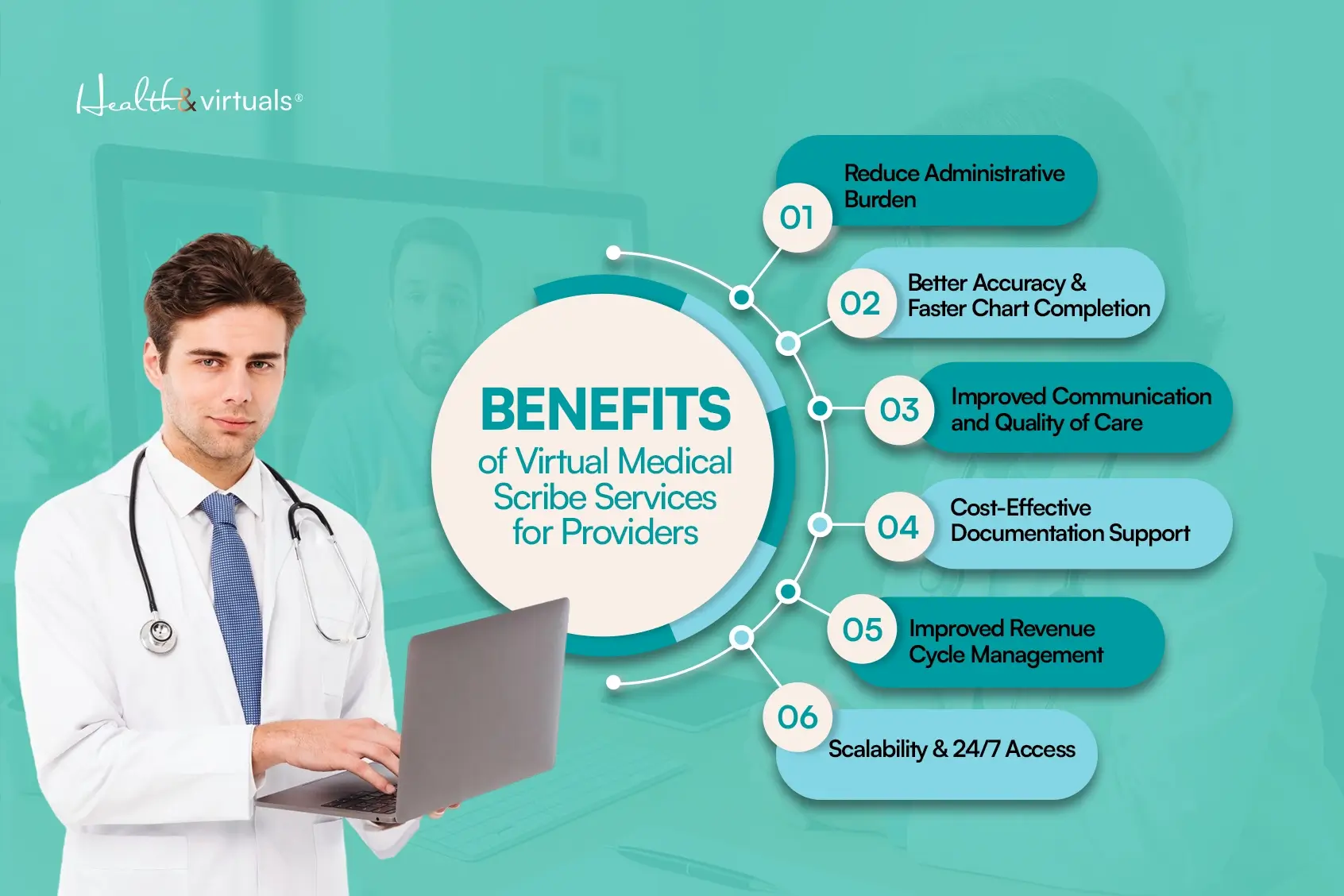
Accurate medical documentation is the backbone of efficient healthcare delivery…
Why?
Because it supports clinical decision-making. Proper documentation also ensures regulatory compliance and protects patient data. It directly impacts provider productivity and patient outcomes.
As healthcare systems increasingly rely on digital records and virtual care models, documentation responsibilities have expanded… often placing a heavy administrative burden on physicians and clinical staff.
To address this challenge, many practices turn to specialized documentation professionals. The most common ones are medical scribes and medical transcriptionists.
A virtual medical scribe is a documentation professional who helps a healthcare provider by completing records for patient interactions as soon as they happen. Scribes usually assist during patient interactions. Either face-to-face or virtually. They enter data into the electronic health records (EHRs) systems.

Scribes usually document patient medical records, complaints, history, and results of the examination, as well as the provider’s clinical impressions and plans for management. This helps physicians prioritize patient care over documentation.
As telehealth has become more common, virtual scribe services have been provided for telehealth consultations as well, and these virtual medical scribes perform the same duties remotely.
While a medical transcriptionist converts VoC (voice of customer) recordings made by medical professionals into text documents. Examples of such recordings include operative notes, discharge summaries, consultation reports, and progress notes.
Transcriptionists, unlike scribes, usually work after the patient encounter. Because of this, the job has a high demand for listening, medical terminology, and attention to detail. They have to review audio files, transcribe them, and edit them to comply with clinical standards before the documents can be submitted to the medical record.
Both roles aim to maintain clear, complete, and compliant medical records. Although they differ significantly in how, when, and where documentation is created.
If your healthcare practice is looking to optimize workflows, reduce burnout, and choose the most effective documentation support model, you should understand the clear medical scribe vs transcriptionist.
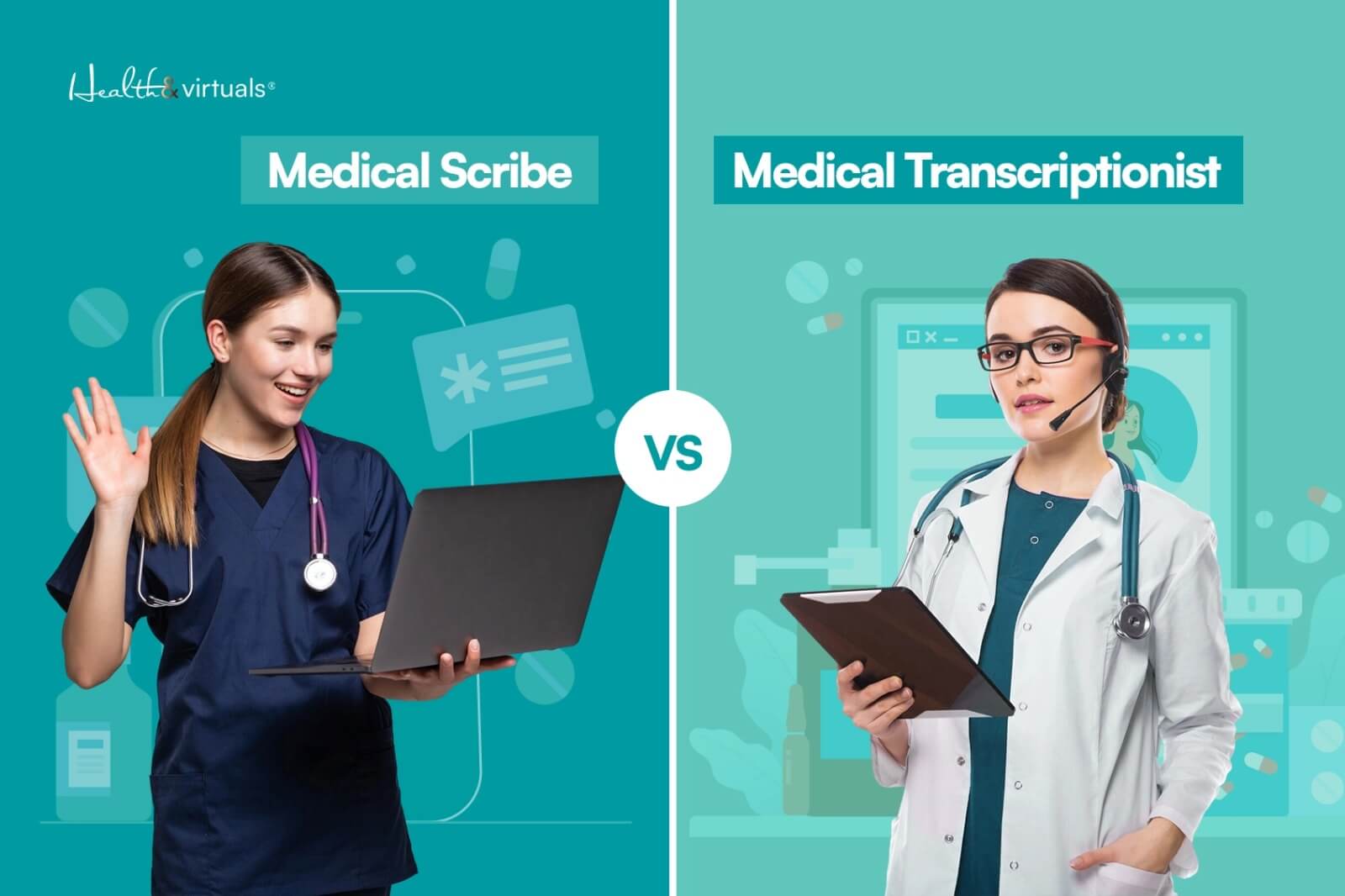
Medical Scribe vs Medical Transcriptionist: Quick Comparison
| Aspect | Medical Scribe | Medical Transcriptionist |
| Timing | Real-time documentation | Post-visit documentation |
| Interaction | Direct interaction with providers | No direct patient interaction |
| Work Style | Live or virtual presence | Audio-based transcription |
| Primary Focus | Supporting clinical workflow | Converting dictation into text |
Key Differences Between Medical Scribe and Medical Transcriptionist
→ Primary Role
Medical Scribe: Documents patient encounters in real time during visits.
Medical Transcriptionist: Converts recorded physician dictations into written medical reports.
→ Work Setting
Medical Scribe: Works on-site or virtually alongside providers during patient care.
Medical Transcriptionist: Typically works remotely, after patient encounters.
→ Timing of Documentation
Medical Scribe: Real-time, during the patient visit.
Medical Transcriptionist: Post-visit, based on audio recordings.
→ Interaction Level
Medical Scribe: Direct exposure to clinical workflows and patient interactions.
Medical Transcriptionist: No direct patient or provider interaction during care.
→ Skill Focus
Medical Scribe: EHR navigation, clinical terminology, multitasking.
Medical Transcriptionist: Listening accuracy, grammar, formatting, medical terminology.
→ Impact on Providers
Medical Scribe: Reduces physician burnout by handling live documentation.
Medical Transcriptionist: Ensures accurate, finalized medical records.
→ The main difference is when and how each professional does healthcare documentation. Medical scribes document encounters in real-time and have immediate records available. Medical transcriptionists work at different times and turn voice memos into structured documents.
→ Another difference is how they interact with the providers. Scribes interact with the physicians directly during clinic hours, whereas transcriptionists do not. Scribes are embedded into the daily routine, while transcriptionists usually work in the background.
Work Environment And Interaction Of Medical Scribe And Transcriptionist

Medical Scribe Work Environment
Medical scribes can work in a variety of settings, like hospitals, clinics, and outpatient centers. A virtual medical scribe can work remotely in a remote capacity, reducing your in-house staffing costs…
Remote medical scribes connect securely to your practice’s EHR platforms and communication systems. It allows them to document your patient encounters in real time from off-site locations.
Because scribes consistently work with the same providers, they adapt to individual documentation styles and clinical workflows.
Medical Transcriptionist Work Environment
Medical transcriptionists work from home or a remote office. They listen to recordings and documents. This job is more isolated because there is more communication with the recorded dictations and less with actual people. Their role centers on reviewing audio recordings and producing accurate, finalized reports.
The interaction of a transcriptionist is limited to recorded dictation and quality checks. It makes this position less collaborative but highly detail-oriented…
Which Should You Choose for Your Practice? A Medical Scribe or A Transcriptionist?
 Different practices will have different needs when it comes to documenting workflows. Practices looking for supp312ort in real-time while reducing burnout for physicians and improving patient engagement may find value in medical scribing.
Practices looking for accurate documentation production based on recorded dictation may find value in transcription services.
Practices almost always prefer medical remote scribing services due to being able to integrate into the workflows of practice seamlessly without the need for someone to be on-site.
Future of Medical Documentation!
With the rapid advancement of technology, telemedicine, and automation, documentation in the healthcare industry is improving. The importance of real-time documentation support is increasing alongside the relevance of transcription services.
Virtual medical scribing is a flexible and scalable answer to the needs of today’s healthcare environment.
Health & Virtuals provides fully HIPAA-compliant, trained professionals to serve your practice’s needs. Our remote medical scribing is designed to fit the needs of various healthcare practices. No matter whether you need full-time, part-time, or project-based support, our flexible model is for you to serve you without any hassle.
With different documentation support models to choose from, your practice can optimize its workflow without compromising its clinical workflow.
Improve Your Practice Documentation with Health & Virtuals!
 Take the burden of clinical documentation off your providers and restore focus to patient care. Health & Virtuals’ HIPAA-compliant remote medical scribes integrate seamlessly into your workflow, delivering accurate, real-time documentation without the cost or complexity of on-site staffing.
Whether you need full-time, part-time, or flexible support, our remote scribing solutions are designed to improve efficiency, reduce burnout, and maintain the highest documentation standards.
Get started today!
Schedule a consultation with Health & virtuals and discover how remote medical scribing can transform your practice!
FAQs
What is the difference between a medical scribe and a medical transcriptionist?
A medical scribe, unlike a medical transcriptionist, converts the patient encounter into documentation in real time, while a medical transcriptionist does it after the encounter and converts anecdotal dictation into written reports.
Which is more beneficial for healthcare practices?
The two serve entirely different purposes. Real-time documentation is an immediate concern for the practice when it is in progress, and as a result, medical scribes are preferred. For documentation that is needed after the encounter, transcriptionists are more beneficial.
Which option is more cost-effective?
It all depends on the workflow requirements. Remote medical scribes have the potential to reduce the administrative burden on staff and increase the productivity of the medical provider, which may sufficiently compensate for the expense.
Can virtual medical scribes work as effectively as in-person scribes?
Yes, virtual medical scribes complete the same level of documentation using various secure digital and real-time communication tools.
Do medical scribes and transcriptionists work under HIPAA?
Yes. Both roles adhere to HIPAA regulations when properly trained and when the organizations they work for are HIPAA compliant.
Which practices benefit more from medical scribes?
Real-time scribe support is beneficial for telehealth practices, high-volume clinics, and specific medical specialties.
How do I determine the best documentation solution for my practice?
Consider the aspects of your workflow, the time required to create documentation, the burden on the provider, and your tech infrastructure.
How can Health & virtuals help with medical scribes?
Health&virtualss offers HIPAA-compliant remote medical scribes who can work full-time, remotely, or on a project basis, with different engagement options.