
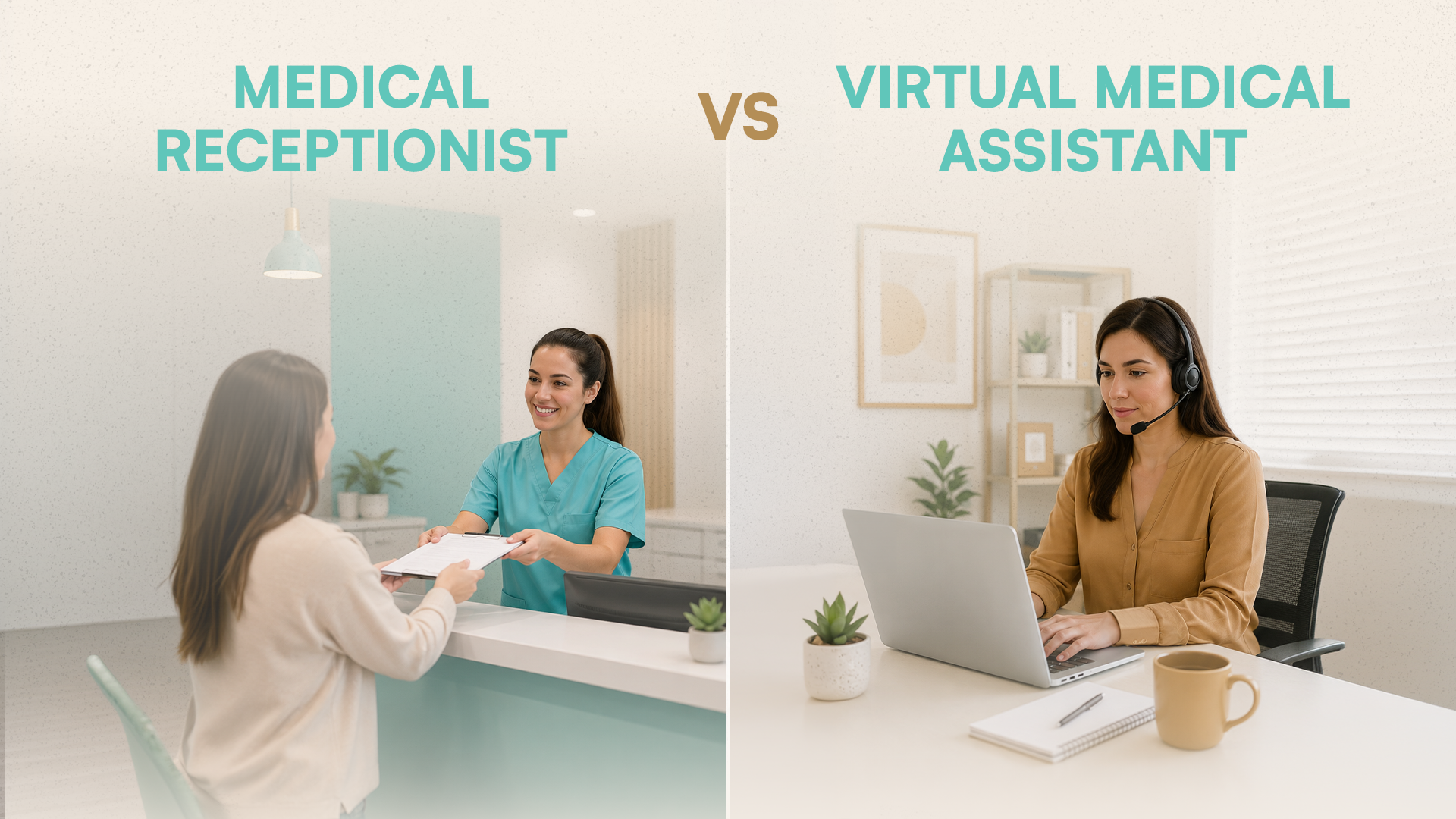
Running a medical practice requires more than delivering excellent patient care. Physicians, practice managers, and clinic owners must also manage scheduling, patient communication, insurance verification, billing coordination, documentation support, and countless administrative responsibilities.
As labor costs rise and staffing shortages continue across the United States, many healthcare organizations are evaluating the medical receptionist vs virtual medical assistant debate. Understanding the differences between these roles can help clinics make informed staffing decisions, improve patient experiences, and reduce operational strain.
From my experience working with healthcare practices, the right support model often determines whether providers spend their day caring for patients or catching up on administrative tasks after hours.
Quick Summary / Key Takeaways
- A medical receptionist works on-site and primarily handles front-desk responsibilities.
- A virtual medical assistant supports administrative, scheduling, billing, and patient communication tasks remotely.
- Virtual medical assistants often provide broader support at a lower operating cost.
- Clinics can improve efficiency, reduce staff burnout, and extend coverage with trained healthcare virtual assistants.
- HIPAA-compliant virtual assistants can integrate into existing healthcare workflows without disrupting patient care.
What Is a Medical Receptionist?
A medical receptionist is an on-site employee responsible for managing front-desk operations within a healthcare facility.
Their primary responsibilities typically include:
- Greeting patients upon arrival
- Answering incoming phone calls
- Scheduling appointments
- Checking patients in and out
- Collecting copayments
- Updating patient records
- Managing basic front-office communication
Medical receptionists serve as the first point of contact for patients visiting a clinic. Their physical presence is valuable when practices require in-person assistance, patient check-in management, and front-desk coordination.
However, their work is generally limited to office hours and tasks that occur within the facility.
What Is a Virtual Medical Assistant?
A virtual medical assistant is a remote healthcare support professional trained to assist medical practices with administrative, operational, and revenue-cycle responsibilities.
Depending on clinic needs, virtual medical assistants may handle:
- Appointment scheduling
- Insurance verification
- Prior authorization support
- Medical billing assistance
- Patient follow-up calls
- Referral coordination
- Electronic health record updates
- Inbox management
- Telehealth support
- Patient reminders
Unlike traditional front-desk staff, virtual medical assistants can often support multiple workflows across the practice rather than focusing solely on reception duties.
This flexibility makes them increasingly attractive to healthcare organizations looking to scale operations efficiently.
Medical Receptionist vs Virtual Medical Assistant: Core Differences
When comparing medical receptionist vs virtual medical assistant roles, the distinction extends far beyond physical location.
Work Environment
Medical receptionists work inside the clinic and interact with patients face-to-face.
Virtual medical assistants work remotely using secure systems, practice management software, and HIPAA-compliant communication tools.
Scope of Responsibilities
Medical receptionists primarily focus on front-desk tasks.
Virtual medical assistants often support:
- Administrative operations
- Revenue-cycle processes
- Patient engagement
- Documentation workflows
- Scheduling optimization
As a result, clinics typically gain broader operational support from a virtual assistant.
Coverage and Availability
An in-house receptionist generally works standard business hours.
Virtual medical assistants can often provide:
- Extended scheduling coverage
- Early morning support
- Evening administrative assistance
- Overflow call management
This additional coverage helps practices reduce missed opportunities and improve patient responsiveness.
Cost Structure
One of the most important factors in the medical receptionist vs virtual medical assistant comparison is cost.
Hiring an on-site receptionist usually involves:
- Salary or hourly wages
- Payroll taxes
- Benefits
- Paid time off
- Training expenses
- Equipment and workspace costs
Virtual medical assistants often eliminate many of these overhead expenses while delivering specialized healthcare support.
Scalability
Adding additional reception staff requires more office space, equipment, and onboarding.
Virtual medical assistants can typically be scaled more quickly as patient volume grows, making them an attractive solution for expanding practices.
Which Role Better Supports Modern Healthcare Practices?
Healthcare operations have changed dramatically over the last decade.
Patients expect faster responses, online scheduling, telehealth access, and proactive communication. At the same time, providers face increasing documentation requirements, reimbursement challenges, and staffing shortages.
In many situations, a virtual medical assistant can support a broader range of operational needs than a traditional receptionist.
For example, a medical receptionist may answer a scheduling call.
A virtual medical assistant may:
- Schedule the appointment
- Verify insurance eligibility
- Send reminders
- Coordinate referrals
- Document updates in the EHR
- Follow up after the visit
This expanded support helps reduce administrative bottlenecks across the patient journey.
How Virtual Medical Assistants Help Reduce Physician Burnout
Administrative overload remains one of the leading contributors to physician burnout in the United States.
Many providers spend hours completing tasks that do not directly involve patient care.
Virtual medical assistants can help relieve this burden by managing repetitive operational responsibilities, including:
- Appointment management
- Patient communication
- Insurance-related tasks
- Billing support
- Documentation assistance
When providers spend less time on administrative work, they can focus more attention on clinical outcomes and patient relationships.
For many practices, this improvement alone creates a measurable return on investment.
When a Medical Receptionist Still Makes Sense
The medical receptionist vs virtual medical assistant discussion is not always an either-or decision.
Medical receptionists remain valuable when practices require:
- In-person patient check-in
- Front-desk visitor management
- Physical paperwork handling
- On-site coordination between departments
Large clinics and multispecialty organizations often benefit from maintaining front-desk staff while supplementing operations with virtual medical assistants.
This hybrid model provides both physical patient support and scalable administrative assistance.
Why More Clinics Are Choosing Healthcare Virtual Assistants
Healthcare leaders are increasingly turning to virtual staffing because it addresses several persistent operational challenges.
Key advantages include:
- Lower staffing costs
- Reduced administrative burden
- Improved scheduling efficiency
- Better patient communication
- Increased workflow flexibility
- Faster scalability
Most importantly, healthcare virtual assistants allow providers to focus on patient care rather than administrative backlogs.
Choosing the Right Solution for Your Practice
Selecting between a receptionist and a virtual assistant depends on your operational goals.
Consider a medical receptionist if your primary need involves face-to-face patient interaction.
Consider a virtual medical assistant if you need support with:
- Scheduling
- Insurance verification
- Billing workflows
- Referral management
- Patient outreach
- Administrative efficiency
Many growing practices find that virtual medical assistants provide greater value because they address multiple operational challenges simultaneously.
Real-World Impact on Clinic Performance
Practices that implement trained healthcare virtual assistants frequently report measurable improvements across key performance indicators. Missed calls decrease, appointment scheduling becomes more consistent, and staff members spend less time switching between administrative tasks.
Revenue-cycle processes often move faster because insurance verification and follow-up activities receive dedicated attention. Patients also benefit from quicker responses and clearer communication.
Over time, these operational gains can strengthen retention, improve patient satisfaction scores, and create a more sustainable work environment for providers and support teams each day consistently.
Conclusion
The medical receptionist vs virtual medical assistant comparison ultimately comes down to functionality, scalability, and efficiency.
Medical receptionists remain essential for in-person patient interactions, but virtual medical assistants offer broader operational support that aligns with the realities of modern healthcare delivery.
For clinics seeking to reduce administrative workload, improve patient communication, lower staffing costs, and combat provider burnout, virtual medical assistants often deliver the strongest long-term value.
Frequently Asked Questions
- Are virtual medical assistants HIPAA compliant?
Yes. Reputable healthcare virtual assistant providers train staff on HIPAA requirements, secure communication practices, patient privacy standards, and healthcare workflow compliance.
- How quickly can a virtual medical assistant be onboarded?
Most virtual medical assistants can be onboarded within days or weeks, depending on workflow complexity, software access requirements, and training needs.
- Can a virtual medical assistant help with medical billing?
Yes. Many healthcare virtual assistants support billing-related tasks, insurance verification, claims follow-up, payment posting, and revenue-cycle workflows.
- How much does a virtual medical assistant cost compared to a receptionist?
Costs vary by provider and responsibilities, but virtual medical assistants typically reduce overhead expenses associated with salaries, benefits, office space, and equipment.
- Can clinics use both a receptionist and a virtual medical assistant?
Absolutely. Many successful healthcare organizations use a hybrid staffing model that combines in-person reception services with remote administrative and operational support.