
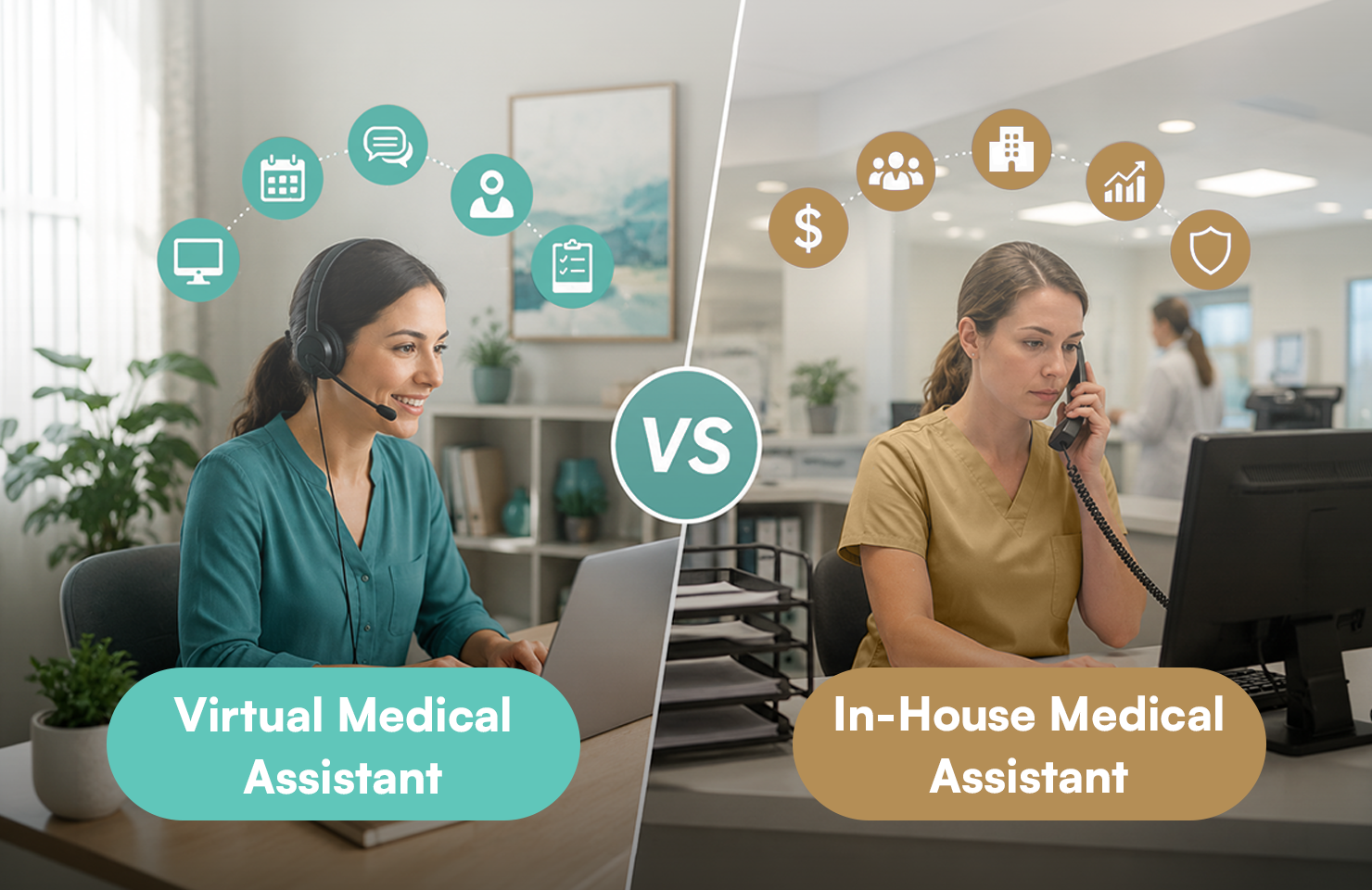
Quick Summary / Key Takeaways
- A virtual medical assistant can handle scheduling, patient communication, insurance verification, billing support, and administrative workflows remotely.
- An in-house medical assistant provides on-site clinical and administrative support but comes with higher employment and overhead costs.
- When comparing virtual medical assistant vs medical assistant models, clinics often choose virtual support for scalability, flexibility, and cost savings.
- Virtual assistants help reduce physician burnout by removing repetitive administrative work.
- The best choice depends on patient volume, operational needs, budget, and growth goals.
Healthcare practices across the United States are under pressure to do more with fewer resources. Rising labor costs, staffing shortages, increasing patient expectations, and administrative complexity are forcing clinic owners and practice managers to rethink how work gets done.
One of the most common questions we hear from medical groups is whether they should hire a virtual medical assistant or continue relying on traditional in-house support. Understanding the differences can help practices improve efficiency, reduce overhead, and create a better experience for both staff and patients.
This guide provides a practical comparison of virtual medical assistant vs medical assistant models and explains which option delivers the greatest value for modern healthcare organizations.
What Is a Virtual Medical Assistant?
A virtual medical assistant is a trained healthcare support professional who works remotely and assists medical practices with administrative and operational tasks.
Depending on the clinic’s needs, a virtual medical assistant may handle:
- Appointment scheduling
- Patient intake coordination
- Insurance verification
- Referral management
- Medical billing support
- Prior authorization follow-ups
- Electronic health record updates
- Patient reminders and recalls
- Customer service and call handling
Many virtual assistants work exclusively with healthcare organizations and are trained on HIPAA requirements, medical terminology, and healthcare workflows.
What Is an In-House Medical Assistant?
An in-house medical assistant is a staff member physically present in the clinic. Their responsibilities often include both administrative and clinical duties.
Typical responsibilities include:
- Rooming patients
- Taking vital signs
- Preparing examination rooms
- Assisting physicians during visits
- Collecting patient information
- Scheduling appointments
- Managing front-desk tasks
Because they work on-site, in-house medical assistants are essential for direct patient interaction and clinical support functions that cannot be performed remotely.
Virtual Medical Assistant vs Medical Assistant: Core Differences
When evaluating virtual medical assistant vs medical assistant options, practice leaders should focus on five critical areas.
1. Cost of Employment
Cost is often the biggest deciding factor.
Hiring an in-house medical assistant involves expenses beyond salary, including:
- Payroll taxes
- Benefits
- Paid time off
- Recruiting costs
- Training expenses
- Office space
- Equipment and workstation expenses
A virtual medical assistant typically works through an outsourcing model, allowing clinics to avoid many of these overhead costs.
For growing practices, this difference can translate into significant annual savings while maintaining operational support.
2. Scalability
Healthcare demand rarely stays consistent throughout the year.
An in-house employee provides fixed capacity. If patient volume rises unexpectedly, clinics may need to hire additional staff, which can take weeks or months.
Virtual staffing offers greater flexibility. Practices can often increase support hours, add specialized resources, or expand coverage without lengthy hiring cycles.
This scalability is one reason many organizations prefer the virtual medical assistant vs medical assistant approach when planning growth.
3. Clinical Support Capabilities
This category clearly favors in-house staff.
Virtual assistants cannot:
- Take vital signs
- Prepare patients for examinations
- Assist with procedures
- Perform hands-on clinical tasks
If your practice requires extensive clinical support, an in-house medical assistant remains necessary.
However, many administrative responsibilities can be delegated to remote team members, allowing on-site staff to focus on patient care.
4. Productivity and Workflow Efficiency
Administrative work consumes a significant portion of a healthcare team’s day.
Common time-consuming tasks include:
- Insurance verification
- Appointment reminders
- Data entry
- Referral coordination
- Billing follow-up
- Call management
A virtual medical assistant can manage these activities throughout the day, reducing interruptions for physicians and front-office teams.
Many practices discover that moving administrative responsibilities to remote support creates faster workflows and better staff utilization.
5. Coverage and Availability
Traditional employees generally work fixed schedules.
Virtual staffing models can provide extended coverage options, including:
- Early morning support
- Evening coverage
- Weekend assistance
- Overflow call handling
For clinics receiving high call volumes, additional coverage can improve responsiveness and reduce missed opportunities.
Why More Clinics Are Choosing Virtual Medical Assistants
The healthcare workforce continues to face staffing challenges across the United States.
Practice owners increasingly choose virtual support because it helps address several operational problems simultaneously.
Key advantages include:
- Lower operating costs
- Reduced hiring challenges
- Faster onboarding
- Improved scheduling efficiency
- Better patient communication
- Increased staff productivity
- Reduced physician burnout
When evaluating virtual medical assistant vs medical assistant solutions, many organizations find that remote support delivers stronger administrative performance at a lower cost.
Impact on Physician Burnout
Administrative overload remains one of the leading causes of physician burnout.
Doctors often spend hours each week handling documentation, reviewing messages, coordinating referrals, and managing operational issues.
Delegating these responsibilities to a virtual medical assistant allows providers to spend more time on patient care and less time on repetitive administrative work.
The result is often:
- Improved provider satisfaction
- Better work-life balance
- Reduced stress
- More patient-facing time
- Stronger practice performance
For clinics struggling with burnout, staffing strategy can be just as important as technology investments.
Which Tasks Should Be Assigned to a Virtual Medical Assistant?
The most successful practices assign repeatable, process-driven work to remote team members.
Ideal tasks include:
- Appointment scheduling
- Insurance eligibility verification
- Prior authorization follow-up
- Referral processing
- Patient reminders
- Recall campaigns
- Revenue cycle support
- Data entry
- Inbox management
- Customer service
These responsibilities can usually be standardized, measured, and optimized without requiring physical presence inside the clinic.
When an In-House Medical Assistant Is the Better Choice
Although virtual support offers substantial benefits, in-house staffing still plays an important role.
An in-house medical assistant may be the better option when:
- Clinical assistance is required daily
- Patient volume requires constant room preparation
- Providers need hands-on support during procedures
- The practice depends heavily on face-to-face patient interaction
For many organizations, the answer is not choosing one model exclusively.
Instead, the strongest approach combines both.
The Hybrid Model: Best of Both Worlds
Many high-performing practices use a hybrid staffing structure.
Under this model:
- Virtual medical assistants handle administrative workflows.
- In-house medical assistants focus on clinical responsibilities.
- Physicians spend more time with patients.
- Front-desk teams experience fewer interruptions.
This approach maximizes efficiency while controlling labor costs.
When comparing virtual medical assistant vs medical assistant strategies, hybrid staffing often produces the best balance of cost, productivity, and patient experience.
How to Choose the Right Solution for Your Practice
Before making a staffing decision, evaluate:
- Current staffing gaps
- Administrative workload
- Monthly patient volume
- Growth objectives
- Budget constraints
- Physician burnout levels
- Revenue cycle challenges
Practices overwhelmed by administrative work often achieve the fastest return on investment through virtual support.
If your team spends excessive time scheduling appointments, verifying insurance, processing referrals, or managing billing tasks, a virtual medical assistant can deliver immediate operational relief.
Clinics that adopt structured virtual support frequently report stronger patient retention, fewer scheduling bottlenecks, improved responsiveness, and more predictable growth over time overall.
Ready to reduce administrative burdens and improve practice efficiency? Partner with our healthcare virtual assistant team to streamline workflows, support your staff, and create a better patient experience.
Schedule a consultation today to discover how dedicated healthcare virtual assistants can help your clinic save time, lower costs, and scale with confidence.
Frequently Asked Questions
Is a virtual medical assistant HIPAA compliant?
Yes. Reputable healthcare virtual assistant providers train team members on HIPAA requirements, secure communication protocols, and patient data protection procedures.
How much does a virtual medical assistant cost?
Pricing varies based on experience, hours, and responsibilities. However, virtual support is typically more cost-effective than hiring a full-time in-house employee.
How long does onboarding take?
Most healthcare virtual assistants can be onboarded significantly faster than traditional employees, especially when standardized workflows and documentation are already in place.
Can a virtual medical assistant help with medical billing?
Yes. Many virtual assistants support billing workflows, insurance verification, claim follow-ups, payment posting assistance, and revenue cycle administrative tasks.
Should clinics replace all in-house medical assistants with virtual assistants?
Not usually. The most effective model often combines remote administrative support with on-site clinical staff to maximize efficiency and maintain excellent patient care.