
14Jul

Healthcare Staffing Shortage 2026: Why Practices Are Turning to Virtual Support

Healthcare Staffing Shortage 2026: Why Practices Are Turning to Virtual Support

The healthcare staffing shortage is no longer only a hospital recruitment problem. Across the United States, independent practices, behavioral health clinics, specialty offices, and primary care organizations are struggling to keep critical positions filled while patient demand continues to grow. 

The pressure affects more than clinical coverage. When a practice cannot hire enough schedulers, receptionists, billing support personnel, referral coordinators, or medical administrative staff, patients may experience unanswered calls, longer appointment delays, incomplete intake forms, and slower follow-up. 

Healthcare employment demand is also expected to remain strong. The US Bureau of Labor Statistics projects healthcare and social assistance to be the fastest-growing major employment sector between 2024 and 2034, largely because of an aging population and increasing demand for healthcare services. 

As a result, many practices are exploring virtual support—not as a replacement for clinicians, but as a way to protect their clinical teams from unnecessary administrative overload. 

Key Takeaways 

✅ The US healthcare staffing shortage affects clinical and administrative roles. 

✅ Hiring delays can reduce patient access and increase staff workload. 

✅ Virtual support can handle approved nonclinical and administrative tasks. 

✅ Practices should protect HIPAA-regulated information when using remote teams. 

✅ Virtual staff should supplement—not replace—licensed healthcare professionals. 

✅ A structured implementation plan helps practices maintain quality and accountability. 

What Is Causing the Healthcare Staffing Shortage in 2026?

The current shortage does not have one simple cause. It reflects several long-term workforce and operational pressures happening at the same time. 

Growing demand for healthcare services 

America’s population is aging, which increases the need for primary care, chronic-condition management, behavioral healthcare, home-based services, and specialty treatment. 

This demand is developing faster than many organizations can recruit and retain qualified workers. Recent reporting has highlighted hundreds of thousands of healthcare vacancies each month and particularly difficult recruitment conditions in rural communities. 

A limited supply of qualified professionals

Clinical professionals require extensive education, supervised training, licensing, and credentialing. Practices cannot rapidly create a larger supply of physicians, nurses, therapists, or advanced practice providers when vacancies appear. 

The Association of American Medical Colleges has projected that the United States could face a physician shortage ranging from 13,500 to 86,000 physicians by 2036. The size of the eventual gap will depend on population needs, retirement patterns, care-delivery models, and workforce policy. 

Burnout and administrative overload

Healthcare workers do not leave solely because of clinical responsibilities. Documentation requirements, inbox management, insurance communication, scheduling problems, and repetitive data entry can also create significant stress. 

AMA survey findings reported that approximately 48% of physicians experienced at least one symptom of burnout in 2023. Although this represented an improvement from pandemic-era levels, it still demonstrated how common workforce strain remained. 

Geographic recruitment gaps

Healthcare professionals are not distributed evenly across the country. Rural and underserved communities often have fewer available candidates, smaller recruitment pipelines, and greater difficulty retaining specialists. 

Practices in these areas may spend months trying to fill an in-office position. Meanwhile, existing employees absorb the unfinished work. 

How the Healthcare Staffing Shortage Affects Medical Practices

Understaffing creates a chain reaction. A missing employee may initially appear to be an isolated human resources problem, but the effects can spread throughout the practice. 

Staffing problem  Operational effect  Possible patient impact 
Insufficient front-desk coverage  More unanswered calls  Delayed appointments 
Scheduling backlog  Unfilled or duplicated slots  Longer wait times 
Incomplete intake processing  Missing patient information  Slower check-in 
Limited referral coordination  Untracked referrals  Delayed specialty care 
Excessive clinician documentation  Less available clinical time  Shorter or delayed visits 
Weak follow-up processes  Missed reminders and outreach  Lower continuity of care 

These problems can also affect revenue. Missed calls may become missed appointments. Incomplete insurance information can delay claims. Poor scheduling can leave valuable appointment times unused. 

Most importantly, clinicians may spend more time fixing administrative problems and less time performing work that requires clinical judgment. 

Why Practices Are Turning to Virtual Healthcare Support 

Virtual support allows a qualified remote professional to perform defined tasks through secure digital systems. Depending on the practice, this professional may work as a virtual receptionist, scheduler, administrative assistant, referral coordinator, scribe, or patient-support representative. 

The model is attractive because it expands the hiring pool beyond the practice’s immediate location. 

Access to a broader talent pool

An office-based hiring strategy limits recruitment to candidates who live within commuting distance. Virtual staffing allows practices to consider qualified professionals from other regions. 

This can be particularly useful for organizations in rural locations, competitive metropolitan markets, or areas with high employee turnover. 

More flexibility during changing workloads

Patient volume does not always remain consistent. A growing practice may need support before it is ready to add several permanent in-office positions. 

Virtual personnel may help practices increase administrative capacity gradually, extend telephone coverage, or support specific workflows without immediately expanding physical office space. 

Better use of clinicians’ time 

A psychiatrist, physician, nurse practitioner, or therapist should not routinely spend clinical hours resolving preventable scheduling issues or sending basic appointment reminders. 

Moving suitable nonclinical tasks to trained support personnel can help licensed professionals focus on evaluation, treatment planning, medication management, and direct patient care. 

Virtual support does not solve the national clinician shortage. However, it may reduce the amount of clinical capacity lost to administrative work. 

What Tasks Can Virtual Support Handle?

The appropriate responsibilities depend on the worker’s qualifications, the practice’s policies, applicable laws, payer requirements, and the technology being used. 

Common nonclinical functions may include: 

  • Answering and routing incoming calls 
  • Scheduling, confirming, and rescheduling appointments 
  • Sending approved appointment reminders 
  • Collecting completed intake documents 
  • Updating demographic information 
  • Organizing referral documentation 
  • Following up on approved administrative requests 
  • Supporting records-management workflows 
  • Conducting basic insurance eligibility checks 
  • Managing approved email and portal messages 
  • Preparing standardized administrative reports 
  • Coordinating telehealth appointment instructions 

Some virtual professionals may also support clinical documentation. However, clinicians must review documentation for accuracy, completeness, and compliance before relying on it as part of the patient record. 

Virtual workers should not diagnose conditions, independently provide medical advice, prescribe treatment, or perform tasks that require a professional license unless they are appropriately licensed and legally authorized to do so. 

Virtual Support vs. Traditional In-Office Hiring

Virtual support is not automatically the right solution for every vacancy. Practice leaders should match the staffing model to the actual work. 

Factor  Virtual support  In-office employee 
Geographic hiring pool  Broad  Local 
Physical patient assistance  Limited  Available 
Administrative workflows  Strong fit  Strong fit 
Facility management  Limited  Strong fit 
Equipment and office space  Often lower need  Usually required 
Direct supervision  Digital and structured  Face-to-face 
Clinical procedures  Generally unsuitable  Possible when qualified 
Schedule flexibility  Often adaptable  Depends on employment arrangement 

Practices may benefit most from a hybrid model. On-site employees can manage physical operations and face-to-face patient needs, while remote personnel support calls, scheduling, documentation, referrals, and digital communication. 

How Virtual Support Can Improve Patient Access Across the USA

The healthcare staffing shortage becomes a patient-access problem when people cannot reach a practice or obtain a timely appointment. 

A patient may call during work hours, receive no answer, and never call again. Another may miss an appointment because a reminder was not sent. A referral may remain incomplete because no one had time to request a missing record. 

Virtual administrative support can strengthen the systems surrounding care by helping practices: 

  1. Respond to inquiries more consistently. 
  2. Keep appointment calendars updated. 
  3. Identify cancellations and open time slots. 
  4. Send standardized reminders. 
  5. Organize intake information before visits. 
  6. Route patient messages to the appropriate team member. 
  7. Support telehealth access and instructions. 

These improvements do not guarantee better clinical outcomes. However, they can reduce avoidable friction between a patient seeking care and the clinician prepared to provide it. 

Compliance and Security Questions Practices Must Ask

Healthcare organizations should not select virtual support solely because it is convenient or inexpensive. Remote access to patient information introduces serious privacy, security, and compliance responsibilities. 

Before onboarding a virtual worker or staffing partner, ask: 

  • Will the worker access protected health information? 
  • Is a business associate agreement required? 
  • Which systems and records will the worker be able to access? 
  • Does the worker receive HIPAA privacy and security training? 
  • Are login credentials assigned individually? 
  • Is multifactor authentication enabled? 
  • Can access be restricted according to job duties? 
  • Are devices, internet connections, and workspaces secure? 
  • How are incidents documented and reported? 
  • What happens to system access when the engagement ends? 

Practices should involve qualified compliance, cybersecurity, legal, and human resources professionals when designing remote-work policies. HIPAA compliance depends on the complete operational environment—not simply a vendor’s marketing claim. 

How to Introduce Virtual Support Without Disrupting Your Practice

A rushed implementation can create more work instead of less. Use a controlled process. 

1. Identify the actual bottleneck

Review call abandonment, appointment delays, documentation time, referral backlogs, no-show rates, and unfinished tasks. 

Do not hire a general assistant when the real problem requires a specialized scheduler, biller, scribe, or referral coordinator. 

2. Define the role in writing

Document the worker’s responsibilities, working hours, performance expectations, escalation process, and prohibited activities. 

Clear boundaries protect patients and prevent remote workers from making decisions outside their authority. 

3. Standardize the workflow

Create written procedures for recurring tasks. Include scripts, decision trees, templates, and examples of when the worker must contact an on-site supervisor. 

4. Limit access appropriately

Provide access only to the information and tools required for the assigned role. Review permissions regularly and remove unused access promptly. 

5. Start with a focused pilot

Begin with one measurable workflow, such as appointment confirmation or incoming-call support. 

Track results before adding more responsibilities. 

6. Monitor quality

Evaluate accuracy, responsiveness, patient feedback, scheduling performance, unresolved tasks, and compliance incidents. 

The goal should be reliable support—not simply a higher volume of completed tasks. 

Is Virtual Support the Answer to the Healthcare Staffing Shortage?

Virtual support is one part of the solution, not a complete answer. 

The United States still needs more licensed clinicians, stronger retention programs, expanded training capacity, better workforce distribution, manageable workloads, and policies that support sustainable healthcare careers. 

However, practices do not need to wait for the national workforce pipeline to improve before addressing administrative inefficiency. 

A thoughtful virtual staffing strategy can help an organization: 

  • Protect clinical time 
  • Improve communication 
  • Increase administrative capacity 
  • Reduce workflow bottlenecks 
  • Support telehealth operations 
  • Create more consistent patient experiences 

The strongest strategy combines technology, trained personnel, documented processes, appropriate supervision, and realistic expectations. 

Questions to Ask a Virtual Support Provider

Before selecting a staffing partner or independent virtual professional, ask: 

  1. What healthcare experience does the candidate have? 
  2. Which tasks can the candidate perform competently? 
  3. How is HIPAA training documented? 
  4. What security standards are required? 
  5. How are performance and attendance monitored? 
  6. Who handles training and ongoing supervision? 
  7. How quickly can access be removed? 
  8. How are mistakes or privacy incidents escalated? 
  9. Can the service integrate with the practice’s current systems? 
  10. What happens when the assigned worker is unavailable? 

A responsible provider should give clear, specific answers. Be cautious when a company promises immediate results, perfect compliance, or clinical capabilities that exceed the worker’s qualifications. 

Conclusion: Building a More Resilient Healthcare Practice 

The healthcare staffing shortage will continue to challenge practices throughout the USA, but understaffing should not force clinicians to carry every administrative responsibility. 

Virtual support can give practices access to a wider talent pool and strengthen scheduling, intake, communication, referral, and documentation workflows. Its value depends on proper role design, secure technology, careful supervision, and clear limits. 

For Health & Psychiatry, accessible systems and well-supported care teams help patients connect with appropriate mental health services. You do not have to navigate concerns about your mental health alone.


Frequently Asked Questions

What is the healthcare staffing shortage?

The healthcare staffing shortage is the gap between the number of healthcare workers organizations need and the number of qualified professionals available and willing to fill those roles. It can affect physicians, nurses, behavioral health professionals, medical assistants, schedulers, billing personnel, and administrative teams. 

Will the healthcare staffing shortage continue after 2026?

Current workforce projections suggest that staffing pressure will continue beyond 2026. The severity will vary by occupation, specialty, location, retirement patterns, and changes in healthcare delivery. 

Can virtual assistants replace medical staff?

No. Virtual assistants should not replace licensed clinicians or employees needed for physical patient care. They can supplement a healthcare team by handling suitable administrative and communication tasks. 

Are virtual healthcare assistants HIPAA compliant?

A person or service is not automatically HIPAA compliant because it works in healthcare. Compliance depends on training, contracts, technology, access controls, security practices, supervision, and how protected health information is handled. 

What types of practices can use virtual support?

Primary care offices, behavioral health practices, dental offices, specialty clinics, telehealth organizations, therapy practices, and other outpatient providers may use virtual support when the role fits their workflows and compliance requirements. 

How can virtual support reduce clinician burnout?

Virtual personnel may reduce repetitive administrative work involving scheduling, reminders, records organization, and message routing. This can help clinicians reserve more of their time for direct patient care, although staffing support alone cannot eliminate burnout. 

Is virtual staffing less expensive than in-office hiring?

It may reduce certain costs, such as office space or local recruitment expenses. However, practices must also consider technology, security, training, management, vendor fees, classification rules, and quality control. The lowest-cost option is not always the safest or most effective. 

How quickly should a practice implement virtual support?

Implementation speed should depend on workflow complexity and data sensitivity. A small pilot with clearly defined responsibilities is generally safer than transferring several critical processes at once.

————————————————————————– 

Medical and Professional Disclaimer 

This article is provided for general educational and operational information. It does not constitute medical, legal, cybersecurity, human resources, employment, or regulatory advice. Healthcare practices should consult qualified professionals regarding staffing, worker classification, licensing, HIPAA compliance, contracts, and patient-care responsibilities. Individuals should consult a licensed healthcare professional for personal medical advice. If you or someone else is in immediate danger, call 911 or go to the nearest emergency department.

10Jul

Prior Authorization Workflow: How Virtual Medical Assistants Speed Up Insurance Approvals

Prior Authorization Workflow: How Virtual Medical Assistants Speed Up Insurance Approvals 

A prior authorization workflow is the step-by-step process a medical practice follows to confirm whether an insurance plan will approve a medication, test, procedure, referral, or treatment before it is provided. Virtual Medical Assistants can speed up approvals by collecting documents, checking payer rules, submitting requests, tracking status, following up, and reducing missing-information delays. 

Key Takeaways 

  • Prior authorization delays often happen because of missing documentation, payer-specific rules, or slow follow-up. 
  • A Virtual Medical Assistant can manage the administrative side of prior authorizations while clinical decisions stay with licensed providers. 
  • Strong workflows improve approval speed, reduce staff workload, and protect patient experience. 
  • EMR/EHR accuracy, payer portal tracking, and denial documentation are essential. 
  • Outsourcing prior authorization support can help busy U.S. practices scale without overloading in-house teams. 

What Is a Prior Authorization Workflow? 

A prior authorization workflow is the structured process used to request insurance approval before a patient receives certain services, medications, imaging, procedures, durable medical equipment, or specialty care. 

For many U.S. healthcare practices, prior authorization is one of the most time-consuming administrative tasks. It often requires insurance verification, payer rule review, clinical documentation, forms, portal submissions, phone calls, fax follow-ups, and appeal tracking. 

Health insurers have recently pledged to reduce some prior authorization friction, including more electronic submissions, fewer services requiring authorization, and faster real-time approvals by 2027. Still, practices need strong internal workflows today because payer requirements remain complex and can vary by plan.

That is where a trained Virtual Medical Assistant can make a measurable difference. 

Why Prior Authorization Delays Happen 

Prior authorization does not usually fail because a practice is careless. It often slows down because the process has too many moving parts. 

Common causes include: 

Delay Point What Usually Happens Impact on Practice
Missing clinical notes Payer requests additional records Approval timeline resets
Wrong payer form Staff submits an incomplete request Rework and resubmission
No status tracking Request remains pending Patient calls increase
Poor EMR documentation Medical necessity is unclear Higher risk of denial
Delayed appeal Denial is not handled promptly Treatment delays
Staff overload In-house team cannot follow up daily Revenue loss and reduced patient experience

According to reporting on AMA survey findings, many physicians say prior authorization delays access to care and can lead some patients to abandon treatment. For practice managers, this makes prior authorization both an operational problem and a patient-retention issue. 

Step-by-Step Prior Authorization Workflow

1. Identify Whether Authorization Is Required

The process starts when a provider orders a medication, procedure, imaging test, referral, or treatment that may require insurance approval. 

A Virtual Medical Assistant can help by: 

  • Reviewing payer rules 
  • Checking plan-specific requirements 
  • Confirming CPT, ICD-10, NPI, and patient insurance details 
  • Flagging cases that need provider input 

2. Collect Patient and Insurance Information

Accurate patient information is essential. One wrong member ID, date of birth, or plan name can delay the request. 

A VMA can verify: 

  • Insurance eligibility 
  • Plan type 
  • Subscriber details 
  • Referral requirements 
  • Deductible or coverage notes when available 
  • Payer portal access requirements 

3. Gather Medical Necessity Documentation

This is one of the most important steps. Payers usually need documentation showing why the requested service is medically necessary. 

Documents may include: 

  • Provider notes 
  • Diagnosis details 
  • Previous treatment history 
  • Failed conservative treatment records 
  • Lab results or imaging reports 
  • Medication history 
  • Referral notes 
  • Plan-specific medical necessity forms 

Recent research on AI-generated prior authorization letters found that even strong clinical content can fail if administrative details such as billing codes, authorization duration, or follow-up plans are missing. This supports the need for a precise administrative workflow. 

4. Submit the Prior Authorization Request

Once the documentation is ready, the request may be submitted through: 

  • Payer portal 
  • Electronic prior authorization platform 
  • Fax 
  • Phone 
  • Clearinghouse or EHR-integrated system 

A Virtual Medical Assistant can prepare and submit the administrative portion, while clinical content and final review remain under the appropriate provider or practice team. 

5. Track Status Daily

Submission is not the end of the workflow. Many delays happen because nobody checks the request until the patient calls. 

A VMA can track: 

  • Pending status 
  • Additional information requests 
  • Peer-to-peer review notices 
  • Approval numbers 
  • Expiration dates 
  • Denials 
  • Appeal deadlines 

6. Update the EMR/EHR

Once the payer responds, the authorization details should be documented properly. 

This may include: 

  • Authorization number 
  • Approved service 
  • Approved units or visits 
  • Valid date range 
  • Payer notes 
  • Denial reason 
  • Next action required 

Clean documentation helps providers, schedulers, billers, and patients stay aligned. 

7. Handle Denials and Appeals Support

Not every request is approved the first time. A VMA can help organize denial letters, identify missing documents, prepare appeal packets, and coordinate next steps with the provider. 

They should not make clinical decisions, but they can reduce administrative lag by making sure the right information is ready at the right time.

How Virtual Medical Assistants Speed Up Insurance Approvals 

A Virtual Medical Assistant improves the prior authorization workflow by creating consistency. 

VMA Task How It Speeds Up Approval
Insurance verification Prevents wrong-plan submissions
Payer checklist review Reduces missing documentation
EMR/EHR document gathering Helps submit complete requests
Portal submission Saves in-house staff time
Daily status checks Prevents requests from sitting idle
Patient communication support Reduces inbound call pressure
Denial packet preparation Helps practices respond faster
Authorization documentation Improves scheduling and billing handoff

For busy practices, this is not just about saving minutes. It helps protect provider time, patient satisfaction, and revenue flow. 

What Tasks Should Stay With Licensed Providers? 

A Virtual Medical Assistant can support the administrative workflow, but some responsibilities should remain with licensed clinicians or authorized practice staff. 

Task Best Owner
Clinical decision-making Provider
Diagnosis and treatment plan Provider
Medical necessity judgment Provider
Peer-to-peer clinical discussion Provider or licensed clinician
Document collection Virtual Medical Assistant
Payer portal tracking Virtual Medical Assistant
Status updates Virtual Medical Assistant
Appeal packet organization Virtual Medical Assistant + Provider review

This separation helps maintain compliance and protects care quality. 

Why Practices Outsource Prior Authorization Support 

Many clinics outsource prior authorization tasks because in-house teams are already managing phones, scheduling, patient intake, billing coordination, reminders, and front-desk demands. 

Outsourcing can help practices: 

  • Reduce staff burnout 
  • Improve turnaround time 
  • Lower administrative bottlenecks 
  • Keep providers focused on patient care 
  • Improve patient communication 
  • Create a repeatable approval workflow 
  • Scale support without hiring full-time onsite staff 

If your practice needs trained administrative support, Health & Virtuals provides healthcare-focused virtual support through its Virtual Medical Assistant services.

Best Practices for a Faster Prior Authorization Workflow 

Use a standard checklist for every request: 

  • Confirm insurance eligibility first 
  • Check payer-specific rules before submission 
  • Use correct CPT and ICD-10 codes 
  • Attach complete medical records 
  • Track every submission date 
  • Follow up before the deadline 
  • Document authorization numbers in the EMR 
  • Keep denial templates and appeal workflows ready 
  • Train staff on payer portal updates 
  • Review recurring denial reasons monthly 

A strong workflow does not guarantee every approval, but it reduces preventable delays. 

FAQ

What is a prior authorization workflow? 

A prior authorization workflow is the step-by-step process a practice follows to check requirements, collect documentation, submit requests, track status, and document payer decisions before care is delivered.

Can a Virtual Medical Assistant submit prior authorization requests?

Yes, a trained Virtual Medical Assistant can usually support administrative submission tasks, depending on the practice’s policies, payer rules, and compliance requirements.

Can a Virtual Medical Assistant make clinical decisions?

No. Clinical decisions, diagnosis, treatment planning, medical necessity decisions, and peer-to-peer clinical discussions should stay with licensed providers.

How does prior authorization affect patients?

Prior authorization can delay tests, medications, referrals, or procedures if documentation is incomplete or approval is slow.

What causes most prior authorization delays?

Common causes include missing records, incorrect forms, wrong insurance details, unclear medical necessity, slow follow-up, and payer portal issues.

How can practices reduce prior authorization denials?

Practices can reduce avoidable denials by submitting complete documentation, using payer-specific checklists, tracking deadlines, and reviewing denial patterns.

Is prior authorization the same as insurance verification?

No. Insurance verification confirms coverage and eligibility. Prior authorization asks the payer to approve a specific service before it is provided.

Why should practices outsource prior authorization support?

Outsourcing helps reduce staff workload, improve follow-up consistency, and keep administrative tasks moving without overwhelming in-house teams.

08Jul

Insurance Verification Explained: How Virtual Medical Assistants Prevent Claim Denials

Insurance Verification Process Explained: How Virtual Medical Assistants Prevent Claim Denials 

Introduction 

The insurance verification process is one of the most important steps in healthcare administration. Before a patient receives care, medical practices must confirm active coverage, benefits, eligibility, deductibles, copays, prior authorization requirements, and payer rules. When this step is rushed or incomplete, clinics face denied claims, delayed reimbursements, frustrated patients, and extra administrative work. 

For busy medical, dental, and specialty practices across the USA, insurance verification often becomes a bottleneck. Front desk teams are already handling appointment scheduling, patient calls, intake forms, EMR/EHR updates, and provider support. That is where a trained Virtual Medical Assistant can help. 

Health & Virtuals provides healthcare-focused virtual support that helps practices manage insurance verification more accurately, reduce preventable claim issues, and improve the patient experience. 

What Is the Insurance Verification Process? 

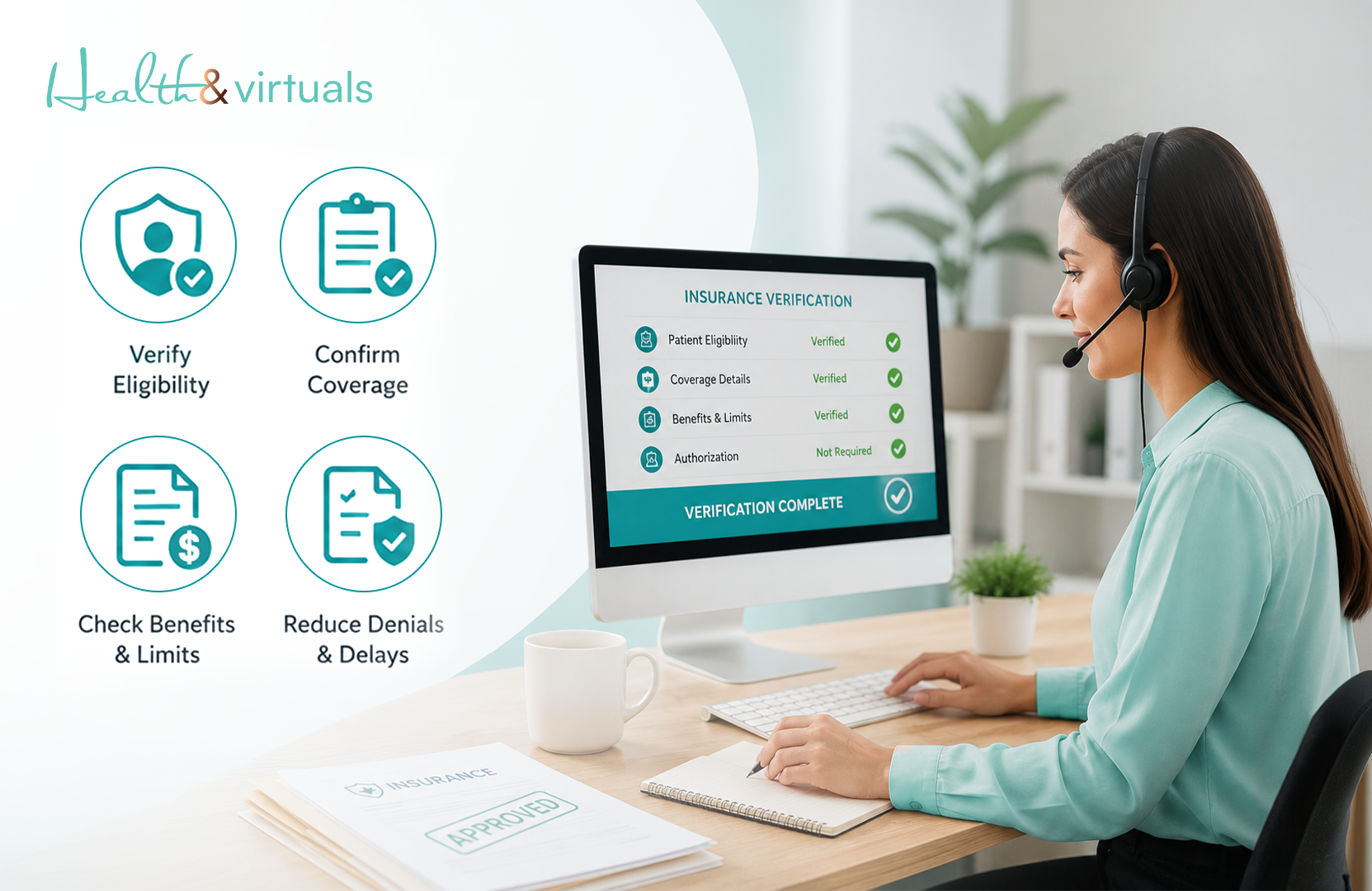
The insurance verification process is the administrative workflow used to confirm whether a patient’s insurance plan is active and whether the planned service is covered before the appointment or procedure. 

A complete verification process typically confirms: 

  • Patient name, date of birth, and policy details 
  • Active insurance coverage 
  • Primary and secondary insurance 
  • Copay, coinsurance, and deductible status 
  • In-network or out-of-network benefits 
  • Referral requirements 
  • Prior authorization requirements 
  • Coverage limits or exclusions 
  • Coordination of benefits 
  • Payer-specific documentation rules 

This process supports accurate medical billing, clean claim submission, better revenue cycle management, and clearer patient communication. 

Why Insurance Verification Matters for Claim Denial Prevention 

Claim denials are often caused by preventable administrative errors. These can include inactive coverage, incorrect patient information, missing authorization, wrong payer details, eligibility mismatch, or services that are not covered under the patient’s plan. 

When verification is completed before the visit, your team can identify issues early instead of discovering them after the claim is submitted. 

Strong insurance verification helps practices: 

  • Reduce avoidable denials 
  • Improve first-pass claim acceptance 
  • Collect accurate patient responsibility upfront 
  • Avoid billing surprises for patients 
  • Save staff time on rework and appeals 
  • Improve cash flow and reimbursement timelines 
  • Support a more professional patient experience 

For clinics with high patient volume, even small verification errors can create major revenue leakage over time. 

Common Insurance Verification Mistakes That Lead to Denials 

Many practices have a verification process in place, but denials still happen because the workflow is inconsistent. Common mistakes include:

1. Verifying Only Basic Eligibility

Basic eligibility does not always mean the service is covered. A plan may be active but still require authorization, referral, or specific documentation.

2. Checking Coverage Too Early

Insurance details can change quickly. If verification is done too far before the appointment and not rechecked, the practice may miss terminated coverage or plan changes.

3. Missing Prior Authorization Requirements

Some services, procedures, imaging, medications, dental treatments, behavioral health services, and specialty visits require prior authorization. Missing this step can result in denial even when the patient has active coverage.

4. Incorrect Patient or Policy Information

A misspelled name, wrong date of birth, outdated insurance card, or incorrect member ID can delay or deny claims.

5. Poor Documentation in EMR/EHR

If verification notes are not properly entered into the EMR/EHR, billing teams may not have the information they need when submitting claims. 

How Virtual Medical Assistants Support the Insurance Verification Process 

A trained Virtual Medical Assistant can handle repetitive, time-consuming verification tasks while your in-office team focuses on patients and providers. 

Virtual Medical Assistants can support: 

  • Patient insurance data collection 
  • Eligibility and benefits verification 
  • Payer portal checks 
  • Phone verification with insurance representatives 
  • Copay, deductible, and coinsurance confirmation 
  • Prior authorization coordination 
  • EMR/EHR documentation 
  • Patient communication about insurance updates 
  • Appointment flagging for unresolved coverage issues 
  • Follow-up with patients for missing information 

This gives your practice a more organized, proactive workflow. 

Insurance Verification Process Checklist 

Step  What to Verify  Why It Matters 
Patient Information  Name, DOB, address, phone, insurance ID  Prevents demographic and claim matching errors 
Coverage Status  Active or inactive plan  Confirms whether the patient is covered 
Benefits  Covered services, visit limits, exclusions  Reduces service-related denials 
Patient Responsibility  Copay, deductible, coinsurance  Helps collect accurate payments upfront 
Network Status  In-network or out-of-network  Prevents unexpected patient billing issues 
Prior Authorization  Required or not required  Avoids authorization-related denials 
Referral Needs  PCP or specialist referral  Important for certain plans and specialties 
EMR/EHR Notes  Verification date, payer details, reference number  Supports billing and claim follow-up 

Practical Example: Before and After Virtual Medical Assistant Support 

Before 

A clinic’s front desk verifies insurance only when patients arrive. Some patients have inactive coverage, some need prior authorization, and some have outdated insurance cards. Claims are delayed, billing staff spend hours fixing errors, and patients are frustrated by unexpected bills. 

After 

A Virtual Medical Assistant reviews the next week’s schedule, verifies benefits in advance, checks payer portals, flags authorization needs, updates the EMR/EHR, and contacts patients for missing information. The clinic has fewer last-minute surprises, cleaner claims, and a smoother patient experience. 

Where Insurance Verification Fits in the Patient Journey 

Insurance verification should not be treated as a billing-only task. It affects the entire patient journey. 

It connects with: 

  • Appointment scheduling 
  • Patient intake 
  • Eligibility checks 
  • Prior authorization 
  • Provider documentation 
  • Billing and claims 
  • Patient payment collection 
  • Follow-up care coordination 

When this process is managed well, patients feel more informed and practices operate more efficiently. 

Insurance Verification Process for Medical and Dental Practices 

Medical and dental practices both benefit from accurate insurance verification, but their workflows may differ. 

Medical practices often need to confirm eligibility, specialist visit coverage, diagnostic testing, medication-related authorization, and procedure benefits. 

Dental practices may need to verify annual maximums, waiting periods, frequency limitations, coverage percentages, deductibles, missing tooth clauses, and treatment-specific benefits. 

A Virtual Medical Assistant or Virtual Dental Assistant can help organize these details before the appointment so the provider and billing team are not left guessing. 

Why Outsourcing Insurance Verification Can Save Time and Money 

Outsourcing administrative support does not mean losing control. It means giving your team more capacity. 

When insurance verification is delegated to trained virtual support, practices can reduce: 

  • Staff burnout 
  • Front desk overload 
  • Missed calls 
  • Delayed eligibility checks 
  • Claim rework 
  • Patient billing confusion 
  • Unnecessary administrative costs 

Instead of hiring additional in-house staff for every administrative need, clinics can use virtual healthcare staffing to scale support more efficiently. 

Why Choose Health & Virtuals? 

Health & Virtuals provides healthcare-focused virtual staffing support for practices across the USA. Our team understands the daily administrative pressure medical and dental practices face, from patient communication to scheduling, insurance verification, EMR/EHR support, and practice coordination. 

With Health & Virtuals, your practice can get support from trained virtual professionals who are familiar with healthcare workflows and patient-facing communication. 

Our Virtual Medical Assistant support can help your practice: 

  • Improve administrative efficiency 
  • Reduce repetitive workload 
  • Support insurance verification workflows 
  • Improve appointment preparation 
  • Strengthen patient communication 
  • Help providers and staff stay focused on care 
  • Support HIPAA-conscious administrative processes 


FAQs 

1. What is the insurance verification process in healthcare? 

The insurance verification process is the workflow used to confirm a patient’s active coverage, benefits, eligibility, copay, deductible, coinsurance, network status, and authorization requirements before care is provided. 

2. Why is the insurance verification process important? 

The insurance verification process helps reduce claim denials, billing delays, patient confusion, and administrative rework. It also helps practices collect accurate patient responsibility upfront. 

3. Can a Virtual Medical Assistant handle insurance verification? 

Yes. A trained Virtual Medical Assistant can help verify eligibility, check benefits, document payer information in the EMR/EHR, contact insurance companies, and communicate missing information to patients. 

4. How does insurance verification prevent claim denials? 

Insurance verification prevents denials by identifying inactive coverage, missing authorization, incorrect patient details, uncovered services, and payer-specific requirements before the claim is submitted. 

5. Is insurance verification useful for dental practices too? 

Yes. Dental practices can use insurance verification to confirm coverage percentages, annual maximums, deductibles, waiting periods, treatment limitations, and patient responsibility before treatment.

Conclusion 

The insurance verification process is more than an administrative task. It is a critical part of claim denial prevention, patient communication, revenue cycle management, and practice efficiency. 

When verification is done accurately and consistently, practices can reduce avoidable denials, improve reimbursement timelines, and give patients a clearer understanding of their coverage. 

Health & Virtuals helps medical and dental practices across the USA strengthen administrative workflows with trained virtual support. If your team needs help managing insurance verification, scheduling, patient communication, or EMR/EHR updates, a Virtual Medical Assistant can make your practice more efficient and prepared.

07Jul

Medical Administrative Support Services You Should Outsource First to Save Time and Money 

Introduction 

Running a healthcare practice requires more than excellent patient care. Every day, your team manages phone calls, appointment scheduling, insurance verification, patient reminders, EMR/EHR updates, prior authorization requests, intake forms, follow-ups, and front-desk coordination. When these tasks pile up, providers lose valuable time, patients experience delays, and administrative costs increase. 

That is why many clinics, dental practices, and healthcare organizations are turning to medical administrative support services as a smarter way to reduce workload without sacrificing patient experience. 

Outsourcing the right tasks first can help your practice save time, lower staffing pressure, improve patient communication, and keep operations running smoothly. The key is knowing which tasks to delegate first and which should remain closely managed by your in-house clinical team. 

Why Medical Practices Should Outsource Administrative Tasks 

Administrative work is essential, but not every task needs to be handled by an in-office employee. Many healthcare administrative responsibilities can be completed remotely by trained virtual medical support professionals using your existing systems, workflows, and communication protocols. 

For busy practices, outsourcing can help solve common operational challenges such as: 

  • Missed calls during peak hours 
  • Appointment gaps and scheduling errors 
  • Delayed insurance verification 
  • Backlogged prior authorization requests 
  • Incomplete patient intake forms 
  • EMR/EHR data entry delays 
  • Staff burnout from repetitive admin work 
  • High payroll and hiring costs 

A well-trained virtual medical assistant can support front-office and back-office workflows while helping your in-house staff focus on patients inside the clinic. 

Medical Administrative Support Services to Outsource First 

Not every task should be outsourced at the same time. The best approach is to start with repetitive, time-consuming, and process-driven tasks that directly affect patient flow and revenue. 

1. Patient Appointment Scheduling

Appointment scheduling is one of the first tasks healthcare practices should consider outsourcing. It is repetitive, time-sensitive, and directly affects patient access. 

A virtual medical scheduler or virtual medical assistant can help manage: 

  • New appointment booking 
  • Rescheduling requests 
  • Calendar updates 
  • Provider availability coordination 
  • Appointment reminders 
  • Waitlist management 
  • No-show follow-up 

When scheduling is handled consistently, patients receive faster responses, providers experience fewer gaps, and the practice can maintain a healthier daily schedule. 

Example: 

A primary care clinic receiving high call volume may miss appointment requests during busy hours. By outsourcing scheduling support, the practice can respond faster and reduce missed booking opportunities. 

2. Patient Communication and Call Handling

Patient communication is another high-impact task to outsource early. Missed calls, delayed callbacks, and unanswered messages can lead to frustrated patients and lost revenue. 

A trained virtual medical assistant can support: 

  • Incoming call handling 
  • Outbound patient calls 
  • Appointment confirmations 
  • Basic patient questions 
  • Message routing 
  • Follow-up reminders 
  • Voicemail management 

This type of support helps your practice maintain a professional and responsive patient experience without overloading your front desk. 

3. Insurance Verification

Insurance verification is one of the most important medical administrative support services because it affects patient billing, revenue cycle flow, and appointment readiness. 

A virtual assistant can help verify: 

  • Patient eligibility 
  • Active coverage 
  • Copays 
  • Deductibles 
  • Referral requirements 
  • Authorization requirements 
  • Benefit details before appointments 

When insurance verification is completed before the visit, your team can reduce billing surprises, claim issues, and appointment delays. 

4. Prior Authorization Support

Prior authorization can be time-consuming for medical practices. It often requires gathering documentation, submitting requests, following up with payers, and tracking status updates. 

Outsourcing prior authorization support can help with: 

  • Collecting required patient and insurance details 
  • Preparing authorization requests 
  • Submitting documentation 
  • Tracking pending approvals 
  • Following up with insurance companies 
  • Updating the practice team on authorization status 

This is especially helpful for specialty clinics, behavioral health practices, diagnostic services, and treatment-based providers where authorization delays can slow down care. 

5. EMR/EHR Data Entry and Documentation Support

Accurate EMR/EHR management is essential for patient care, compliance, and workflow efficiency. However, data entry can take significant time away from providers and in-house staff. 

A virtual medical assistant can assist with: 

  • Updating patient demographics 
  • Entering intake information 
  • Uploading documents 
  • Organizing records 
  • Updating appointment notes 
  • Managing task lists 
  • Supporting chart preparation 

This helps providers walk into appointments with cleaner, more complete patient information. 

6. Patient Intake and Form Management

Patient intake is often the first administrative step in the care journey. If forms are missing, outdated, or incomplete, the appointment process becomes slower. 

Outsourced support can help with: 

  • Sending intake forms 
  • Checking form completion 
  • Verifying demographic details 
  • Collecting insurance information 
  • Preparing charts before visits 
  • Flagging missing information 

This is useful for medical clinics, dental practices, telehealth providers, and specialty healthcare offices that need smoother patient onboarding. 

7. Follow-Up Care Coordination

Follow-up communication keeps patients engaged and helps practices maintain continuity of care. However, many practices struggle to keep up with post-visit follow-up tasks. 

A virtual medical assistant can support: 

  • Follow-up appointment scheduling 
  • Reminder calls 
  • Referral coordination 
  • Lab or imaging follow-up communication 
  • Care plan reminders 
  • Patient reactivation calls 

This type of administrative support can improve patient retention and reduce gaps in care. 

8. Referral Management

Referral coordination can become complicated when multiple providers, insurance rules, and patient preferences are involved. 

Outsourced referral support can help with: 

  • Sending referrals 
  • Tracking referral status 
  • Communicating with outside offices 
  • Updating patients 
  • Managing documentation 
  • Following up on pending referral requests 

For busy practices, referral management support can prevent delays and keep patients moving through the care process. 

9. Dental Administrative Support

Dental practices can also benefit from outsourcing administrative work, especially when front-desk teams are busy with patients inside the office. 

A virtual dental assistant can support: 

  • Dental appointment scheduling 
  • Patient reminders 
  • Insurance benefit verification 
  • Treatment plan follow-up 
  • Recall calls 
  • New patient intake 
  • Front-desk phone support 

This helps dental teams stay productive while improving the patient experience from the first call to follow-up care. 

Outsourcing Priority Checklist 

Task  Outsource First?  Why It Matters 
Appointment scheduling  Yes  Reduces missed calls and keeps calendars full 
Patient reminders  Yes  Helps reduce no-shows 
Insurance verification  Yes  Improves visit readiness and billing accuracy 
Prior authorization support  Yes  Reduces delays in care 
EMR/EHR data entry  Yes  Saves staff and provider time 
Patient intake forms  Yes  Speeds up check-in and onboarding 
Follow-up calls  Yes  Improves retention and continuity of care 
Clinical decision-making  No  Must remain with licensed clinical providers 
Diagnosis or treatment advice  No  Should only be handled by qualified clinicians 

Practical Use Cases 

Use Case 1: Small Medical Clinic 

A small clinic with two providers may not need another full-time in-office employee, but it may need help with calls, scheduling, intake forms, and insurance checks. Outsourcing these tasks allows the clinic to extend support without adding the full cost of hiring locally. 

Use Case 2: Multi-Provider Specialty Practice 

A specialty practice may struggle with prior authorizations and referral coordination. A trained virtual medical assistant can help track requests, submit documents, and follow up with payers so patients do not experience unnecessary delays. 

Use Case 3: Dental Practice 

A dental office may have strong clinical staff but limited front-desk capacity. A virtual dental assistant can support recall campaigns, insurance verification, patient reminders, and treatment follow-up calls. 

Use Case 4: Telehealth Practice 

A telehealth provider may need help managing patient intake, appointment reminders, digital forms, and EMR updates. Outsourced administrative support can keep virtual care operations organized and responsive. 

How Medical Administrative Support Services Save Time and Money 

Outsourcing is not only about reducing workload. It can also help practices control operational costs. 

Medical administrative support services can help reduce: 

  • Hiring and onboarding time 
  • Payroll burden 
  • Overtime costs 
  • Staff burnout 
  • Missed appointment opportunities 
  • Front-desk overload 
  • Workflow delays 
  • Administrative backlogs 

Instead of hiring multiple in-office employees for every administrative function, practices can use trained virtual support for the tasks that are repetitive, process-driven, and easy to manage remotely. 

How to Outsource Without Losing Control 

Some practice owners worry that outsourcing means losing control over quality. The right structure prevents that. 

Before outsourcing, create a clear workflow for: 

  • Task ownership 
  • Communication channels 
  • HIPAA expectations 
  • EMR/EHR access rules 
  • Call scripts 
  • Escalation steps 
  • Reporting frequency 
  • Performance metrics 

Your virtual support team should work inside your process, not create a separate one. 

Why Choose Health & Virtuals 

Health & Virtuals provides healthcare-focused virtual support for medical and dental practices across the USA. Our team understands the importance of patient communication, HIPAA-conscious workflows, scheduling accuracy, and reliable administrative support. 

With Health & Virtuals, practices can get support for: 

  • Virtual Medical Assistant services 
  • Virtual Medical Scheduler services 
  • Virtual Dental Assistant services 
  • Patient communication 
  • Scheduling and reminders 
  • Insurance verification support 
  • EMR/EHR administrative support 
  • Follow-up coordination 
  • Healthcare back-office support 

Our goal is simple: help your practice reduce administrative workload, improve patient experience, and operate more efficiently. 

Conclusion 

Medical practices lose valuable time and money when administrative work overwhelms providers and front-desk teams. By outsourcing the right tasks first, clinics and dental practices can improve patient communication, reduce scheduling problems, speed up insurance-related workflows, and support smoother daily operations. 

The best place to start is with repetitive, high-volume tasks such as scheduling, patient calls, insurance verification, prior authorization support, intake forms, EMR/EHR updates, and follow-up coordination. 

If your practice is ready to reduce administrative workload, Health & Virtuals can help you build a reliable virtual support system designed for healthcare operations across the USA. 


FAQs 

What are medical administrative support services?

Medical administrative support services include non-clinical tasks that help a healthcare practice operate smoothly, such as appointment scheduling, patient communication, insurance verification, EMR/EHR updates, prior authorization support, intake coordination, and follow-up calls.

Which medical administrative tasks should I outsource first?

Most practices should start by outsourcing appointment scheduling, patient reminders, call handling, insurance verification, prior authorization support, and EMR/EHR data entry. These tasks are repetitive, time-consuming, and easy to manage through clear workflows.

Can a virtual medical assistant handle patient communication?

Yes. A trained virtual medical assistant can help with patient calls, appointment confirmations, reminders, follow-ups, message routing, and basic administrative questions. Clinical questions should always be escalated to licensed healthcare professionals.

Are medical administrative support services HIPAA-compliant?

They can be, as long as the provider follows HIPAA-conscious processes, secure access protocols, confidentiality expectations, and proper workflow controls. Healthcare practices should always choose trained virtual support teams that understand patient privacy.

How do outsourced medical administrative support services help save money?

They help reduce hiring pressure, overtime, missed calls, scheduling gaps, and administrative backlogs. Practices can receive reliable support without taking on the full overhead of additional in-office staff. 

07Jul

Virtual Medical Assistant Workflow: From Patient Scheduling to Follow-Up Care

Introduction 

A strong virtual medical assistant workflow helps medical practices reduce administrative pressure, improve patient communication, and keep daily operations organized from the first phone call to post-visit follow-up. 

For many clinics, dental offices, specialty practices, and healthcare groups, the problem is not only staffing. It is workflow. Calls are missed. Appointments are delayed. Insurance details are incomplete. Providers spend too much time dealing with administrative gaps instead of focusing on patient care. 

A trained Virtual Medical Assistant can help create a smoother patient journey by supporting scheduling, intake coordination, insurance verification, EMR/EHR updates, prior authorization support, reminders, and follow-up communication. 

At Health & Virtuals, our goal is to help healthcare providers build efficient, reliable, and scalable support systems without overloading in-office teams. 

What Is a Virtual Medical Assistant Workflow? 

A virtual medical assistant workflow is a structured process that shows how remote healthcare support staff manage non-clinical and administrative tasks across the patient lifecycle. 

This workflow may include: 

  • Answering patient calls 
  • Scheduling appointments 
  • Sending reminders 
  • Collecting intake information 
  • Verifying insurance 
  • Supporting prior authorization 
  • Updating EMR/EHR records 
  • Coordinating referrals 
  • Following up after appointments 
  • Helping reduce front-desk workload 

The purpose is not to replace your clinical team. The goal is to give your team better support so providers, nurses, office managers, and front-desk staff can focus on higher-value patient care and practice growth. 

Why Clinics Need a Clear Virtual Medical Assistant Workflow 

Many healthcare practices hire support staff but still struggle because tasks are not organized. Without a clear workflow, the same problems continue: 

  • Patients wait too long for callbacks 
  • Scheduling becomes inconsistent 
  • Insurance issues are discovered too late 
  • Documentation is incomplete 
  • Follow-ups are missed 
  • Staff burnout increases 
  • Patient satisfaction drops 

A clear workflow gives your practice a repeatable system. Everyone knows what happens before, during, and after each patient interaction. 

For clinic owners and practice managers, this matters because better workflow often means better patient access, fewer administrative bottlenecks, and more consistent revenue cycle support. 

Step-by-Step Virtual Medical Assistant Workflow 

Step 1: Patient Inquiry and First Contact 

The workflow usually begins when a patient contacts your practice through a phone call, website form, email, referral, or patient portal. 

A Virtual Medical Assistant can help by: 

  • Answering incoming calls 
  • Responding to patient inquiries 
  • Collecting basic patient details 
  • Explaining next steps 
  • Routing urgent matters to the appropriate in-office team 
  • Documenting the inquiry in the approved system 

This first step is important because patient experience often begins before the appointment. If the patient receives a fast, professional, and helpful response, they are more likely to schedule and keep the appointment. 

Step 2: Appointment Scheduling 

Scheduling is one of the most important parts of the virtual medical assistant workflow. 

A Virtual Medical Assistant can help manage: 

  • New patient appointments 
  • Follow-up appointments 
  • Rescheduling requests 
  • Cancellations 
  • Provider calendar coordination 
  • Waitlist management 
  • Appointment reminders 

For busy practices, scheduling support can reduce phone traffic and help prevent missed revenue from unbooked appointment slots. 

A good scheduling workflow should answer these questions: 

  • What type of appointment does the patient need? 
  • Which provider is appropriate? 
  • Is the patient new or existing? 
  • Is insurance accepted? 
  • Is paperwork required before the visit? 
  • Does the patient need a reminder? 

When scheduling is handled properly, the entire visit becomes easier for the patient and the practice. 

Step 3: Patient Intake Support 

Before the appointment, patients often need to complete forms, provide insurance details, update demographics, or share medical history. 

A Virtual Medical Assistant can support intake by: 

  • Sending intake forms 
  • Confirming patient information 
  • Updating demographic details 
  • Checking required documents 
  • Collecting insurance information 
  • Noting missing paperwork 
  • Reminding patients to complete forms before the visit 

This reduces delays on the day of the appointment and helps the in-office team stay focused. 

For dental practices, intake support may include new patient forms, dental insurance details, treatment history, and appointment preparation. For medical practices, it may include medical history, medication lists, referral documents, and consent forms. 

Step 4: Insurance Verification 

Insurance verification is a key part of healthcare administration. If benefits are not checked before the visit, the practice may face claim delays, patient confusion, or payment issues. 

A Virtual Medical Assistant can help verify: 

  • Patient eligibility 
  • Active coverage 
  • Copay information 
  • Deductible status 
  • Referral requirements 
  • Authorization requirements 
  • Plan limitations 

This step helps your team avoid surprises and gives patients clearer financial expectations. 

For many practices, insurance verification is one of the best tasks to delegate because it is repetitive, time-sensitive, and essential for clean operations. 

Step 5: Prior Authorization Support 

Prior authorization can slow down care if it is not managed carefully. A Virtual Medical Assistant can support the process by helping gather information, submit required documents, track status, and follow up with payers when appropriate. 

Common prior authorization support tasks include: 

  • Collecting required documentation 
  • Preparing payer forms 
  • Tracking authorization status 
  • Following up on pending requests 
  • Updating internal notes 
  • Notifying the appropriate team when action is needed 

The Virtual Medical Assistant should always work within the practice’s approved process and scope. Clinical decisions must remain with licensed providers. 

Step 6: EMR/EHR Updates and Documentation Support 

Accurate records are essential for patient care and practice operations. A Virtual Medical Assistant can help keep administrative information organized inside the EMR/EHR. 

Support may include: 

  • Updating patient demographics 
  • Entering appointment notes related to administrative communication 
  • Uploading documents 
  • Updating insurance details 
  • Organizing referrals 
  • Adding follow-up reminders 
  • Maintaining task lists 

This helps reduce incomplete records and makes it easier for providers and staff to find the information they need. 

Step 7: Appointment Reminders and No-Show Reduction 

Missed appointments affect both patient care and practice revenue. A Virtual Medical Assistant can help reduce no-shows by managing reminder workflows. 

This may include: 

  • Calling patients before appointments 
  • Sending approved text or email reminders 
  • Confirming appointment times 
  • Reminding patients about forms or documents 
  • Rescheduling when needed 
  • Updating the calendar after confirmation 

The best reminder workflow is proactive. Instead of waiting for a no-show, the practice confirms the appointment early and fills open slots when cancellations happen. 

Step 8: Patient Communication During the Care Journey 

Patient communication is one of the most valuable areas where a Virtual Medical Assistant can support a practice. 

They can help with: 

  • General patient questions 
  • Appointment updates 
  • Form completion reminders 
  • Referral status updates 
  • Insurance-related communication 
  • Follow-up scheduling 
  • Routing clinical questions to licensed staff 

Clear communication helps patients feel supported and reduces unnecessary pressure on providers. 

A Virtual Medical Assistant should not answer clinical questions outside their role. Instead, they should route those questions to the proper provider or care team member. 

Step 9: Post-Visit Follow-Up Care Coordination 

Follow-up is where many practices lose efficiency. After a visit, patients may need another appointment, referral, lab instructions, insurance updates, payment reminders, or general communication. 

A Virtual Medical Assistant can help with: 

  • Scheduling follow-up visits 
  • Sending post-visit instructions approved by the practice 
  • Confirming referral details 
  • Tracking pending documents 
  • Following up on incomplete forms 
  • Updating task lists 
  • Helping patients stay connected with the practice 

This keeps the care loop organized and improves the patient experience. 

Step 10: End-of-Day Administrative Wrap-Up 

A strong virtual medical assistant workflow should include an end-of-day process. 

This may include: 

  • Reviewing incomplete tasks 
  • Updating patient records 
  • Flagging urgent items 
  • Preparing next-day schedules 
  • Confirming pending appointments 
  • Sending task summaries to the practice manager 
  • Organizing follow-up lists 

This prevents small tasks from becoming next-week problems. 

Practical Examples and Use Cases 

Use Case 1: A Busy Primary Care Clinic 

A primary care clinic receives dozens of patient calls every day. The front desk is overwhelmed, and patients often wait too long for scheduling help. 

With a Virtual Medical Assistant workflow, the assistant can answer calls, schedule appointments, verify insurance, send reminders, and update the EHR. The in-office team can focus on patients who are physically present at the clinic. 

Use Case 2: A Dental Practice 

A dental office needs help managing new patient calls, insurance verification, treatment follow-up, and hygiene recall appointments. 

A Virtual Dental Assistant can help confirm appointments, verify dental insurance, organize patient forms, manage recall lists, and support communication before and after visits. 

Use Case 3: A Specialty Practice 

A specialty clinic may deal with referrals, prior authorizations, medical records, and follow-up scheduling. 

A Virtual Medical Assistant can track incoming referrals, organize documents, follow up with patients, and help reduce delays in care coordination. 

Use Case 4: A Growing Multi-Provider Practice 

A growing practice may not be ready to hire multiple in-office staff members but still needs more administrative support. 

A Virtual Medical Assistant can help extend the team without adding more office space, equipment, or unnecessary overhead. 

Virtual Medical Assistant Workflow Checklist 

Workflow Stage  Tasks a Virtual Medical Assistant Can Support  Practice Benefit 
Patient Inquiry  Answer calls, respond to forms, collect basic details  Faster response time 
Scheduling  Book, reschedule, confirm, and manage calendars  Fewer missed opportunities 
Intake  Send forms, collect documents, update demographics  Smoother appointment preparation 
Insurance  Verify eligibility, benefits, copays, and referral needs  Fewer billing surprises 
Prior Authorization  Track requests, gather documents, follow up with payers  Reduced administrative delays 
EMR/EHR Support  Update records, upload forms, organize notes  Cleaner documentation 
Reminders  Call, text, or email reminders based on practice policy  Lower no-show risk 
Follow-Up  Schedule next visits, track pending items, coordinate communication  Better care continuity 
Daily Wrap-Up  Review tasks, prepare next-day schedule, flag issues  More organized operations 

How This Workflow Supports Better Patient Experience 

Patients judge a practice by how easy it is to get help. When calls are missed, forms are confusing, or follow-ups are delayed, patients may feel frustrated. 

A strong workflow helps create: 

  • Faster responses 
  • Clearer communication 
  • Easier scheduling 
  • Better appointment preparation 
  • Fewer repeated questions 
  • More consistent follow-up 

This is especially important in competitive healthcare markets across the USA, where patients expect convenience, responsiveness, and professionalism. 

How This Workflow Supports Practice Growth 

A Virtual Medical Assistant workflow does more than reduce busywork. It can support business growth by helping the practice: 

  • Capture more appointment requests 
  • Reduce missed calls 
  • Improve patient retention 
  • Support revenue cycle processes 
  • Reduce staff burnout 
  • Improve operational consistency 
  • Scale without overloading the in-office team 

For clinic owners and healthcare administrators, this makes virtual staffing a performance strategy—not just a cost-saving option. 

HIPAA and Security Considerations 

Healthcare practices must take privacy seriously. A Virtual Medical Assistant should work within HIPAA-conscious processes and follow the practice’s security protocols. 

Important safeguards may include: 

  • Secure access to approved systems 
  • Role-based permissions 
  • Proper training 
  • Confidentiality procedures 
  • Secure communication channels 
  • Clear escalation rules 
  • Documentation standards 

Health & Virtuals focuses on healthcare-specific virtual support, which means our team understands that patient privacy, professionalism, and process discipline matter in every interaction. 

Virtual Medical Assistant vs. General Virtual Assistant 

A general virtual assistant may be helpful for basic admin work, but healthcare requires specialized knowledge. 

Category  General Virtual Assistant  Virtual Medical Assistant 
Healthcare terminology  Limited  Trained for healthcare workflows 
EMR/EHR familiarity  Usually limited  More relevant to medical practice support 
Insurance tasks  Not usually specialized  Can support verification and payer communication 
Patient communication  General support  Healthcare-focused communication 
HIPAA awareness  May vary  Expected as part of healthcare support 
Best fit  General business tasks  Medical, dental, and healthcare administration 

For clinics, dental offices, and healthcare providers, a trained Virtual Medical Assistant is usually a better fit than a general VA because the workflow requires healthcare-specific accuracy and professionalism. 

Why Choose Health & Virtuals? 

Health & Virtuals helps healthcare practices across the USA build reliable virtual support systems for daily operations. 

Our core services include: 

  • Virtual Medical Assistant 
  • Virtual Medical Scheduler 
  • Virtual Dental Assistant 

We understand that medical practices need more than remote admin help. They need trained support that fits into real healthcare workflows. 

Health & Virtuals can help your practice with: 

  • Patient scheduling support 
  • Healthcare administration 
  • Patient communication 
  • Insurance verification assistance 
  • EMR/EHR task support 
  • Follow-up coordination 
  • Dental front-office support 
  • Scalable staffing support 

Our approach is designed for clinic owners, practice managers, dentists, healthcare administrators, and providers who want dependable support without compromising patient experience. 

Ready to Improve Your Practice Workflow? 

If your front desk is overloaded, your providers are losing time to admin tasks, or patients are waiting too long for follow-up, Health & Virtuals can help. 

Explore our Virtual Medical Assistant service: 

https://healthandvirtuals.com/medical-practice-support/virtual-medical-assistant/ 

Build a More Efficient Healthcare Team 

Get trained virtual support for scheduling, patient communication, insurance verification, EMR/EHR updates, and follow-up coordination. 

Contact Health & Virtuals today to discuss the right virtual staffing solution for your practice. 

Need Scheduling or Dental Support? 

Health & Virtuals also provides Virtual Medical Scheduler and Virtual Dental Assistant support for practices that need focused help with appointments, patient access, and dental front-office workflows. 

——————————————————– 

FAQs

What is a virtual medical assistant workflow?

A virtual medical assistant workflow is a structured process for managing administrative healthcare tasks such as patient scheduling, intake support, insurance verification, EMR/EHR updates, patient communication, and follow-up coordination.

How does a Virtual Medical Assistant help with scheduling?

A Virtual Medical Assistant can answer appointment requests, schedule new and follow-up visits, manage cancellations, send reminders, update calendars, and help reduce missed calls or no-shows.

Can a Virtual Medical Assistant support insurance verification?

Yes. A trained Virtual Medical Assistant can help verify eligibility, coverage details, copays, deductibles, referral requirements, and authorization needs based on the practice’s approved process.

Is a Virtual Medical Assistant the same as a general virtual assistant?

No. A Virtual Medical Assistant is trained for healthcare administration, patient communication, scheduling workflows, insurance-related support, and EMR/EHR task coordination. A general virtual assistant may not understand healthcare-specific processes.

Why should a clinic use Health & Virtuals?

Health & Virtuals provides healthcare-focused virtual staffing support for medical and dental practices across the USA. Our services help practices reduce administrative workload, improve patient communication, and build more organized workflows. 

Conclusion 

A well-designed virtual medical assistant workflow can help healthcare practices manage the complete patient journey—from first contact and scheduling to insurance verification, EMR/EHR updates, and follow-up care. 

For clinic owners, dentists, healthcare administrators, and practice managers, the right workflow creates more than convenience. It helps protect staff time, improve patient experience, reduce administrative bottlenecks, and support long-term growth. 

Health & Virtuals helps practices across the USA build dependable virtual support systems through trained Virtual Medical Assistants, Virtual Medical Schedulers, and Virtual Dental Assistants. 

If your practice is ready to reduce administrative pressure and improve daily operations, Health & Virtuals is ready to help.

30Jun

How Much Does a Virtual Medical Assistant Cost in 2026? 

Quick Summary / Key Takeaways 

  • The average virtual medical assistant cost in 2026 ranges from $8 to $25 per hour depending on experience, specialization, and service model. 
  • Most US clinics spend between $1,300 and $3,500 per month for a dedicated healthcare virtual assistant. 
  • Tasks commonly outsourced include scheduling, insurance verification, patient communication, medical billing support, prior authorizations, and EHR updates. 
  • Hiring a virtual assistant can reduce administrative burden, improve patient satisfaction, and help lower staff burnout. 
  • Clinics should evaluate HIPAA compliance, healthcare experience, training standards, and scalability before choosing a provider. 

Healthcare practices across the United States continue to face staffing shortages, rising labor costs, increasing patient expectations, and growing administrative complexity. As a result, many clinic owners and practice managers are exploring virtual staffing solutions that deliver operational support without the expense of adding more in-house employees. 

One of the most common questions we hear from physicians and healthcare administrators is straightforward: what is the actual virtual medical assistant cost in 2026? 

The answer depends on several factors, including the assistant’s experience, scope of work, specialty knowledge, and whether you hire independently or through a healthcare-focused outsourcing partner. This guide breaks down current pricing, cost drivers, expected return on investment, and what clinics should know before hiring. 

Understanding Virtual Medical Assistant Pricing in 2026 

A virtual medical assistant is a remote healthcare support professional who handles administrative and operational tasks for medical practices. Unlike a general virtual assistant, a healthcare VA is trained to work within clinical workflows and patient communication processes. 

The typical virtual medical assistant cost in 2026 falls into three categories: 

  • Entry-level healthcare VAs: $8–$12 per hour 
  • Experienced healthcare VAs: $12–$18 per hour 
  • Specialized medical VAs: $18–$25+ per hour 

Monthly costs vary based on workload and coverage requirements. 

For example: 

  • Part-time support (20 hours weekly): approximately $700–$1,800 monthly 
  • Full-time dedicated support (40 hours weekly): approximately $1,300–$3,500 monthly 
  • Multiple VA teams for larger practices: $4,000+ monthly 

Compared with hiring an in-office administrative employee, virtual staffing often provides substantial savings while maintaining service quality. 

What Factors Affect Virtual Medical Assistant Cost? 

Not all healthcare virtual assistants are priced the same. Several variables influence total investment. 

Experience and Healthcare Knowledge 

A VA with experience supporting primary care, mental health, cardiology, dermatology, or multi-specialty clinics typically commands higher rates. 

Healthcare-trained assistants often understand: 

  • Medical terminology 
  • Insurance workflows 
  • EHR systems 
  • Patient intake processes 
  • Referral management 

This expertise reduces training time and accelerates productivity. 

Scope of Responsibilities 

The virtual medical assistant cost increases when responsibilities become more specialized. 

Common tasks include: 

  • Appointment scheduling 
  • Patient reminders 
  • Call handling 
  • Calendar management 
  • Data entry 
  • Intake documentation 

Higher-value responsibilities may include: 

  • Medical billing assistance 
  • Prior authorizations 
  • Claims follow-up 
  • Insurance verification 
  • EHR documentation support 
  • Revenue cycle coordination 

The broader the role, the greater the expected cost. 

Dedicated vs Shared Support 

Dedicated assistants work exclusively for one clinic during assigned hours. 

Shared assistants divide their time across multiple clients. 

Dedicated staffing generally costs more but provides: 

  • Better workflow familiarity 
  • Greater accountability 
  • Stronger patient interactions 
  • Consistent availability 

Provider Training and Compliance Standards 

Healthcare organizations should prioritize HIPAA-trained professionals with documented security protocols. 

Providers that offer: 

  • HIPAA compliance training 
  • Ongoing supervision 
  • Performance monitoring 
  • Quality assurance reviews 

may charge slightly higher rates, but they also reduce operational risk. 

Virtual Medical Assistant Cost vs In-House Staffing 

For many clinics, the financial comparison is compelling. 

An in-house medical receptionist or administrative coordinator may require: 

  • Salary and wages 
  • Payroll taxes 
  • Employee benefits 
  • Office space 
  • Equipment 
  • Recruiting expenses 
  • Ongoing training 

In many US markets, these costs can exceed $45,000 to $70,000 annually. 

By comparison, the average virtual medical assistant cost is significantly lower while still delivering administrative support across critical workflows. 

Many practices report savings of 40% to 70% compared with traditional staffing models. 

The financial advantages become even more meaningful for independent practices operating with tight margins. 

What Tasks Deliver the Highest ROI? 

The best virtual assistant programs focus on time-consuming tasks that pull physicians and clinical staff away from patient care. 

High-impact responsibilities include: 

  • Appointment scheduling and rescheduling 
  • Patient follow-up communications 
  • Insurance eligibility verification 
  • Referral coordination 
  • Prior authorization support 
  • Medical billing assistance 
  • Patient intake processing 
  • EHR updates 
  • Prescription refill coordination 
  • Recall campaigns 

When administrative workloads decrease, providers can dedicate more time to patient encounters and revenue-generating activities. 

Many practices discover that a single healthcare VA can recover several hours of staff capacity every day. 

How Much Can Clinics Save? 

Savings vary by specialty, patient volume, and staffing structure. 

Consider a clinic paying an in-house employee $55,000 annually after benefits and overhead. 

A dedicated healthcare virtual assistant might cost between $18,000 and $36,000 annually depending on responsibilities and service levels. 

Potential annual savings may range from: 

  • $15,000 
  • $20,000 
  • $30,000 or more 

Beyond direct labor savings, practices often gain operational improvements such as: 

  • Faster scheduling response times 
  • Reduced call abandonment 
  • Better patient retention 
  • Improved billing follow-up 
  • Lower staff turnover 

These indirect benefits can significantly increase overall return on investment. 

How to Choose the Right Healthcare VA Provider 

Price should never be the only consideration. 

When evaluating providers, look for: 

  • Healthcare-specific experience 
  • HIPAA-compliant processes 
  • Knowledge of US healthcare workflows 
  • Experience with major EHR platforms 
  • Transparent pricing 
  • Dedicated account management 
  • Scalable staffing options 

Ask prospective providers how assistants are trained, supervised, evaluated, and supported. 

The lowest virtual medical assistant cost is not always the best value if service quality is inconsistent. 

A qualified assistant who improves workflow efficiency and patient experience can generate far greater returns than a lower-cost option with limited healthcare knowledge. 

Why More Clinics Are Outsourcing in 2026 

The healthcare labor market remains challenging. 

Practice managers continue to face: 

  • Staff shortages 
  • Rising wage expectations 
  • Burnout-related turnover 
  • Administrative overload 
  • Increased patient communication demands 

Healthcare virtual assistants help address these challenges by providing flexible staffing support without the long recruitment cycles associated with traditional hiring. 

For growing clinics, outsourcing also creates scalability. 

Instead of hiring multiple full-time employees, practices can expand support incrementally as patient volume increases. 

Real-World Example of Cost Efficiency 

Consider a busy primary care clinic managing thousands of patient interactions each month. Front-desk employees often spend hours answering routine calls, confirming appointments, verifying insurance coverage, and following up on missed visits. 

By assigning these responsibilities to a trained healthcare virtual assistant, the practice can improve responsiveness without increasing local payroll expenses. Providers frequently report shorter wait times, better schedule utilization, fewer administrative bottlenecks, and improved staff morale. 

Even modest gains matter. Recovering one additional patient appointment per day, reducing claim delays, or preventing staff overtime can offset a significant portion of the virtual assistant investment while supporting sustainable growth over time. These measurable improvements create stronger patient experiences and healthier operations overall today. 

The Bottom Line on Virtual Medical Assistant Cost 

For most US healthcare organizations, the virtual medical assistant cost in 2026 represents a practical investment rather than an expense. 

Clinics gain access to trained administrative support, reduce staff workload, improve operational efficiency, and often lower overall labor costs. 

While pricing varies based on experience and responsibilities, most practices can expect monthly costs between $1,300 and $3,500 for dedicated support. 

The key is choosing a healthcare-focused partner that understands compliance requirements, patient expectations, and medical practice operations. 


FAQ: Virtual Medical Assistant Cost in 2026 

What is the average virtual medical assistant cost in 2026? 

Most healthcare virtual assistants cost between $8 and $25 per hour. Full-time dedicated support typically ranges from $1,300 to $3,500 per month depending on experience and responsibilities. 

Are healthcare virtual assistants HIPAA compliant? 

Reputable providers train assistants on HIPAA requirements, secure communication practices, and patient data protection protocols. Always verify compliance processes before hiring. 

Can a virtual medical assistant help with medical billing? 

Yes. Many healthcare virtual assistants assist with insurance verification, claims follow-up, billing support, prior authorizations, and revenue cycle administrative tasks. 

How long does onboarding usually take? 

Most clinics can onboard a healthcare virtual assistant within a few days to a few weeks, depending on workflow complexity, software access, and training requirements. 

Is hiring a virtual medical assistant cheaper than hiring in-house staff? 

In most cases, yes. The virtual medical assistant cost is often substantially lower than the combined salary, benefits, office space, recruiting, and training expenses associated with in-house employees.


29Jun

Virtual Medical Assistant vs In-House Medical Assistant: Which Is Better? 

Quick Summary / Key Takeaways 

  • A virtual medical assistant can handle scheduling, patient communication, insurance verification, billing support, and administrative workflows remotely. 
  • An in-house medical assistant provides on-site clinical and administrative support but comes with higher employment and overhead costs. 
  • When comparing virtual medical assistant vs medical assistant models, clinics often choose virtual support for scalability, flexibility, and cost savings. 
  • Virtual assistants help reduce physician burnout by removing repetitive administrative work. 
  • The best choice depends on patient volume, operational needs, budget, and growth goals. 

Healthcare practices across the United States are under pressure to do more with fewer resources. Rising labor costs, staffing shortages, increasing patient expectations, and administrative complexity are forcing clinic owners and practice managers to rethink how work gets done. 

One of the most common questions we hear from medical groups is whether they should hire a virtual medical assistant or continue relying on traditional in-house support. Understanding the differences can help practices improve efficiency, reduce overhead, and create a better experience for both staff and patients. 

This guide provides a practical comparison of virtual medical assistant vs medical assistant models and explains which option delivers the greatest value for modern healthcare organizations. 

What Is a Virtual Medical Assistant? 

A virtual medical assistant is a trained healthcare support professional who works remotely and assists medical practices with administrative and operational tasks. 

Depending on the clinic’s needs, a virtual medical assistant may handle: 

  • Appointment scheduling 
  • Patient intake coordination 
  • Insurance verification 
  • Referral management 
  • Medical billing support 
  • Prior authorization follow-ups 
  • Electronic health record updates 
  • Patient reminders and recalls 
  • Customer service and call handling 

Many virtual assistants work exclusively with healthcare organizations and are trained on HIPAA requirements, medical terminology, and healthcare workflows. 

What Is an In-House Medical Assistant? 

An in-house medical assistant is a staff member physically present in the clinic. Their responsibilities often include both administrative and clinical duties. 

Typical responsibilities include: 

  • Rooming patients 
  • Taking vital signs 
  • Preparing examination rooms 
  • Assisting physicians during visits 
  • Collecting patient information 
  • Scheduling appointments 
  • Managing front-desk tasks 

Because they work on-site, in-house medical assistants are essential for direct patient interaction and clinical support functions that cannot be performed remotely. 

Virtual Medical Assistant vs Medical Assistant: Core Differences 

When evaluating virtual medical assistant vs medical assistant options, practice leaders should focus on five critical areas.

1. Cost of Employment

Cost is often the biggest deciding factor. 

Hiring an in-house medical assistant involves expenses beyond salary, including: 

  • Payroll taxes 
  • Benefits 
  • Paid time off 
  • Recruiting costs 
  • Training expenses 
  • Office space 
  • Equipment and workstation expenses 

A virtual medical assistant typically works through an outsourcing model, allowing clinics to avoid many of these overhead costs. 

For growing practices, this difference can translate into significant annual savings while maintaining operational support.

2. Scalability

Healthcare demand rarely stays consistent throughout the year. 

An in-house employee provides fixed capacity. If patient volume rises unexpectedly, clinics may need to hire additional staff, which can take weeks or months. 

Virtual staffing offers greater flexibility. Practices can often increase support hours, add specialized resources, or expand coverage without lengthy hiring cycles. 

This scalability is one reason many organizations prefer the virtual medical assistant vs medical assistant approach when planning growth.

3. Clinical Support Capabilities

This category clearly favors in-house staff. 

Virtual assistants cannot: 

  • Take vital signs 
  • Prepare patients for examinations 
  • Assist with procedures 
  • Perform hands-on clinical tasks 

If your practice requires extensive clinical support, an in-house medical assistant remains necessary. 

However, many administrative responsibilities can be delegated to remote team members, allowing on-site staff to focus on patient care.

4. Productivity and Workflow Efficiency

Administrative work consumes a significant portion of a healthcare team’s day. 

Common time-consuming tasks include: 

  • Insurance verification 
  • Appointment reminders 
  • Data entry 
  • Referral coordination 
  • Billing follow-up 
  • Call management 

A virtual medical assistant can manage these activities throughout the day, reducing interruptions for physicians and front-office teams. 

Many practices discover that moving administrative responsibilities to remote support creates faster workflows and better staff utilization.

5. Coverage and Availability

Traditional employees generally work fixed schedules. 

Virtual staffing models can provide extended coverage options, including: 

  • Early morning support 
  • Evening coverage 
  • Weekend assistance 
  • Overflow call handling 

For clinics receiving high call volumes, additional coverage can improve responsiveness and reduce missed opportunities. 

Why More Clinics Are Choosing Virtual Medical Assistants 

The healthcare workforce continues to face staffing challenges across the United States. 

Practice owners increasingly choose virtual support because it helps address several operational problems simultaneously. 

Key advantages include: 

  • Lower operating costs 
  • Reduced hiring challenges 
  • Faster onboarding 
  • Improved scheduling efficiency 
  • Better patient communication 
  • Increased staff productivity 
  • Reduced physician burnout 

When evaluating virtual medical assistant vs medical assistant solutions, many organizations find that remote support delivers stronger administrative performance at a lower cost. 

Impact on Physician Burnout 

Administrative overload remains one of the leading causes of physician burnout. 

Doctors often spend hours each week handling documentation, reviewing messages, coordinating referrals, and managing operational issues. 

Delegating these responsibilities to a virtual medical assistant allows providers to spend more time on patient care and less time on repetitive administrative work. 

The result is often: 

  • Improved provider satisfaction 
  • Better work-life balance 
  • Reduced stress 
  • More patient-facing time 
  • Stronger practice performance 

For clinics struggling with burnout, staffing strategy can be just as important as technology investments. 

Which Tasks Should Be Assigned to a Virtual Medical Assistant? 

The most successful practices assign repeatable, process-driven work to remote team members. 

Ideal tasks include: 

  • Appointment scheduling 
  • Insurance eligibility verification 
  • Prior authorization follow-up 
  • Referral processing 
  • Patient reminders 
  • Recall campaigns 
  • Revenue cycle support 
  • Data entry 
  • Inbox management 
  • Customer service 

These responsibilities can usually be standardized, measured, and optimized without requiring physical presence inside the clinic. 

When an In-House Medical Assistant Is the Better Choice 

Although virtual support offers substantial benefits, in-house staffing still plays an important role. 

An in-house medical assistant may be the better option when: 

  • Clinical assistance is required daily 
  • Patient volume requires constant room preparation 
  • Providers need hands-on support during procedures 
  • The practice depends heavily on face-to-face patient interaction 

For many organizations, the answer is not choosing one model exclusively. 

Instead, the strongest approach combines both. 

The Hybrid Model: Best of Both Worlds 

Many high-performing practices use a hybrid staffing structure. 

Under this model: 

  • Virtual medical assistants handle administrative workflows. 
  • In-house medical assistants focus on clinical responsibilities. 
  • Physicians spend more time with patients. 
  • Front-desk teams experience fewer interruptions. 

This approach maximizes efficiency while controlling labor costs. 

When comparing virtual medical assistant vs medical assistant strategies, hybrid staffing often produces the best balance of cost, productivity, and patient experience. 

How to Choose the Right Solution for Your Practice 

Before making a staffing decision, evaluate: 

  • Current staffing gaps 
  • Administrative workload 
  • Monthly patient volume 
  • Growth objectives 
  • Budget constraints 
  • Physician burnout levels 
  • Revenue cycle challenges 

Practices overwhelmed by administrative work often achieve the fastest return on investment through virtual support. 

If your team spends excessive time scheduling appointments, verifying insurance, processing referrals, or managing billing tasks, a virtual medical assistant can deliver immediate operational relief. 

Clinics that adopt structured virtual support frequently report stronger patient retention, fewer scheduling bottlenecks, improved responsiveness, and more predictable growth over time overall. 

Ready to reduce administrative burdens and improve practice efficiency? Partner with our healthcare virtual assistant team to streamline workflows, support your staff, and create a better patient experience. 

Schedule a consultation today to discover how dedicated healthcare virtual assistants can help your clinic save time, lower costs, and scale with confidence. 

Frequently Asked Questions 

Is a virtual medical assistant HIPAA compliant? 

Yes. Reputable healthcare virtual assistant providers train team members on HIPAA requirements, secure communication protocols, and patient data protection procedures. 

How much does a virtual medical assistant cost? 

Pricing varies based on experience, hours, and responsibilities. However, virtual support is typically more cost-effective than hiring a full-time in-house employee. 

How long does onboarding take? 

Most healthcare virtual assistants can be onboarded significantly faster than traditional employees, especially when standardized workflows and documentation are already in place. 

Can a virtual medical assistant help with medical billing? 

Yes. Many virtual assistants support billing workflows, insurance verification, claim follow-ups, payment posting assistance, and revenue cycle administrative tasks. 

Should clinics replace all in-house medical assistants with virtual assistants? 

Not usually. The most effective model often combines remote administrative support with on-site clinical staff to maximize efficiency and maintain excellent patient care.

25Jun

10 Tasks a Virtual Medical Assistant Can Handle for Your Clinic 

Quick Summary / Key Takeaways 

  • Virtual medical assistant services help clinics reduce administrative overload, improve patient communication, and support staff productivity. 
  • A trained healthcare VA can manage scheduling, insurance verification, billing support, patient follow-ups, and EHR updates. 
  • Outsourcing routine tasks allows physicians and in-house teams to focus on patient care and revenue-generating activities. 
  • HIPAA-trained virtual assistants can work within established workflows while maintaining compliance and data security. 
  • Clinics often use virtual assistants to lower operational costs, reduce burnout, and scale efficiently. 

Running a medical practice requires much more than delivering quality patient care. Physicians, practice managers, and administrators spend countless hours managing appointments, responding to patients, processing paperwork, and handling billing-related tasks. 

As administrative demands continue to grow, many clinics are turning to virtual medical assistant services to improve efficiency without increasing overhead. A qualified virtual medical assistant can support daily operations, reduce staff workload, and help create a better experience for both patients and providers. 

Below are ten high-impact tasks a virtual medical assistant can handle for your clinic.

1. Appointment Scheduling and Calendar Management

Scheduling errors can lead to patient dissatisfaction, lost revenue, and workflow disruptions. 

A virtual medical assistant can: 

  • Schedule new patient appointments 
  • Reschedule cancellations 
  • Manage provider calendars 
  • Coordinate referrals and specialist visits 
  • Reduce scheduling conflicts 

With professional virtual medical assistant services, clinics can maintain organized schedules while minimizing no-shows and administrative delays.

2. Patient Appointment Reminders

Missed appointments affect productivity and revenue. 

A virtual assistant can send: 

  • Phone reminders 
  • SMS notifications 
  • Email confirmations 
  • Follow-up communications 

Consistent reminders help improve attendance rates while ensuring patients stay informed about upcoming visits.

3. Insurance Verification and Eligibility Checks

Insurance verification is one of the most time-consuming front-office responsibilities. 

A virtual medical assistant can: 

  • Verify active coverage 
  • Confirm benefits 
  • Check deductibles 
  • Review copay requirements 
  • Identify authorization needs 

Completing these tasks before appointments helps reduce claim denials and billing complications.

4. Medical Billing Support

Many clinics struggle with billing backlogs and reimbursement delays. 

While virtual assistants do not replace certified billers, they can support billing workflows by: 

  • Reviewing patient demographics 
  • Updating insurance information 
  • Following up on claim status 
  • Organizing billing documentation 
  • Assisting with payment tracking 

Virtual medical assistant services often help practices maintain cleaner administrative processes that support faster reimbursement cycles.

5. Patient Intake and Registration

The patient experience starts before the clinical encounter. 

A virtual medical assistant can streamline intake by: 

  • Collecting demographic information 
  • Sending registration forms 
  • Gathering insurance details 
  • Confirming required documents 
  • Updating records before appointments 

Efficient intake processes reduce wait times and improve operational flow.

6. Electronic Health Record Updates

Accurate documentation is critical for quality care and compliance. 

A trained virtual assistant can help: 

  • Update patient records 
  • Enter non-clinical information 
  • Upload documents 
  • Organize digital files 
  • Maintain record accuracy 

This support reduces administrative burden on in-house teams while keeping information accessible and organized.

7. Patient Follow-Up Coordination

Patient engagement does not end when an appointment concludes. 

A virtual medical assistant can: 

  • Contact patients after visits 
  • Schedule follow-up appointments 
  • Share approved educational resources 
  • Confirm treatment plan compliance 
  • Address routine administrative questions 

Regular communication helps improve patient satisfaction and continuity of care.

8. Referral Management

Referral coordination can become a significant bottleneck for busy practices. 

Virtual assistants can: 

  • Process referral requests 
  • Coordinate with specialists 
  • Track referral status 
  • Collect required documentation 
  • Maintain communication with patients 

Strong referral management helps ensure patients receive timely care while reducing delays

9. Prior Authorization Support

Prior authorization requirements continue to increase across healthcare specialties. 

A virtual medical assistant can assist by: 

  • Gathering required information 
  • Preparing documentation 
  • Tracking authorization requests 
  • Following up with payers 
  • Updating internal records 

This support allows clinical staff to spend less time on administrative paperwork.

10. Phone and Inbox Management

Front-desk teams are frequently overwhelmed by incoming calls and messages. 

Virtual medical assistant services can provide support by: 

  • Answering routine inquiries 
  • Routing urgent requests appropriately 
  • Managing email inboxes 
  • Responding to non-clinical questions 
  • Tracking communication requests 

Improved responsiveness enhances patient satisfaction and reduces pressure on office staff. 

Why Clinics Are Increasingly Using Virtual Medical Assistant Services 

Healthcare organizations across the United States face ongoing staffing challenges, rising operational costs, and increasing administrative complexity. 

A virtual medical assistant offers several advantages: 

  • Lower staffing expenses compared with additional full-time hires 
  • Greater scheduling flexibility 
  • Faster administrative turnaround times 
  • Reduced employee burnout 
  • Improved patient communication 
  • Better operational scalability 

For many practices, virtual medical assistant services provide a practical way to expand support capacity without adding physical office space or extensive onboarding requirements. 

How Virtual Assistants Help Reduce Physician Burnout 

Physician burnout remains a major concern throughout the healthcare industry. 

Doctors often spend hours each day on tasks that do not require clinical expertise. Scheduling, documentation support, insurance coordination, and patient communication can consume valuable time that could otherwise be dedicated to patient care. 

By delegating repetitive administrative responsibilities, clinics create a more sustainable work environment. Virtual medical assistant services help physicians focus on diagnosis, treatment planning, and patient relationships instead of routine paperwork. 

This shift often contributes to improved job satisfaction, better productivity, and stronger patient outcomes. 

What to Look for When Hiring a Virtual Medical Assistant 

Not all healthcare virtual assistants offer the same level of expertise. 

When evaluating providers, look for: 

  • HIPAA training and compliance knowledge 
  • Experience supporting US healthcare practices 
  • Familiarity with EHR systems 
  • Strong communication skills 
  • Knowledge of insurance workflows 
  • Reliable availability and responsiveness 

Selecting the right partner helps ensure seamless integration with existing clinic operations. 

Real-World Impact on Clinic Performance 

From my experience working with healthcare organizations, the most successful clinics treat administrative efficiency as a patient care strategy. Every minute providers spend chasing paperwork, returning routine calls, or tracking missing information is a minute unavailable for patient interactions. 

When virtual medical assistant services are implemented correctly, measurable improvements often follow: 

  • Faster appointment turnaround times 
  • Improved patient response rates 
  • Reduced front-desk workload 
  • Better documentation accuracy 
  • Stronger revenue cycle support 
  • More consistent patient communication 

For example, a growing multi-provider practice may receive hundreds of calls, portal messages, and scheduling requests every week. Without adequate support, staff members can become overwhelmed, leading to longer response times and missed opportunities to engage patients. 

A dedicated virtual medical assistant creates structure and accountability across these workflows. Requests are tracked, follow-ups are completed, and routine administrative responsibilities are handled consistently. 

The result is not simply lower costs. Clinics frequently gain improved operational visibility, stronger patient retention, and a better experience for both providers and support staff. As healthcare becomes increasingly competitive, efficient administrative processes are no longer optional. They are an essential part of delivering high-quality care while maintaining financial stability and sustainable growth. 

These advantages help practices strengthen capacity, improve consistency, and support sustainable expansion nationwide over time effectively. 

Ready to Reduce Administrative Burden? 

Administrative overload can limit growth, increase stress, and negatively affect patient experiences. 

Professional virtual medical assistant services provide clinics with trained healthcare support staff who can handle essential administrative responsibilities while maintaining efficiency and compliance. 

If your practice is looking for ways to improve productivity, reduce burnout, and create a better patient experience, now is the time to explore a dedicated healthcare virtual assistant solution. 

Contact our team today to learn how virtual medical assistant services can be customized for your clinic’s unique workflow needs. 

Schedule a free consultation and discover how a healthcare virtual assistant can help your practice save time, improve efficiency, and support long-term growth. 


Frequently Asked Questions 


Are virtual medical assistants HIPAA compliant? 

Reputable providers train virtual assistants on HIPAA requirements, data privacy standards, and secure communication practices. Clinics should always verify compliance protocols before hiring.

How long does it take to onboard a virtual medical assistant? 

Most clinics can begin onboarding within days. The timeline depends on workflow complexity, software access requirements, and training needs. 

Can a virtual medical assistant work with our EHR system? 

Many virtual assistants have experience with popular EHR platforms and can be trained on clinic-specific workflows and documentation procedures. 

How much do virtual medical assistant services cost? 

Pricing varies based on experience, responsibilities, coverage hours, and service models. Most clinics find outsourcing more cost-effective than hiring additional in-office administrative staff. 

What specialties can benefit from a virtual medical assistant? 

Primary care, behavioral health, dermatology, cardiology, orthopedics, pediatrics, urgent care, and many other specialties use virtual medical assistants to support daily operations.

23Jun

What is a Virtual Medical Assistant and How Can They Help Your Practice? 

Quick Summary 

A virtual medical assistant (VMA) is a trained remote healthcare professional who supports medical practices with administrative, patient communication, scheduling, billing, and operational tasks. 

Key Benefits for Healthcare Practices 

  • Reduces physician and staff burnout 
  • Improves patient communication and satisfaction 
  • Lowers staffing and operational costs 
  • Supports medical billing and insurance workflows 
  • Increases appointment efficiency and patient retention 
  • Helps practices scale without adding in-house overhead 
  • Can operate within HIPAA-compliant workflows 

For medical clinics facing staffing shortages and growing administrative demands, a virtual medical assistant provides a cost-effective way to improve efficiency while allowing providers to focus on patient care. 

What Is a Virtual Medical Assistant?

A virtual medical assistant is a remote healthcare support professional who performs non-clinical and administrative tasks for medical practices, clinics, specialty groups, and healthcare organizations. 

Unlike a traditional front-desk employee who works onsite, a virtual medical assistant works remotely while integrating directly into the practice’s daily operations. They use secure systems, practice management software, EHR platforms, and communication tools to support providers and office staff. 

Many healthcare organizations across the United States are increasingly adopting virtual medical assistants to address workforce shortages, rising labor costs, and physician burnout. 

Common healthcare settings that benefit from VMAs include: 

  • Primary care practices 
  • Mental health clinics 
  • Urgent care centers 
  • Family medicine groups 
  • Specialty practices 
  • Multi-location healthcare organizations 
  • Telehealth providers 

The goal is simple: remove administrative burdens so providers can spend more time delivering quality patient care. 

Why Medical Practices Are Turning to Virtual Medical Assistants

Administrative work has become one of the biggest challenges facing healthcare organizations. 

Practice managers and physicians often struggle with: 

  • Staff shortages 
  • Increasing patient volumes 
  • High employee turnover 
  • Insurance verification demands 
  • Scheduling inefficiencies 
  • Growing documentation requirements 
  • Revenue cycle management challenges 

According to multiple healthcare workforce studies, physicians spend significant portions of their workday handling administrative tasks rather than direct patient care. 

A virtual medical assistant helps bridge this gap by taking ownership of repetitive operational responsibilities that consume valuable staff time. 

When properly integrated, VMAs become an extension of the practice team, helping clinics maintain efficiency without the expense of hiring additional full-time in-office employees. 

What Does a Virtual Medical Assistant Do?

The responsibilities of a virtual medical assistant vary depending on the specialty, size, and operational needs of the practice. 

Patient Scheduling and Appointment Management

Appointment scheduling remains one of the most time-consuming front-office functions. 

A virtual medical assistant can: 

  • Schedule appointments 
  • Reschedule cancellations 
  • Manage provider calendars 
  • Send appointment reminders 
  • Confirm patient visits 
  • Reduce no-show rates 
  • Coordinate follow-up appointments 

This ensures providers maintain optimized schedules while improving the patient experience. 

Patient Communication and Support

Patients expect quick responses and convenient communication options. 

A virtual medical assistant can help by: 

  • Answering inbound calls 
  • Returning patient messages 
  • Managing patient portals 
  • Handling intake questions 
  • Following up after appointments 
  • Coordinating referrals 

Consistent communication improves patient satisfaction while reducing workload on clinical teams. 

Insurance Verification

Insurance-related tasks often consume significant administrative resources. 

A virtual medical assistant may assist with: 

  • Eligibility verification 
  • Benefits checks 
  • Prior authorization support 
  • Coverage confirmation 
  • Documentation collection 

Accurate insurance verification helps reduce claim denials and reimbursement delays. 

Medical Billing Support

Many practices use virtual medical assistants to support billing operations. 

Responsibilities may include: 

  • Claims submission assistance 
  • Payment posting 
  • Accounts receivable follow-up 
  • Denial tracking 
  • Billing inquiries 
  • Patient payment coordination 

These functions contribute to stronger revenue cycle performance and improved cash flow. 

EHR and Administrative Support

Electronic health record systems require ongoing management and organization. 

A virtual medical assistant can assist with: 

  • Data entry 
  • Patient record updates 
  • Documentation preparation 
  • Chart organization 
  • Referral tracking 
  • Administrative reporting 

This support helps practices maintain accurate records while reducing administrative bottlenecks. 

Benefits of Hiring a Virtual Medical Assistant

Healthcare organizations invest in virtual staffing because of measurable operational advantages. 

Reduced Physician Burnout

Provider burnout continues to be a major concern across the healthcare industry. 

A virtual medical assistant removes repetitive administrative responsibilities from physicians and onsite staff, allowing providers to focus on diagnosis, treatment planning, and patient engagement. 

Less administrative burden often translates into better work-life balance and improved job satisfaction. 

Lower Operating Costs

Hiring onsite employees involves expenses beyond salary. 

Practices typically pay for: 

  • Office space 
  • Equipment 
  • Benefits 
  • Payroll taxes 
  • Training resources 
  • Employee overhead 

A virtual medical assistant often provides substantial cost savings while maintaining productivity and service quality. 

Improved Patient Experience

Patients value responsive communication and efficient scheduling. 

When a virtual medical assistant manages appointment coordination, reminders, follow-ups, and patient inquiries, practices can deliver a more seamless experience. 

Better patient engagement often leads to stronger retention and improved online reviews. 

Greater Operational Efficiency

Administrative bottlenecks can slow down practice performance. 

A virtual medical assistant helps create streamlined workflows by ensuring routine tasks are completed consistently and accurately. 

This allows onsite staff to focus on higher-value responsibilities that require physical presence. 

Scalability for Growing Practices

As clinics expand, administrative demands increase. 

A virtual medical assistant allows practices to scale support functions without significantly increasing overhead costs. 

Whether a clinic is opening new locations or growing patient volume, remote staffing offers flexibility that traditional hiring often cannot match. 

Are Virtual Medical Assistants HIPAA Compliant?

HIPAA compliance is one of the most common concerns healthcare leaders have when considering remote staffing. 

The answer depends on the provider and the systems being used. 

Reputable virtual medical assistant companies implement strict security measures, including: 

  • HIPAA training 
  • Secure communication channels 
  • Access controls 
  • Confidentiality agreements 
  • Encrypted systems 
  • Role-based permissions 

Healthcare organizations should ensure any virtual medical assistant partner follows HIPAA requirements and healthcare data protection standards. 

When proper safeguards are in place, virtual medical assistants can safely support healthcare operations while maintaining patient privacy. 

How to Choose the Right Virtual Medical Assistant

Not all virtual staffing providers offer the same level of healthcare expertise. 

When evaluating a virtual medical assistant solution, consider the following factors. 

Healthcare Industry Experience

Look for professionals with experience supporting medical practices and healthcare workflows. 

Healthcare-specific knowledge reduces onboarding time and improves productivity. 

Technical Skills

Your virtual medical assistant should be comfortable using: 

  • EHR platforms 
  • Practice management software 
  • Scheduling systems 
  • Billing tools 
  • Patient communication platforms 

Technology proficiency ensures smoother integration with existing workflows. 

Communication Abilities

Strong communication skills are essential because VMAs often interact directly with patients, providers, and administrative teams. 

Professionalism, empathy, and responsiveness should be priorities. 

Compliance and Security Standards

Verify that the provider follows healthcare compliance protocols and maintains secure operational processes. 

Security should never be treated as an afterthought. 

Why More Practices Are Outsourcing Virtual Medical Assistant Services

Healthcare organizations across the United States are facing increasing pressure to do more with fewer resources. 

Recruiting qualified administrative staff has become more difficult, while labor costs continue to rise. 

Outsourcing a virtual medical assistant gives practices access to skilled healthcare support professionals without the delays and expenses associated with traditional hiring. 

Many clinics find that outsourcing helps them: 

  • Reduce staffing gaps 
  • Improve operational consistency 
  • Increase patient satisfaction 
  • Strengthen revenue cycle performance 
  • Support growth initiatives 
  • Minimize administrative burden 

For practice managers seeking sustainable operational improvements, virtual staffing has become an increasingly practical solution. 

Conclusion

A virtual medical assistant can play a critical role in helping modern healthcare practices operate more efficiently. 

From scheduling and patient communication to billing support and administrative management, VMAs allow physicians and clinical staff to focus on what matters most—delivering exceptional patient care. 

As staffing challenges, administrative demands, and burnout continue to impact healthcare organizations, virtual medical assistants offer a scalable and cost-effective solution for improving productivity and patient experiences. 

If your practice is looking to reduce operational strain, improve workflow efficiency, and support long-term growth, partnering with an experienced healthcare virtual assistant provider may be one of the most valuable investments you can make. 


Frequently Asked Questions 

  1. What is a virtual medical assistant?

A virtual medical assistant is a remote healthcare support professional who handles administrative, scheduling, billing, patient communication, and operational tasks for medical practices. 

  1. Are virtual medical assistants HIPAA compliant?

Yes. Reputable providers train their staff on HIPAA requirements and use secure systems, confidentiality agreements, and access controls to protect patient information. 

  1. How much does a virtual medical assistant cost?

Costs vary based on experience, responsibilities, hours required, and service provider. Most practices find virtual assistants significantly more cost-effective than hiring additional in-house staff. 

  1. Can a virtual medical assistant work with my EHR system?

Most experienced virtual medical assistants are trained to work with leading EHR and practice management platforms commonly used throughout the United States healthcare industry. 

  1. How long does it take to onboard a virtual medical assistant?

Onboarding timelines vary, but many healthcare practices can successfully integrate a virtual medical assistant within a few days to a few weeks, depending on workflow complexity and training requirements.

22Jun

Medical Receptionist vs Virtual Medical Assistant: Key Differences 

Running a medical practice requires more than delivering excellent patient care. Physicians, practice managers, and clinic owners must also manage scheduling, patient communication, insurance verification, billing coordination, documentation support, and countless administrative responsibilities. 

As labor costs rise and staffing shortages continue across the United States, many healthcare organizations are evaluating the medical receptionist vs virtual medical assistant debate. Understanding the differences between these roles can help clinics make informed staffing decisions, improve patient experiences, and reduce operational strain. 

From my experience working with healthcare practices, the right support model often determines whether providers spend their day caring for patients or catching up on administrative tasks after hours. 


Quick Summary / Key Takeaways 

  • A medical receptionist works on-site and primarily handles front-desk responsibilities. 
  • A virtual medical assistant supports administrative, scheduling, billing, and patient communication tasks remotely. 
  • Virtual medical assistants often provide broader support at a lower operating cost. 
  • Clinics can improve efficiency, reduce staff burnout, and extend coverage with trained healthcare virtual assistants. 
  • HIPAA-compliant virtual assistants can integrate into existing healthcare workflows without disrupting patient care. 


What Is a Medical Receptionist?

A medical receptionist is an on-site employee responsible for managing front-desk operations within a healthcare facility. 

Their primary responsibilities typically include: 

  • Greeting patients upon arrival 
  • Answering incoming phone calls 
  • Scheduling appointments 
  • Checking patients in and out 
  • Collecting copayments 
  • Updating patient records 
  • Managing basic front-office communication 

Medical receptionists serve as the first point of contact for patients visiting a clinic. Their physical presence is valuable when practices require in-person assistance, patient check-in management, and front-desk coordination. 

However, their work is generally limited to office hours and tasks that occur within the facility. 

What Is a Virtual Medical Assistant?

A virtual medical assistant is a remote healthcare support professional trained to assist medical practices with administrative, operational, and revenue-cycle responsibilities. 

Depending on clinic needs, virtual medical assistants may handle: 

  • Appointment scheduling 
  • Insurance verification 
  • Prior authorization support 
  • Medical billing assistance 
  • Patient follow-up calls 
  • Referral coordination 
  • Electronic health record updates 
  • Inbox management 
  • Telehealth support 
  • Patient reminders 

Unlike traditional front-desk staff, virtual medical assistants can often support multiple workflows across the practice rather than focusing solely on reception duties. 

This flexibility makes them increasingly attractive to healthcare organizations looking to scale operations efficiently. 

Medical Receptionist vs Virtual Medical Assistant: Core Differences

When comparing medical receptionist vs virtual medical assistant roles, the distinction extends far beyond physical location. 

Work Environment

Medical receptionists work inside the clinic and interact with patients face-to-face. 

Virtual medical assistants work remotely using secure systems, practice management software, and HIPAA-compliant communication tools. 

Scope of Responsibilities

Medical receptionists primarily focus on front-desk tasks. 

Virtual medical assistants often support: 

  • Administrative operations 
  • Revenue-cycle processes 
  • Patient engagement 
  • Documentation workflows 
  • Scheduling optimization 

As a result, clinics typically gain broader operational support from a virtual assistant. 

Coverage and Availability

An in-house receptionist generally works standard business hours. 

Virtual medical assistants can often provide: 

  • Extended scheduling coverage 
  • Early morning support 
  • Evening administrative assistance 
  • Overflow call management 

This additional coverage helps practices reduce missed opportunities and improve patient responsiveness. 

Cost Structure

One of the most important factors in the medical receptionist vs virtual medical assistant comparison is cost. 

Hiring an on-site receptionist usually involves: 

  • Salary or hourly wages 
  • Payroll taxes 
  • Benefits 
  • Paid time off 
  • Training expenses 
  • Equipment and workspace costs 

Virtual medical assistants often eliminate many of these overhead expenses while delivering specialized healthcare support. 

Scalability

Adding additional reception staff requires more office space, equipment, and onboarding. 

Virtual medical assistants can typically be scaled more quickly as patient volume grows, making them an attractive solution for expanding practices. 

Which Role Better Supports Modern Healthcare Practices?

Healthcare operations have changed dramatically over the last decade. 

Patients expect faster responses, online scheduling, telehealth access, and proactive communication. At the same time, providers face increasing documentation requirements, reimbursement challenges, and staffing shortages. 

In many situations, a virtual medical assistant can support a broader range of operational needs than a traditional receptionist. 

For example, a medical receptionist may answer a scheduling call. 

A virtual medical assistant may: 

  • Schedule the appointment 
  • Verify insurance eligibility 
  • Send reminders 
  • Coordinate referrals 
  • Document updates in the EHR 
  • Follow up after the visit 

This expanded support helps reduce administrative bottlenecks across the patient journey. 

How Virtual Medical Assistants Help Reduce Physician Burnout

Administrative overload remains one of the leading contributors to physician burnout in the United States. 

Many providers spend hours completing tasks that do not directly involve patient care. 

Virtual medical assistants can help relieve this burden by managing repetitive operational responsibilities, including: 

  • Appointment management 
  • Patient communication 
  • Insurance-related tasks 
  • Billing support 
  • Documentation assistance 

When providers spend less time on administrative work, they can focus more attention on clinical outcomes and patient relationships. 

For many practices, this improvement alone creates a measurable return on investment. 

When a Medical Receptionist Still Makes Sense

The medical receptionist vs virtual medical assistant discussion is not always an either-or decision. 

Medical receptionists remain valuable when practices require: 

  • In-person patient check-in 
  • Front-desk visitor management 
  • Physical paperwork handling 
  • On-site coordination between departments 

Large clinics and multispecialty organizations often benefit from maintaining front-desk staff while supplementing operations with virtual medical assistants. 

This hybrid model provides both physical patient support and scalable administrative assistance. 

Why More Clinics Are Choosing Healthcare Virtual Assistants

Healthcare leaders are increasingly turning to virtual staffing because it addresses several persistent operational challenges. 

Key advantages include: 

  • Lower staffing costs 
  • Reduced administrative burden 
  • Improved scheduling efficiency 
  • Better patient communication 
  • Increased workflow flexibility 
  • Faster scalability 

Most importantly, healthcare virtual assistants allow providers to focus on patient care rather than administrative backlogs. 


Choosing the Right Solution for Your Practice

Selecting between a receptionist and a virtual assistant depends on your operational goals. 

Consider a medical receptionist if your primary need involves face-to-face patient interaction. 

Consider a virtual medical assistant if you need support with: 

  • Scheduling 
  • Insurance verification 
  • Billing workflows 
  • Referral management 
  • Patient outreach 
  • Administrative efficiency 

Many growing practices find that virtual medical assistants provide greater value because they address multiple operational challenges simultaneously. 

Real-World Impact on Clinic Performance

Practices that implement trained healthcare virtual assistants frequently report measurable improvements across key performance indicators. Missed calls decrease, appointment scheduling becomes more consistent, and staff members spend less time switching between administrative tasks. 

Revenue-cycle processes often move faster because insurance verification and follow-up activities receive dedicated attention. Patients also benefit from quicker responses and clearer communication. 

Over time, these operational gains can strengthen retention, improve patient satisfaction scores, and create a more sustainable work environment for providers and support teams each day consistently. 

Conclusion

The medical receptionist vs virtual medical assistant comparison ultimately comes down to functionality, scalability, and efficiency. 

Medical receptionists remain essential for in-person patient interactions, but virtual medical assistants offer broader operational support that aligns with the realities of modern healthcare delivery. 

For clinics seeking to reduce administrative workload, improve patient communication, lower staffing costs, and combat provider burnout, virtual medical assistants often deliver the strongest long-term value.


Frequently Asked Questions

  1. Are virtual medical assistants HIPAA compliant?

Yes. Reputable healthcare virtual assistant providers train staff on HIPAA requirements, secure communication practices, patient privacy standards, and healthcare workflow compliance. 

  1. How quickly can a virtual medical assistant be onboarded?

Most virtual medical assistants can be onboarded within days or weeks, depending on workflow complexity, software access requirements, and training needs. 

  1. Can a virtual medical assistant help with medical billing?

Yes. Many healthcare virtual assistants support billing-related tasks, insurance verification, claims follow-up, payment posting, and revenue-cycle workflows. 

  1. How much does a virtual medical assistant cost compared to a receptionist?

Costs vary by provider and responsibilities, but virtual medical assistants typically reduce overhead expenses associated with salaries, benefits, office space, and equipment. 

  1. Can clinics use both a receptionist and a virtual medical assistant?

Absolutely. Many successful healthcare organizations use a hybrid staffing model that combines in-person reception services with remote administrative and operational support.