
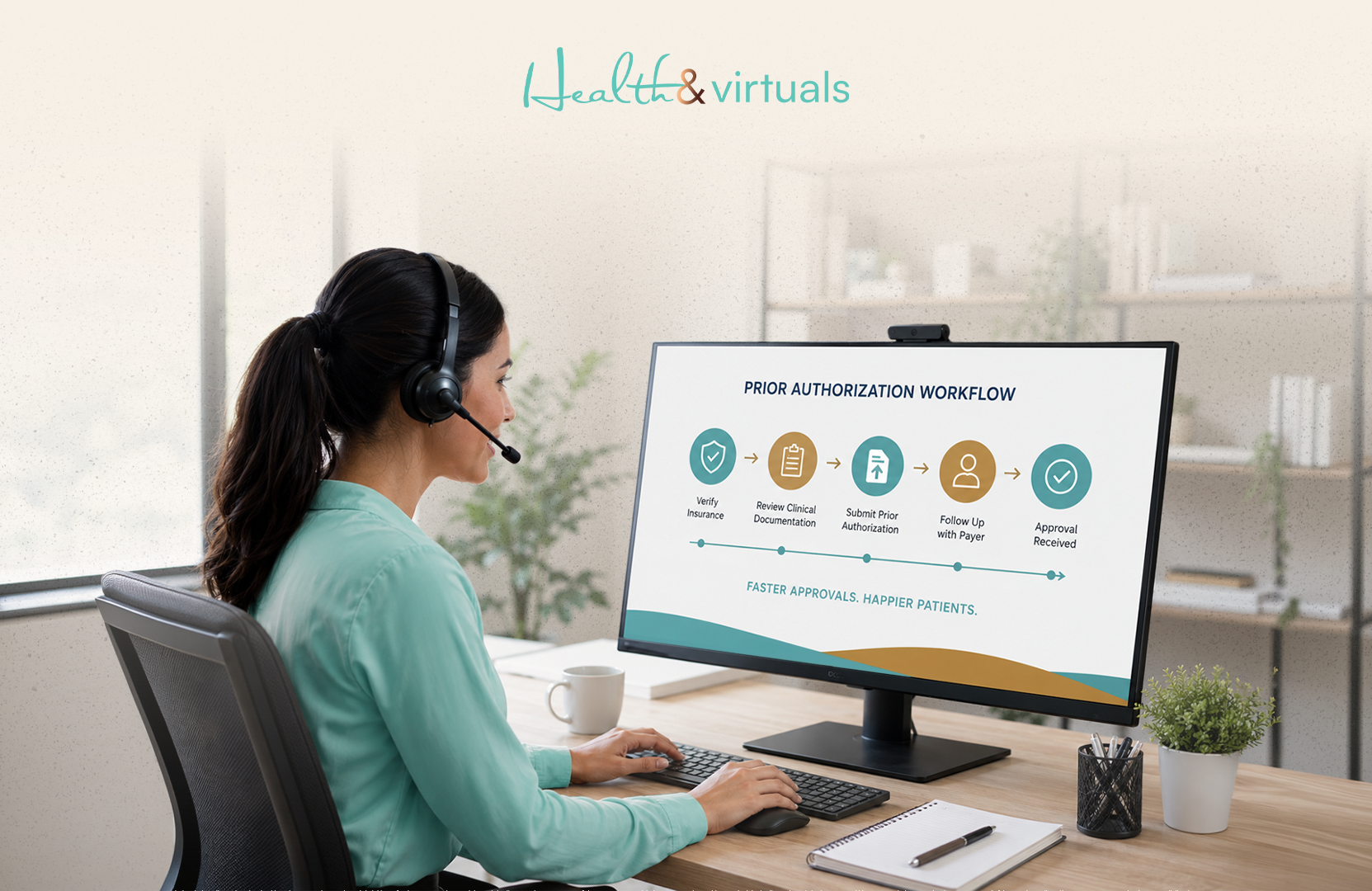
Prior Authorization Workflow: How Virtual Medical Assistants Speed Up Insurance Approvals
A prior authorization workflow is the step-by-step process a medical practice follows to confirm whether an insurance plan will approve a medication, test, procedure, referral, or treatment before it is provided. Virtual Medical Assistants can speed up approvals by collecting documents, checking payer rules, submitting requests, tracking status, following up, and reducing missing-information delays.
Key Takeaways
- Prior authorization delays often happen because of missing documentation, payer-specific rules, or slow follow-up.
- A Virtual Medical Assistant can manage the administrative side of prior authorizations while clinical decisions stay with licensed providers.
- Strong workflows improve approval speed, reduce staff workload, and protect patient experience.
- EMR/EHR accuracy, payer portal tracking, and denial documentation are essential.
- Outsourcing prior authorization support can help busy U.S. practices scale without overloading in-house teams.
What Is a Prior Authorization Workflow?
A prior authorization workflow is the structured process used to request insurance approval before a patient receives certain services, medications, imaging, procedures, durable medical equipment, or specialty care.
For many U.S. healthcare practices, prior authorization is one of the most time-consuming administrative tasks. It often requires insurance verification, payer rule review, clinical documentation, forms, portal submissions, phone calls, fax follow-ups, and appeal tracking.
Health insurers have recently pledged to reduce some prior authorization friction, including more electronic submissions, fewer services requiring authorization, and faster real-time approvals by 2027. Still, practices need strong internal workflows today because payer requirements remain complex and can vary by plan.
That is where a trained Virtual Medical Assistant can make a measurable difference.
Why Prior Authorization Delays Happen
Prior authorization does not usually fail because a practice is careless. It often slows down because the process has too many moving parts.
Common causes include:
| Delay Point | What Usually Happens | Impact on Practice |
|---|---|---|
| Missing clinical notes | Payer requests additional records | Approval timeline resets |
| Wrong payer form | Staff submits an incomplete request | Rework and resubmission |
| No status tracking | Request remains pending | Patient calls increase |
| Poor EMR documentation | Medical necessity is unclear | Higher risk of denial |
| Delayed appeal | Denial is not handled promptly | Treatment delays |
| Staff overload | In-house team cannot follow up daily | Revenue loss and reduced patient experience |
According to reporting on AMA survey findings, many physicians say prior authorization delays access to care and can lead some patients to abandon treatment. For practice managers, this makes prior authorization both an operational problem and a patient-retention issue.
Step-by-Step Prior Authorization Workflow
1. Identify Whether Authorization Is Required
The process starts when a provider orders a medication, procedure, imaging test, referral, or treatment that may require insurance approval.
A Virtual Medical Assistant can help by:
- Reviewing payer rules
- Checking plan-specific requirements
- Confirming CPT, ICD-10, NPI, and patient insurance details
- Flagging cases that need provider input
2. Collect Patient and Insurance Information
Accurate patient information is essential. One wrong member ID, date of birth, or plan name can delay the request.
A VMA can verify:
- Insurance eligibility
- Plan type
- Subscriber details
- Referral requirements
- Deductible or coverage notes when available
- Payer portal access requirements
3. Gather Medical Necessity Documentation
This is one of the most important steps. Payers usually need documentation showing why the requested service is medically necessary.
Documents may include:
- Provider notes
- Diagnosis details
- Previous treatment history
- Failed conservative treatment records
- Lab results or imaging reports
- Medication history
- Referral notes
- Plan-specific medical necessity forms
Recent research on AI-generated prior authorization letters found that even strong clinical content can fail if administrative details such as billing codes, authorization duration, or follow-up plans are missing. This supports the need for a precise administrative workflow.
4. Submit the Prior Authorization Request
Once the documentation is ready, the request may be submitted through:
- Payer portal
- Electronic prior authorization platform
- Fax
- Phone
- Clearinghouse or EHR-integrated system
A Virtual Medical Assistant can prepare and submit the administrative portion, while clinical content and final review remain under the appropriate provider or practice team.
5. Track Status Daily
Submission is not the end of the workflow. Many delays happen because nobody checks the request until the patient calls.
A VMA can track:
- Pending status
- Additional information requests
- Peer-to-peer review notices
- Approval numbers
- Expiration dates
- Denials
- Appeal deadlines
6. Update the EMR/EHR
Once the payer responds, the authorization details should be documented properly.
This may include:
- Authorization number
- Approved service
- Approved units or visits
- Valid date range
- Payer notes
- Denial reason
- Next action required
Clean documentation helps providers, schedulers, billers, and patients stay aligned.
7. Handle Denials and Appeals Support
Not every request is approved the first time. A VMA can help organize denial letters, identify missing documents, prepare appeal packets, and coordinate next steps with the provider.
They should not make clinical decisions, but they can reduce administrative lag by making sure the right information is ready at the right time.
How Virtual Medical Assistants Speed Up Insurance Approvals
A Virtual Medical Assistant improves the prior authorization workflow by creating consistency.
| VMA Task | How It Speeds Up Approval |
|---|---|
| Insurance verification | Prevents wrong-plan submissions |
| Payer checklist review | Reduces missing documentation |
| EMR/EHR document gathering | Helps submit complete requests |
| Portal submission | Saves in-house staff time |
| Daily status checks | Prevents requests from sitting idle |
| Patient communication support | Reduces inbound call pressure |
| Denial packet preparation | Helps practices respond faster |
| Authorization documentation | Improves scheduling and billing handoff |
For busy practices, this is not just about saving minutes. It helps protect provider time, patient satisfaction, and revenue flow.
What Tasks Should Stay With Licensed Providers?
A Virtual Medical Assistant can support the administrative workflow, but some responsibilities should remain with licensed clinicians or authorized practice staff.
| Task | Best Owner |
|---|---|
| Clinical decision-making | Provider |
| Diagnosis and treatment plan | Provider |
| Medical necessity judgment | Provider |
| Peer-to-peer clinical discussion | Provider or licensed clinician |
| Document collection | Virtual Medical Assistant |
| Payer portal tracking | Virtual Medical Assistant |
| Status updates | Virtual Medical Assistant |
| Appeal packet organization | Virtual Medical Assistant + Provider review |
This separation helps maintain compliance and protects care quality.
Why Practices Outsource Prior Authorization Support
Many clinics outsource prior authorization tasks because in-house teams are already managing phones, scheduling, patient intake, billing coordination, reminders, and front-desk demands.
Outsourcing can help practices:
- Reduce staff burnout
- Improve turnaround time
- Lower administrative bottlenecks
- Keep providers focused on patient care
- Improve patient communication
- Create a repeatable approval workflow
- Scale support without hiring full-time onsite staff
If your practice needs trained administrative support, Health & Virtuals provides healthcare-focused virtual support through its Virtual Medical Assistant services.
Best Practices for a Faster Prior Authorization Workflow
Use a standard checklist for every request:
- Confirm insurance eligibility first
- Check payer-specific rules before submission
- Use correct CPT and ICD-10 codes
- Attach complete medical records
- Track every submission date
- Follow up before the deadline
- Document authorization numbers in the EMR
- Keep denial templates and appeal workflows ready
- Train staff on payer portal updates
- Review recurring denial reasons monthly
A strong workflow does not guarantee every approval, but it reduces preventable delays.
FAQ
What is a prior authorization workflow?
A prior authorization workflow is the step-by-step process a practice follows to check requirements, collect documentation, submit requests, track status, and document payer decisions before care is delivered.
Can a Virtual Medical Assistant submit prior authorization requests?
Yes, a trained Virtual Medical Assistant can usually support administrative submission tasks, depending on the practice’s policies, payer rules, and compliance requirements.
Can a Virtual Medical Assistant make clinical decisions?
No. Clinical decisions, diagnosis, treatment planning, medical necessity decisions, and peer-to-peer clinical discussions should stay with licensed providers.
How does prior authorization affect patients?
Prior authorization can delay tests, medications, referrals, or procedures if documentation is incomplete or approval is slow.
What causes most prior authorization delays?
Common causes include missing records, incorrect forms, wrong insurance details, unclear medical necessity, slow follow-up, and payer portal issues.
How can practices reduce prior authorization denials?
Practices can reduce avoidable denials by submitting complete documentation, using payer-specific checklists, tracking deadlines, and reviewing denial patterns.
Is prior authorization the same as insurance verification?
No. Insurance verification confirms coverage and eligibility. Prior authorization asks the payer to approve a specific service before it is provided.
Why should practices outsource prior authorization support?
Outsourcing helps reduce staff workload, improve follow-up consistency, and keep administrative tasks moving without overwhelming in-house teams.