
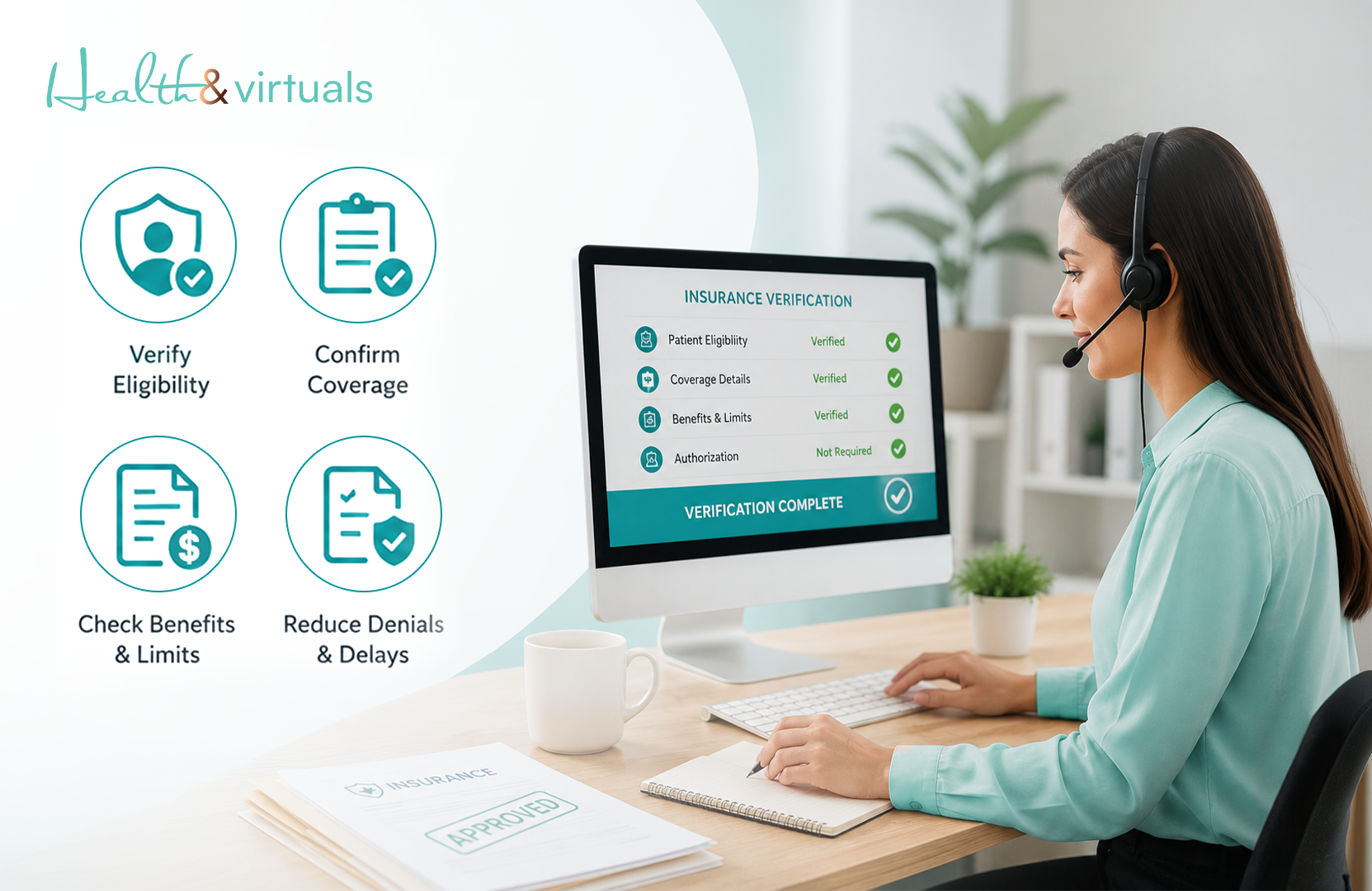
Insurance Verification Process Explained: How Virtual Medical Assistants Prevent Claim Denials
Introduction
The insurance verification process is one of the most important steps in healthcare administration. Before a patient receives care, medical practices must confirm active coverage, benefits, eligibility, deductibles, copays, prior authorization requirements, and payer rules. When this step is rushed or incomplete, clinics face denied claims, delayed reimbursements, frustrated patients, and extra administrative work.
For busy medical, dental, and specialty practices across the USA, insurance verification often becomes a bottleneck. Front desk teams are already handling appointment scheduling, patient calls, intake forms, EMR/EHR updates, and provider support. That is where a trained Virtual Medical Assistant can help.
Health & Virtuals provides healthcare-focused virtual support that helps practices manage insurance verification more accurately, reduce preventable claim issues, and improve the patient experience.
What Is the Insurance Verification Process?
The insurance verification process is the administrative workflow used to confirm whether a patient’s insurance plan is active and whether the planned service is covered before the appointment or procedure.
A complete verification process typically confirms:
- Patient name, date of birth, and policy details
- Active insurance coverage
- Primary and secondary insurance
- Copay, coinsurance, and deductible status
- In-network or out-of-network benefits
- Referral requirements
- Prior authorization requirements
- Coverage limits or exclusions
- Coordination of benefits
- Payer-specific documentation rules
This process supports accurate medical billing, clean claim submission, better revenue cycle management, and clearer patient communication.
Why Insurance Verification Matters for Claim Denial Prevention
Claim denials are often caused by preventable administrative errors. These can include inactive coverage, incorrect patient information, missing authorization, wrong payer details, eligibility mismatch, or services that are not covered under the patient’s plan.
When verification is completed before the visit, your team can identify issues early instead of discovering them after the claim is submitted.
Strong insurance verification helps practices:
- Reduce avoidable denials
- Improve first-pass claim acceptance
- Collect accurate patient responsibility upfront
- Avoid billing surprises for patients
- Save staff time on rework and appeals
- Improve cash flow and reimbursement timelines
- Support a more professional patient experience
For clinics with high patient volume, even small verification errors can create major revenue leakage over time.
Common Insurance Verification Mistakes That Lead to Denials
Many practices have a verification process in place, but denials still happen because the workflow is inconsistent. Common mistakes include:
1. Verifying Only Basic Eligibility
Basic eligibility does not always mean the service is covered. A plan may be active but still require authorization, referral, or specific documentation.
2. Checking Coverage Too Early
Insurance details can change quickly. If verification is done too far before the appointment and not rechecked, the practice may miss terminated coverage or plan changes.
3. Missing Prior Authorization Requirements
Some services, procedures, imaging, medications, dental treatments, behavioral health services, and specialty visits require prior authorization. Missing this step can result in denial even when the patient has active coverage.
4. Incorrect Patient or Policy Information
A misspelled name, wrong date of birth, outdated insurance card, or incorrect member ID can delay or deny claims.
5. Poor Documentation in EMR/EHR
If verification notes are not properly entered into the EMR/EHR, billing teams may not have the information they need when submitting claims.
How Virtual Medical Assistants Support the Insurance Verification Process
A trained Virtual Medical Assistant can handle repetitive, time-consuming verification tasks while your in-office team focuses on patients and providers.
Virtual Medical Assistants can support:
- Patient insurance data collection
- Eligibility and benefits verification
- Payer portal checks
- Phone verification with insurance representatives
- Copay, deductible, and coinsurance confirmation
- Prior authorization coordination
- EMR/EHR documentation
- Patient communication about insurance updates
- Appointment flagging for unresolved coverage issues
- Follow-up with patients for missing information
This gives your practice a more organized, proactive workflow.
Insurance Verification Process Checklist
| Step | What to Verify | Why It Matters |
| Patient Information | Name, DOB, address, phone, insurance ID | Prevents demographic and claim matching errors |
| Coverage Status | Active or inactive plan | Confirms whether the patient is covered |
| Benefits | Covered services, visit limits, exclusions | Reduces service-related denials |
| Patient Responsibility | Copay, deductible, coinsurance | Helps collect accurate payments upfront |
| Network Status | In-network or out-of-network | Prevents unexpected patient billing issues |
| Prior Authorization | Required or not required | Avoids authorization-related denials |
| Referral Needs | PCP or specialist referral | Important for certain plans and specialties |
| EMR/EHR Notes | Verification date, payer details, reference number | Supports billing and claim follow-up |
Practical Example: Before and After Virtual Medical Assistant Support
Before
A clinic’s front desk verifies insurance only when patients arrive. Some patients have inactive coverage, some need prior authorization, and some have outdated insurance cards. Claims are delayed, billing staff spend hours fixing errors, and patients are frustrated by unexpected bills.
After
A Virtual Medical Assistant reviews the next week’s schedule, verifies benefits in advance, checks payer portals, flags authorization needs, updates the EMR/EHR, and contacts patients for missing information. The clinic has fewer last-minute surprises, cleaner claims, and a smoother patient experience.
Where Insurance Verification Fits in the Patient Journey
Insurance verification should not be treated as a billing-only task. It affects the entire patient journey.
It connects with:
- Appointment scheduling
- Patient intake
- Eligibility checks
- Prior authorization
- Provider documentation
- Billing and claims
- Patient payment collection
- Follow-up care coordination
When this process is managed well, patients feel more informed and practices operate more efficiently.
Insurance Verification Process for Medical and Dental Practices
Medical and dental practices both benefit from accurate insurance verification, but their workflows may differ.
Medical practices often need to confirm eligibility, specialist visit coverage, diagnostic testing, medication-related authorization, and procedure benefits.
Dental practices may need to verify annual maximums, waiting periods, frequency limitations, coverage percentages, deductibles, missing tooth clauses, and treatment-specific benefits.
A Virtual Medical Assistant or Virtual Dental Assistant can help organize these details before the appointment so the provider and billing team are not left guessing.
Why Outsourcing Insurance Verification Can Save Time and Money
Outsourcing administrative support does not mean losing control. It means giving your team more capacity.
When insurance verification is delegated to trained virtual support, practices can reduce:
- Staff burnout
- Front desk overload
- Missed calls
- Delayed eligibility checks
- Claim rework
- Patient billing confusion
- Unnecessary administrative costs
Instead of hiring additional in-house staff for every administrative need, clinics can use virtual healthcare staffing to scale support more efficiently.
Why Choose Health & Virtuals?
Health & Virtuals provides healthcare-focused virtual staffing support for practices across the USA. Our team understands the daily administrative pressure medical and dental practices face, from patient communication to scheduling, insurance verification, EMR/EHR support, and practice coordination.
With Health & Virtuals, your practice can get support from trained virtual professionals who are familiar with healthcare workflows and patient-facing communication.
Our Virtual Medical Assistant support can help your practice:
- Improve administrative efficiency
- Reduce repetitive workload
- Support insurance verification workflows
- Improve appointment preparation
- Strengthen patient communication
- Help providers and staff stay focused on care
- Support HIPAA-conscious administrative processes
FAQs
1. What is the insurance verification process in healthcare?
The insurance verification process is the workflow used to confirm a patient’s active coverage, benefits, eligibility, copay, deductible, coinsurance, network status, and authorization requirements before care is provided.
2. Why is the insurance verification process important?
The insurance verification process helps reduce claim denials, billing delays, patient confusion, and administrative rework. It also helps practices collect accurate patient responsibility upfront.
3. Can a Virtual Medical Assistant handle insurance verification?
Yes. A trained Virtual Medical Assistant can help verify eligibility, check benefits, document payer information in the EMR/EHR, contact insurance companies, and communicate missing information to patients.
4. How does insurance verification prevent claim denials?
Insurance verification prevents denials by identifying inactive coverage, missing authorization, incorrect patient details, uncovered services, and payer-specific requirements before the claim is submitted.
5. Is insurance verification useful for dental practices too?
Yes. Dental practices can use insurance verification to confirm coverage percentages, annual maximums, deductibles, waiting periods, treatment limitations, and patient responsibility before treatment.
Conclusion
The insurance verification process is more than an administrative task. It is a critical part of claim denial prevention, patient communication, revenue cycle management, and practice efficiency.
When verification is done accurately and consistently, practices can reduce avoidable denials, improve reimbursement timelines, and give patients a clearer understanding of their coverage.
Health & Virtuals helps medical and dental practices across the USA strengthen administrative workflows with trained virtual support. If your team needs help managing insurance verification, scheduling, patient communication, or EMR/EHR updates, a Virtual Medical Assistant can make your practice more efficient and prepared.