
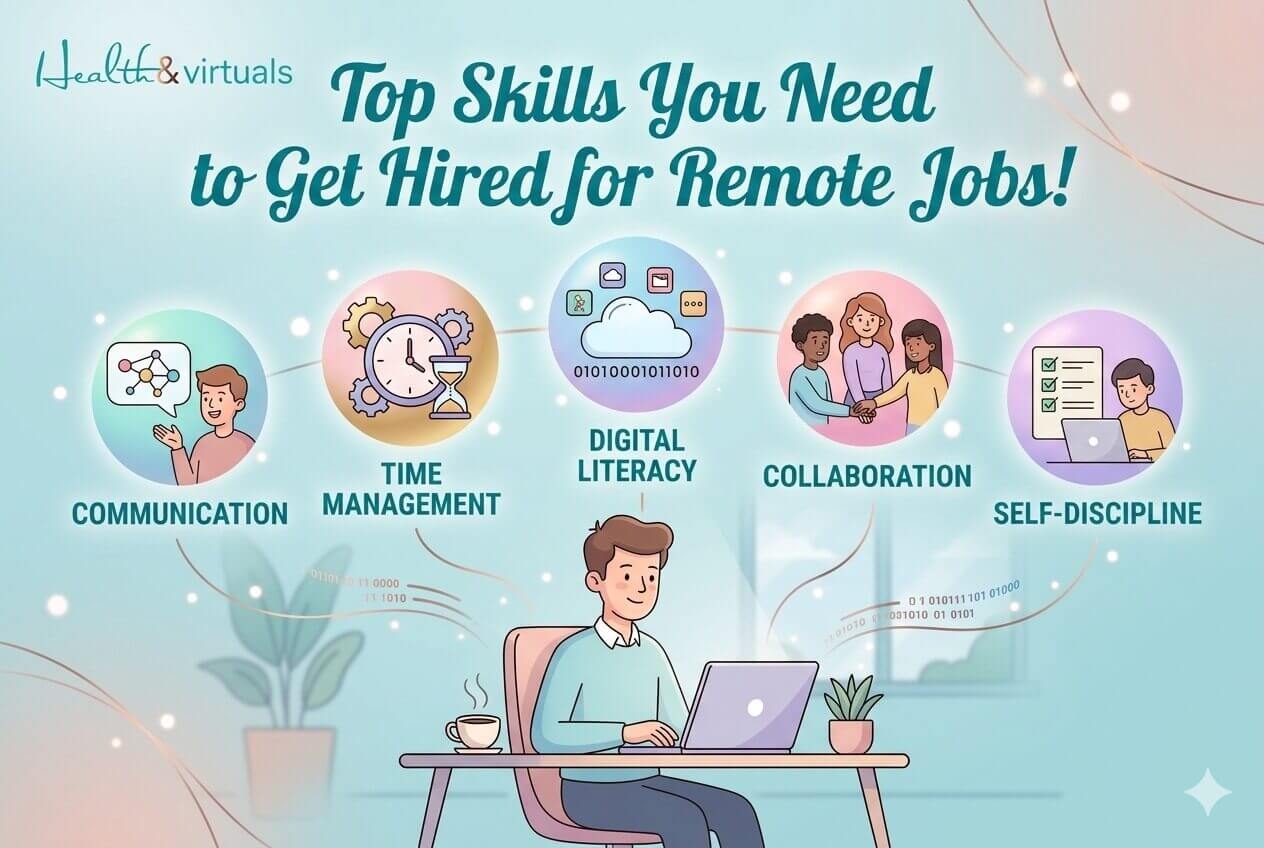
Remote work has shifted from a temporary trend to a permanent part of how companies hire and operate…. Today, employers are no longer just looking for any remote candidate who can do the job – they are looking for professionals … who have the right skills to work effectively in a remote environment.
Do you know that over 424,000 remote roles were posted all over the world in 2025 alone? It is the biggest year of remote opportunities that we have ever had. Meanwhile, the pace of demand keeps rising, as more than 20 percent of remote job postings are on the rise in 2026.
But, there is a downside to the opportunity: competition is growing. Remote jobs give the opportunity to attract talent all over the world, and employers are no longer restricted to local talent pools. Moreover, approximately 65 percent of remote jobs today focus on seasoned professionals, indicating that there is now an evident shift to skill-based employment.
You need some skills to get hired… from communication and time management to digital collaboration tools, these abilities now determine who gets hired and who gets overlooked.
Why Are Remote Job Skills So Important Today?
 A remote workplace does not work the same way as traditional office setups. Companies place a lot of faith in output and communication without physical control. This change has changed the appearance of valuable job skills.
Remote work has more workforce trends. The experts state that nowadays, almost 79 out of 100 workers who can work remotely do it at least in part (it was less than 6 percent before 2020). This radical transformation has put companies back into the process of reconsidering productivity, cooperation, and performance measurements.
Business-wise, remote workers will cut overhead and widen access to talent around the world. Yet it also brings with it risks, such as miscommunication, time-zone delays & accountability. That is why employers give priority to applicants who are skilled, and who are able to show independence, digital savvy & reliability.
Concisely, now good skills for a job remotely are not a nice-to-have anymore. They are business skills that have a direct influence on business results.
What Are The Essential Remote Work Skills You Must Have?

Remote recruitment is moving towards skill-based hiring & the most successful performers exhibit a combination of technical and behavioral job skills list.
→ Skills in Communication (Async + Sync)
Remote work is based on effective communication. You cannot afford fast and brief desk talks, as in the office. On the contrary, you will have to express yourself using written notices, video conferences, and collaborative technologies.
Employers are interested in candidates who can easily communicate concisely without having to clarify all the time and across time zones.
→ Self-Management: Staying Productive Without Supervision
Remote jobs require a lot of discipline. In the absence of supervision, your time and task prioritization and deadline achievement capability become critical. It is especially significant because the work of many companies has become distributed teams in different regions.
→ Technical Literacy for Remote Work Efficiency
Tools are major in remote work: project management software, communication applications, and cloud-based solutions are all important. Knowledge of such tools as Slack, Notion, Trello, or CRM systems is popular and is required.
→ Adaptability and Problem-Solving
Remote environments are changing rapidly. It can be new tools, changing priorities, or cross-functional cooperation, which requires flexibility. Employers prefer those who can be able to solve problems on their own without being directed.
→ Cooperation Over Time Zone
Remote working in many cases implies global work. The ability to work asynchronously and across time zones is an important remote job skill that can be overlooked by many candidates.
→ Results-Oriented Mindset
In remote environments, output is used as a measure of performance and not time spent working. Busy people are not sought after by companies because they are looking to hire people who are oriented to the achievement of measurable outcomes.
How Can You Improve Your Remote Work Skills?
 It takes deliberate effort to develop remote-ready job skills.
This list of job skills may not necessarily be learned formally as they are developed through experiences and exposure, unlike in traditional roles.
1. Stimulation
Start by simulating a remote work environment. Real life experience can be gained through freelancing websites or internships or remote jobs that are part time. The familiarity with remote workflow can be achieved even by doing personal projects with the aid of digital tools.
2. Learning
Another viable alternative is online learning. Communication, productivity & digital tools courses can help greatly enhance your preparedness. But simply learning will not suffice–it has to be applied.
3. Feedback
Feedback is also essential. Be it that you are working on a team project, or as a freelancer, actively solicit feedback on your communication, responsiveness and quality of output.
The insights can be used to narrow down to specific skills in an online job that employers consider throughout hiring.
4. Consistency
Finally, your consistency. It matters! Telecommuting favors those who can be productive without being forced to do so. Routine creation and systems creation: the creation of routines and systems such as daily planning, tracking of tasks, and regular check-ins, can greatly enhance performance over time.
What Employers Look for in Remote Candidates?

Hiring managers treat remote candidates in a different manner as compared to conventional applicants. They also analyze behavioral signals that reveal remote readiness in addition to the technical qualifications.
- Experience level: One of them is the level of experience. As has been mentioned above, most of the remote jobs target professionals in the middle-career segment. This portrays a favor towards those who do not need much supervision.
- Reliability and trustworthiness: Reliability and trustworthiness are also a priority for employers. Because remote staff work on their own, businesses must be assured that business activities will be accomplished without having to watch over their shoulders.
- Communication: Clarity of communication is another important aspect. Applicants who exhibit organized thoughts and articulate expression, particularly in written expression, are instantly singled out.
- Global skills: Also, the companies appreciate global collaboration skills. Remote staff is usually set up at a distance, and the possibility to operate internationally and in various time zones is one of the substantial advantages.
- Tech-savvy: Lastly, the focus on tech-enabled productivity is increasing. Employers do not only want applicants to be users of tools, but also to be efficient and effective users in order to enhance efficiency and teamwork.
What are the Best Ways to Display Remote Skills on Your Resume?

Being equipped with the appropriate top skills is one thing, but you must be able to demonstrate them.
→ Start by highlighting remote-specific experience. If you have worked remotely previously. Be able to include information like tools, communication methodology, and quantifiable results.
→ Rather than enumerating generic skills, emphasize impact. As an example, instead of stating that you had good communication skills, explain how you handled cross-time-zone cooperation or spearheaded distance projects and made them work.
→ Apply measures wherever feasible. Employers are next to respond to data-driven successes, be it the enhanced productivity, decreased turnaround time, or successful project delivery.
→ It is also necessary to re-tune to applicant tracking systems (ATS). Most organizations have automated processes that they use to sieve through the candidates, hence tuning your resume according to job-related keywords is quite important.
→ Lastly, with most of these remote jobs- particularly in technology, marketing or design- it may be more effective to show your portfolio, rather than what you have done.
Bottom Line
The remote work is no longer a niche possibility, but a competitive market around the world. The opportunity is evident with hundreds of thousands of jobs open and more positions on the rise. But so is the challenge.
In this space, qualifications are not enough. It involves a conscious effort to cultivate and showcase the competencies most desired by the remote employers, namely: communication, accountability, flexibility & performance-oriented results.
The next thing that you need to do is start developing your remote job skills for a resume, acquire some practical experience, and place yourself in a strategic position in the job market.
Looking For Remote Jobs?

Health & Virtuals supports remote professionals like you to prepare and get high-quality remote jobs by developing skills, providing career counseling, and accessing global jobs.
We also offer a digital training school designed to polish your talent with top skills and make you job-ready for today’s competitive remote market.
Get hired with us and speed up your remote career with the right guidance, training, and opportunities from a trusted organization in the US…