
16Apr

How to Choose the Right Virtual Assistant for Your Business?

Modern businesses are no longer limited by geography. Nor do the office walls or traditional staffing models stop them anymore… Businesses worldwide are rapidly shifting. Opting toward flexible and remote workforce models. With studies showing that over 70% of companies now rely on remote professionals in some capacity. 

While a 2025 analysis by Upwork shares that 37% of companies are already fully remote. Adding to it, in the next 5 years, 28% more expect to be fully remote. 

So, following the trend, the global demand for a virtual assistant (VA) continues to grow. As organizations seek cost-effective ways to manage their operations. To reduce overhead expenses and access specialized talent without geographical limitations. 

Well, for many startups and growing companies, leveraging an online virtual assistant has become a strategic move. It is to stay competitive in an increasingly digital economy.

However, hiring a virtual assistant is not simply about delegating tasks.. It’s about choosing the right professional. The one suits best and aligns with your workflows, your communication style, and long-term business objectives. 

Learn how to choose the right virtual assistant for your business…


What Is a Virtual Assistant?

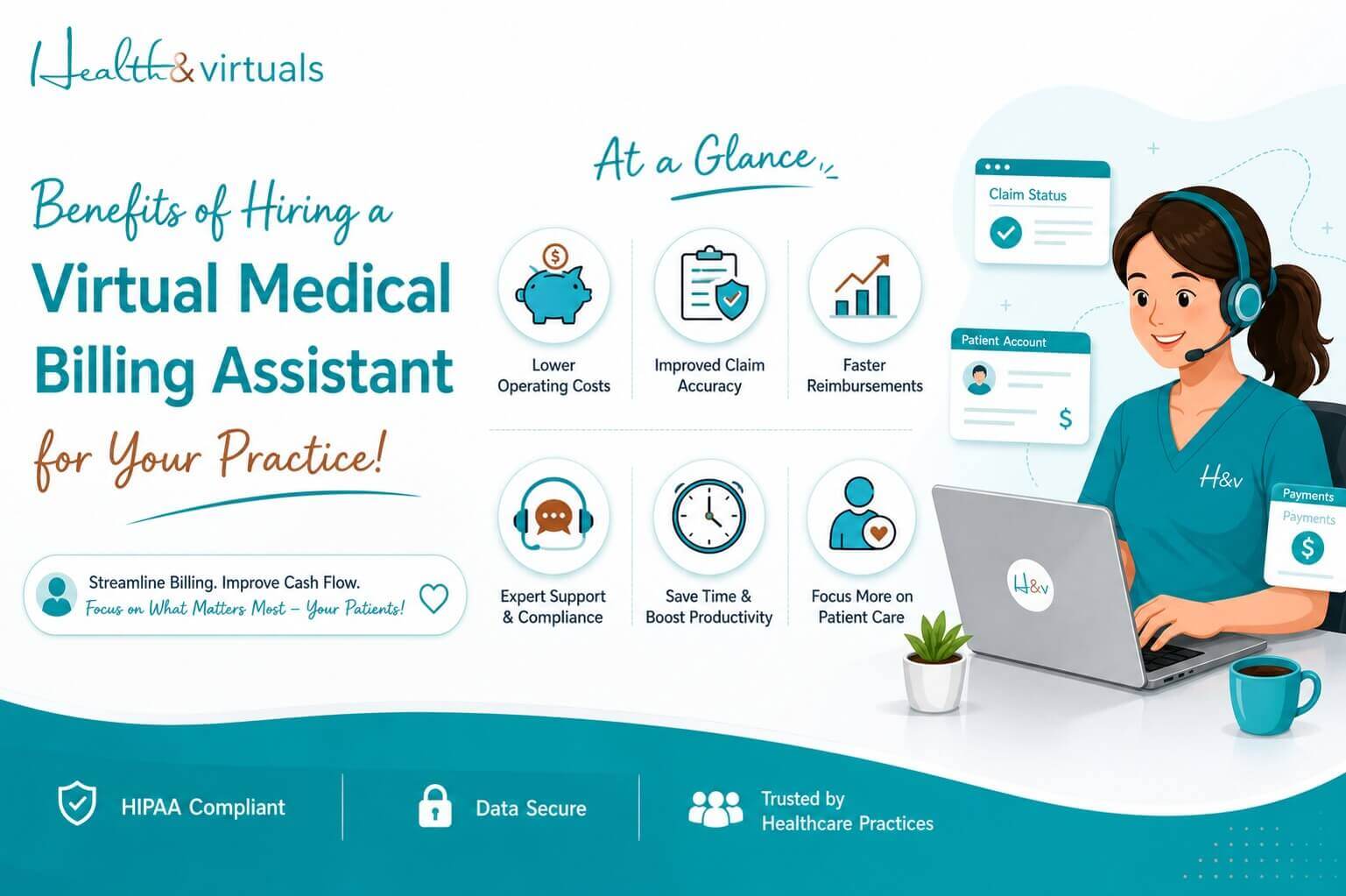
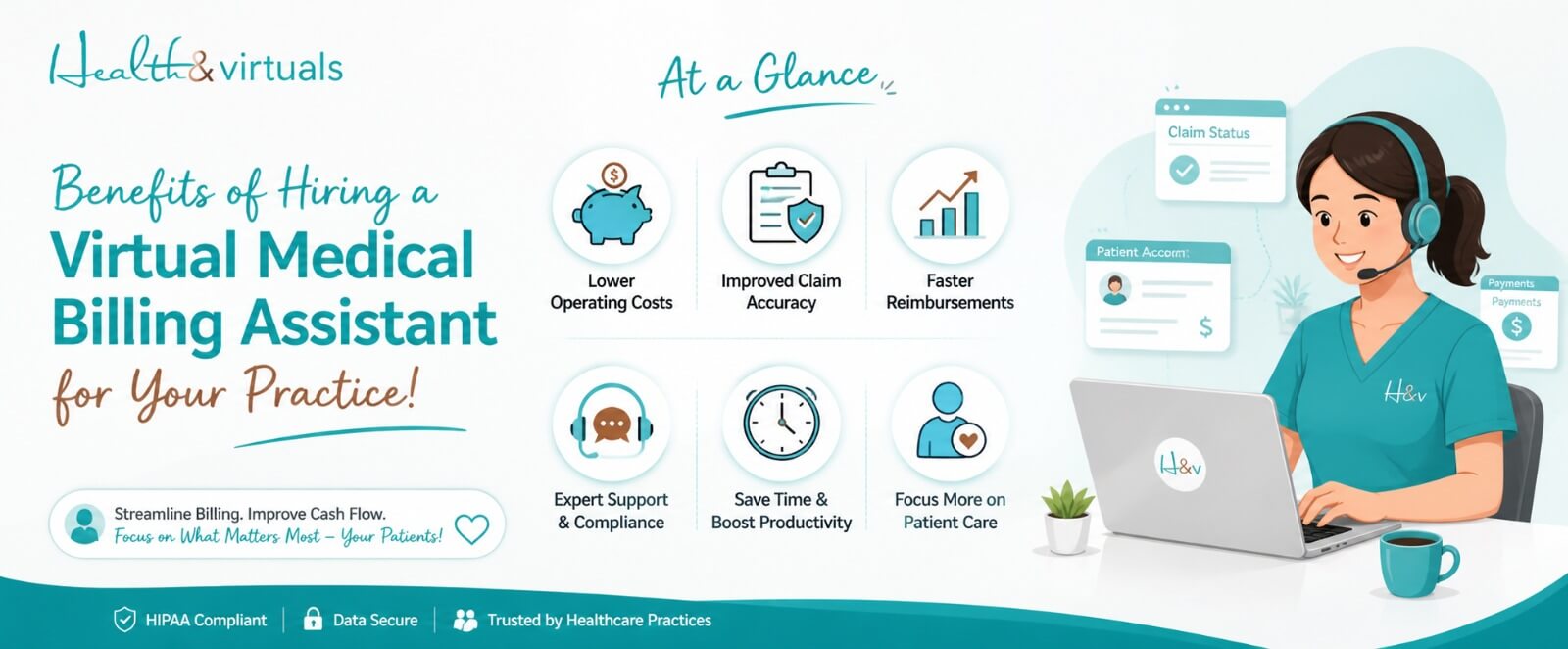
illustration Healthcare team benefiting from virtual billing assistant with improved revenue and reduced workload

A virtual assistant, or simply called a VA, is a remote professional. These remote professionals provide administrative, technical, or creative support to all types and sizes of businesses. 

They are unlike in-house employees; an online virtual assistant works remotely, not in your office space. They are often hired through a virtual assistant agency or as freelancers.

Virtual assistants can handle a wide range of business-critical tasks. Across multiple functions, including:

1. Administrative Support

  • Email management and inbox organization.
  • Calendar scheduling and appointment setting.
  • Data entry and database management.
  • Document preparation and file organization.

2. Specialized Industry Support

3. Customer Support

  • Responding to customer inquiries via email, chat, or phone.
  • Handling complaints and support tickets.
  • Managing CRM systems and customer records.

4. Social Media Management

  • Content scheduling and posting.
  • Audience engagement and message responses.
  • Analytics tracking and performance reporting.

5. Content Creation and SEO

  • Blog writing and article creation.
  • Website content updates.
  • Keyword research and on-page SEO optimization.

6. HR, Finance & Bookkeeping

This versatility makes them a valuable asset for businesses. Virtual assistants (VA) are proven to be helpful for firms, looking to cut costs, streamline operations & improve efficiency.


Why Hiring the Right Virtual Assistant Matters?

Digital hospitality management system improves guest service efficiency and profit your hotel business.

Choosing & hiring the right virtual assistant for your business is critical. 

Why? Because they become an extension of your operations.

A skilled VA can:

  • Improve efficiency and workflow.
  • Reduce operational costs.
  • Increase scalability.
  • Allow you to focus on core business functions.
Business Area Impact of the Right Virtual Assistant Risk of the Wrong Hire
Operational Efficiency Streamlines workflows and reduces bottlenecks Creates confusion and slows processes
Cost Management Reduces overhead and avoids rework costs Leads to wasted budget and repeated hiring
Productivity Frees up time for core business activities Increases workload due to errors and follow-ups
Revenue Growth Allows focus on sales and strategy Distracts from revenue-generating tasks
Scalability Enables flexible and fast business growth Limits growth due to inefficiencies
Communication Ensures clear, timely coordination Causes delays and misunderstandings
Quality Control Maintains consistent and accurate output Results in poor-quality work and client dissatisfaction

Step-by-Step Guide to Choosing the Right Virtual Assistant!

Virtual medical assistant using a laptop to schedule appointments and verify insurance remotely.

1. Identify Your Business Needs

You know your business, so start hiring the right VA by listing the tasks. Evaluate what tasks from your business you want to outsource. 

What are those? Are they repetitive administrative tasks or specialized roles like marketing or billing?

Clear goals help you find a VA with the right virtual assistant skills.

2. Define Your Budget

Costs vary. Depending on your experience, specialization, and location. 

Decide whether you need:

  • Entry-level support (lower cost).
  • Mid-level expertise.
  • Highly specialized professionals.

This will help you choose between freelancers and a virtual assistant staffing agency.

3. Choose the Right Type of Virtual Assistant

Selecting the right type of virtual assistant (VA) is essential. For achieving efficiency, accuracy, and real business impact.

Instead of hiring a generalist, align the VA’s role with your industry needs and operational priorities.

→ Hire a Virtual Executive Assistant (Core Business Support)Remote medical billing assistant using cloud-based software for claims processing and coding

A virtual executive assistant helps to manage routine operations and keep your business organized. Including:

  • Email and calendar management.
  • Data entry and record maintenance.
  • Document preparation and reporting.
  • Appointment scheduling and coordination.

→ Hire A Virtual Sales Development RepresentativeChiropractic patient receiving follow-up reminder call from virtual assistant

 A remote SDR is best for handling ongoing client or patient communication.

  • Responding to inquiries via email or chat.
  • Managing support tickets.
  • Handling follow-ups and confirmations.
  • Maintaining CRM records.

→ Hire a Medical Virtual AssistantNurse using laptop and headset for remote patient monitoring and EHR access

An MVA or a physician assistant providing specialized medical practice support is ideal for clinics, hospitals, and healthcare providers needing operational support.

  • Patient scheduling and appointment coordination.
  • Medical records management (EHR/EMR systems).
  • Insurance verification.
  • Patient communication and follow-ups.

→ Hire a Medical Billing Virtual Assistant

Virtual scribe, virtual medical scheduler & remote billing coordinator can be hired for accurate and efficient revenue cycle management.

They can handle your:

  • Fast medical billing process with virtual assistant handling claims submission and follow-upsMedical coding (ICD-10, CPT, HCPCS) for accurate billing and documentation.
  • Medical billing and insurance claim preparation.
  • Submission, tracking, and follow-up of insurance claims.
  • Payment posting and account reconciliation.
  • Management of denied or rejected claims with proper resubmission.
  • Scheduling and managing patient appointments and physician calendars.
  • Handling patient communication, reminders, and follow-ups.
  • Updating and maintaining Electronic Health Records (EHR/EMR systems).
  • Real-time or post-visit clinical documentation support (virtual scribing).
  • Ensuring compliance with healthcare and insurance regulations.

→ Hire a Virtual Nurse Assistant (Clinical Support Role)virtual assistant nurse helping patient queries online

Hiring a Virtual Nurse Assistant is best suited for healthcare organizations needing clinical-level assistance remotely.

  • Patient triage support (non-diagnostic).
  • Care coordination and follow-ups.
  • Remote patient monitoring assistance.
  • Documentation support for healthcare providers.

→ Hire a Legal Virtual AssistantLegal documents and contracts being prepared by virtual legal assistant services

Remote legal support is essential for law firms and legal professionals if they require structured support for:

  • Legal document drafting and formatting.
  • Case research and file organization.
  • Scheduling client meetings.
  • Managing legal documentation and compliance records.

→ Hire an HR & Payroll Virtual Assistant

Remote HR Assistants: Scale Smarter with the Right HR Recruitment Agency

Your Hr assistant remote can be useful for maintaining financial accuracy and tracking.

  • Invoice generation and payment tracking.
  • Expense management.
  • Payroll & HR data entry and reporting.
  • Account reconciliation support.

→ Hire a Technical Virtual Assistantvirtual medical assistant attending meeting

Best for handling systems, tools, and backend processes.

Including:

  • Website maintenance and updates.
  • CRM setup and management.
  • Workflow automation.
  • Software troubleshooting.

→ Hire a Hospitality Virtual Assistant

Professional virtual legal assistant handling legal documents and client communication using a laptop remotely.Your virtual hospitality assistant is Ideal for hotels, travel agencies, and service-based businesses. They can help with:

  • Booking and reservation management.
  • Guest communication and confirmations.
  • Itinerary planning and coordination.
  • Handling customer queries and service requests.

When hiring a virtual assistant, focus on role-specific expertise… rather than general skills.

A specialized virtual assistant for business, especially in healthcare, legal, or hospitality… ensures higher accuracy, compliance, and operational efficiency.

4. Look for Relevant Skills and Experience

Evaluate candidates based on:

  • Previous work experience.
  • Industry knowledge.
  • Portfolio or case studies.

A qualified remote virtual assistant should align with your business niche.


5. Assess Communication Skills

Strong communication is essential when working remotely. If you want to hire a Virtual assistant for your business, look for:

  • Clear written communication.
  • Prompt responses.
  • Ability to understand instructions.

Miscommunication can quickly lead to errors and delays.

6. Check Tools and Technical Knowledge

Your VA should be familiar with tools such as:

  • Project management tools (Trello, Asana).
  • Communication platforms (Slack, Zoom).
  • CRM systems.
  • Microsoft Office or Google Workspace.

Why? Because technical proficiency is a key part of modern virtual assistant skills.

7. Conduct Interviews and Test Tasks

Don’t rely solely on resumes. You should:

  • Conduct structured interviews.
  • Assign a small paid/unpaid test task.

This helps you evaluate real-world performance.

Or look for the best candidate from a virtual assistant staffing agency or remote talent staffing agency, such as Health & Virtuals, as they provide pre-vetted, qualified, trained, and fit-to-perform candidates for your business. 

8. Start with a Trial Period

If hiring yourself, before a long-term commitment, test the collaboration with a short trial. This reduces risk and ensures compatibility.

9. Recognise Your Own Delegation Challenges

Many business owners struggle to delegate effectively.

  • Be clear with instructions.
  • Set expectations.
  • Provide feedback.

Your success with a virtual assistant for business depends on how well you manage the relationship.


Key Qualities of a Great Virtual Assistant

A high-performing online virtual assistant is not just task-oriented. But brings a combination of technical, behavioral, and business skills. Those skills directly impact productivity, efficiency, and reliability.

They should have:

→ Strong Organizational Skills

  • Ability to manage multiple tasks, deadlines, and priorities efficiently.
  • Systematic handling of emails, files, schedules, and workflows.
  • Keeps business operations structured and well-documented.
  • Ensures nothing falls through the cracks in daily operations.

→ Reliability and Accountability

  • Consistently delivers work on time. NO constant follow-ups.
  • Takes ownership of assigned tasks and outcomes.
  • Maintains professionalism. In meeting deadlines and expectations.
  • Builds trust through consistent performance.

→ Proactive Problem-Solving Ability

  • Identifies issues before they escalate into major problems.
  • Suggests better workflows or process improvements.
  • Handles unexpected tasks with minimal supervision.
  • Thinks independently. Instead of waiting for instructions.

→ Adaptability and Flexibility

  • Quickly learns new tools. Systems and business processes.
  • Adjusts to changing priorities and workloads.
  • Comfortable working across different industries or roles.
  • Adapts communication style based on client needs.

→ Advanced Time Management Skills

  • Prioritizes tasks based on urgency and importance.
  • Manages multiple clients or projects efficiently.
  • Avoids delays through structured planning.
  • Ensures consistent productivity throughout working hours.

→ High Attention to Detail

  • Ensures accuracy.In data entry, documentation, and reporting.
  • Spot errors in communication, billing, or scheduling.
  • Maintains high-quality standards in all deliverables.
  • Reduces costly mistakes in business operations/

→ Strong Communication Skills

  • Clear and professional written communication (emails, reports, messages).
  • Ability to understand instructions accurately.
  • Provides timely updates and progress reports.
  • Maintains smooth coordination with teams and clients.

→ Technical Proficiency

  • Familiarity with tools like CRMs, project management software, and cloud systems..
  • Ability to learn new platforms quickly.
  • Comfortable handling digital workflows and automation tools.
  • Basic troubleshooting skills for common technical issues.

Common Mistakes to Avoid While Hiring Virtual Assistants!

Avoid these pitfalls when hiring a virtual assistant:

  • Not defining tasks clearly.
  • Choosing based solely on low cost.
  • Skipping the interview process.
  • Ignoring communication skills.
  • Not using contracts or agreements.
  • Failing to provide onboarding or training.

These mistakes can lead to poor performance and frustration…


How Much Does a Virtual Assistant Cost?

The cost of a virtual assistant (VA) depends on several factors:

→ Experience Level

  • Beginner: $5–$10/hour
  • Intermediate: $10–$25/hour
  • Expert: $25–$60+/hour

→ Type of Work

Specialized services (e.g., medical billing, legal support) cost more.

→ Hiring Model

  • Freelancers (flexible, cost-effective)
  • Virtual assistant agency (more structured, higher cost, but reliable)

Hiring with a virtual assistant staffing agency is a better option as they provide vetted professionals, reducing hiring risks.


Benefits of Hiring a Virtual Assistant

The following are some of the benefits of hiring a VA for your business:

→ Significant cost savings. Businesses can reduce operational costs by up to 60 to 80%.. When compared to hiring full-time in-house staff. It is done mainly by eliminating office space, benefits, and overhead expenses.

→ Higher productivity levels. Companies using virtual assistants report an average 13–28% increase in overall productivity. Especially in administrative and repetitive tasks.

→ Time savings for business owners. Entrepreneurs save around 15+ hours per week. All by delegating tasks such as email management, scheduling, and data entry.

→ Improved business efficiency. Organizations report up to 35% improvement in workflow efficiency. It when virtual assistants manage routine operations and support systems.

→ Faster task completion. VA-supported teams complete tasks significantly faster. With studies showing up to 1.5x–2x faster turnaround. When compared to traditional in-house admin teams.

→ Better focus on core business growth. By outsourcing repetitive work, business owners can focus on strategy. Focused client acquisition and revenue-generating activities directly improve business growth potential.

→ Access to a global talent pool. Hiring a remote virtual assistant allows businesses to access skilled professionals worldwide. This without geographic limitations. Improving hiring quality and flexibility.

→ Scalability and flexibility. Businesses can easily scale support up or down with VAs. Based on workload without long-term employment commitments. Making it ideal for startups and growing companies.

→ Higher client satisfaction. They offer faster responses, organized systems, and consistent communication. Improve customer experience and retention rates.

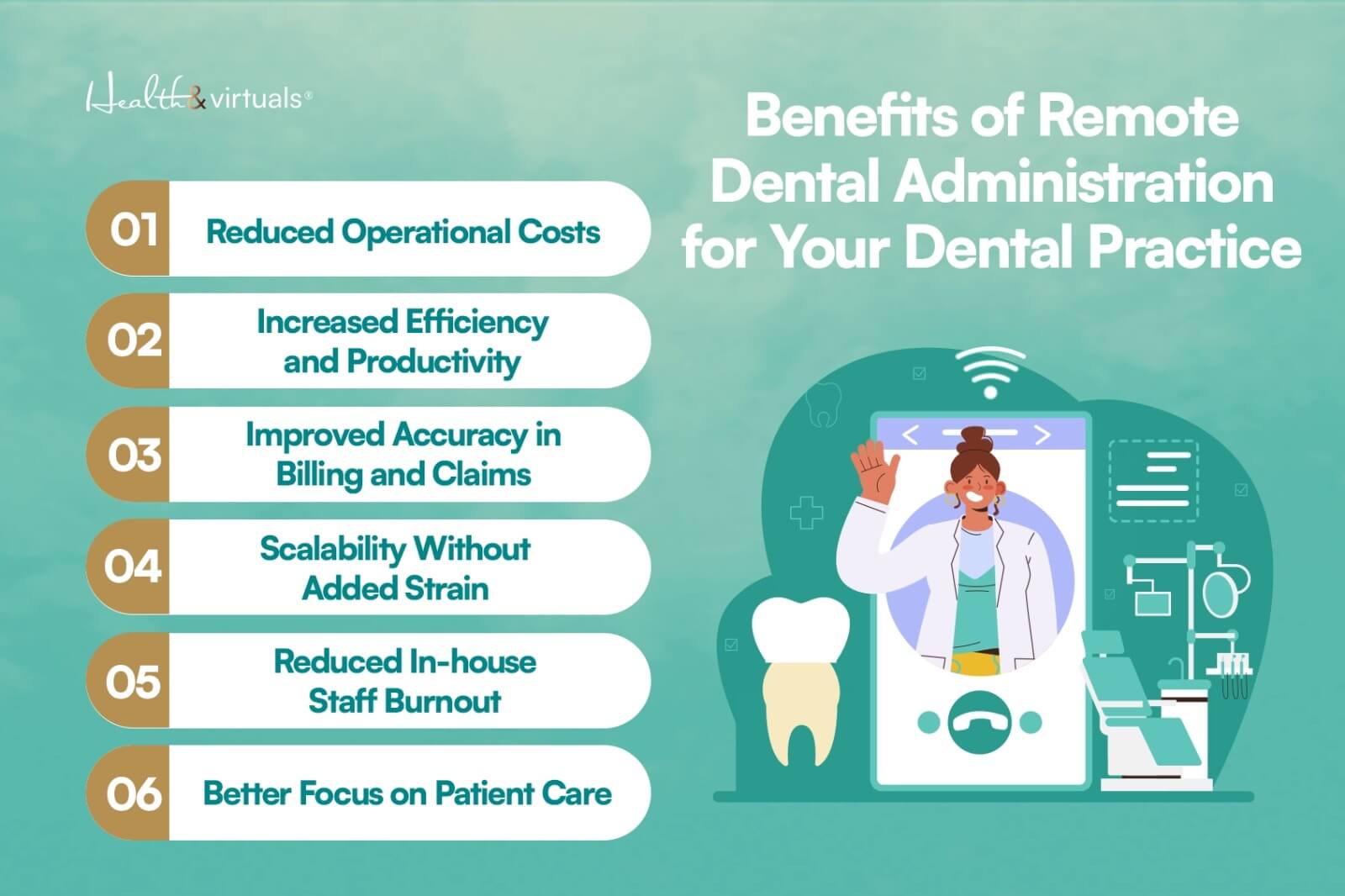
→ Reduced employee burnout. Delegating workload to a virtual assistant for business reduces pressure on core teams, improving morale and long-term productivity.


Hire the Best Virtual Assistants with Health & Virtuals!

Virtual staffing for business growth i, lady working from different time xone

If you want reliability and quality, partnering with a trusted virtual assistant agency like Health & Virtuals can make a significant difference.

They specialize in matching businesses with skilled professionals tailored to specific industries and business needs.


What Types of Virtual Assistants Does Health & Virtuals Provide?

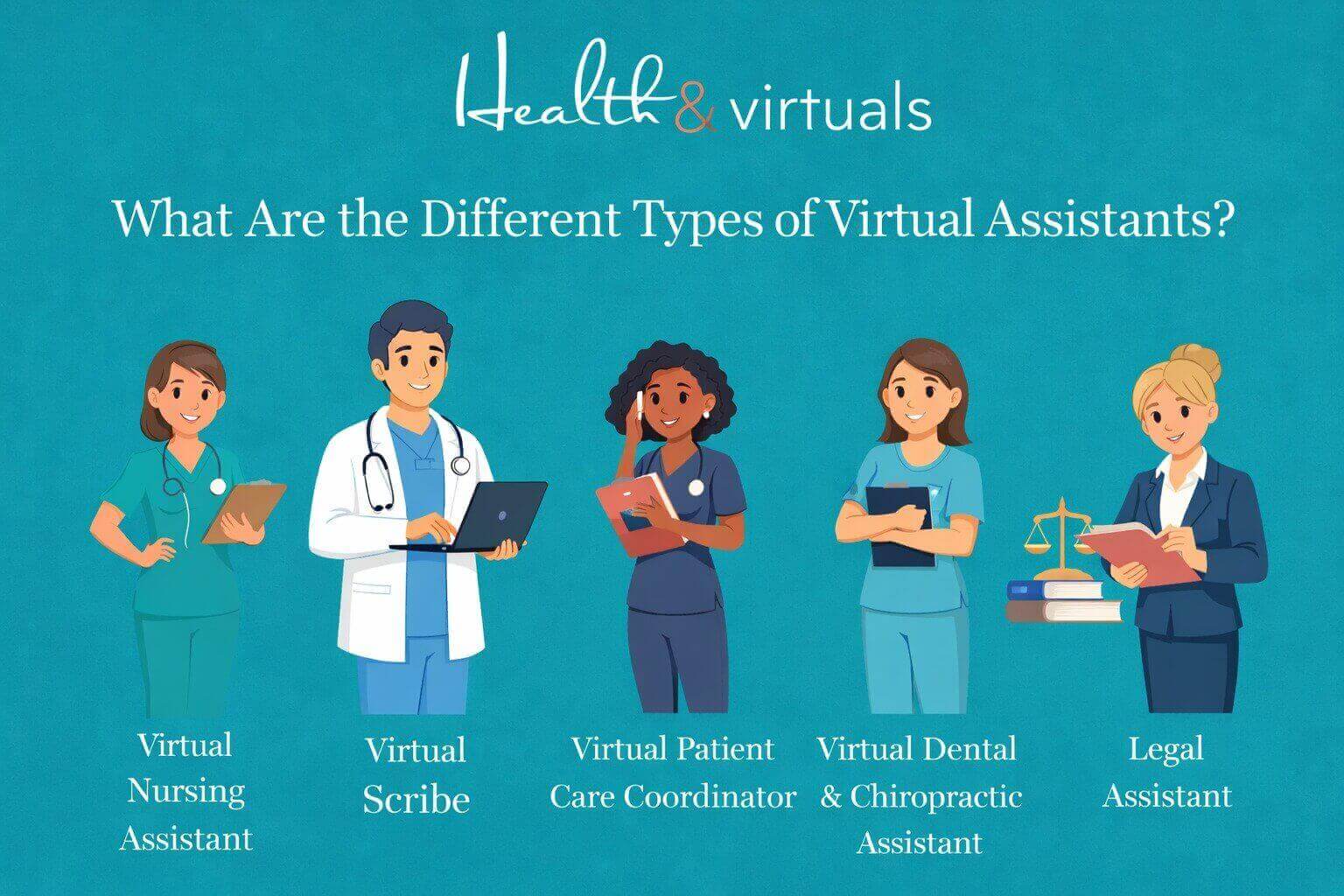
Health & Virtuals offers a wide range of services, including:

  • Administrative virtual assistants
  • Medical and healthcare VAs
  • Virtual Nursing Support
  • Virtual Wellness 7 Chiropractic Assistant
  • Legal virtual assistants
  • Customer support specialists
  • Digital marketing assistants
  • Billing and coding experts
  • HR & Payroll Assistants
  • Sales Development Representatives
  • Virtual Hospitality Assistants

Our structured hiring process ensures you get a qualified virtual assistant for business without the hassle.

Choosing the right virtual assistant can transform your business operations, reduce workload, and accelerate growth. 

Whether you need basic administrative support or specialized expertise, the right VA is a strategic asset.


Happy chiropractic patient receiving seamless communication and care support by virtual chiropractic assistantReady to scale your business?

Partner with Health & Virtuals today, share your requirements, and get your quote! and find the perfect remote virtual assistant for your business’s needs.


FAQs

How do I know if I need a virtual assistant?

If you’re overwhelmed with repetitive tasks, missing deadlines, or unable to focus on growth, it’s time to consider hiring a virtual assistant.

Should I hire a full-time or part-time virtual assistant?

It depends on your workload.

  • Part-time is ideal for small or growing businesses.
  • Full-time is suitable for ongoing, high-volume tasks.

How do I ensure quality work from a VA?

To maintain high-quality output:

  • Set clear expectations.
  • Use project management tools.
  • Provide regular feedback.
  • Start with a trial period.
14Apr

How a Virtual Medical Billing Assistant Can Transform Your Healthcare Revenue Cycle?

Healthcare organizations have been crippled by huge financial constraints. Revenue cycle management (RCM) is now harder than ever due to rising administrative expenses, escalating complexity of claims, and a shortage of staff. Indeed, administrative costs are now over 40 percent of hospital costs, as quoted by the American Hospital Association, and billing inefficiencies alone cost billions per year.

Meanwhile, the efficiency requirement is increasing. Financial optimization is becoming very crucial in healthcare, and thus, the global RCM market will grow to over $117 billion by 2030.

To cut the administrative costs, healthcare organizations in the United States and around the globe are using virtual staffing. In such a domain, a medical billing assistant comes in, not only in the form of administrative support, but as a strategic resource. 

A medical billing virtual assistant can cut your in-house staffing costs, directly enhance the revenue, minimise errors, and optimise the operations.


What is a Virtual Medical Billing Assistant?

Medical billing specialist ensuring accurate coding and reducing claim denials in healthcare billing

A virtual medical billing assistant is a distant administrative help, working as a remote medical billing professional who aids healthcare providers with medical billing and coding procedures and insurance claims, but operates off-site. 

These specialists work remotely, using cloud-based solutions and automating programs, unlike the traditional in-house billing personnel who work in the office.

A remote medical billing coordinator has the responsibility to manage end-to-end billing processes; verification of patient data, submission of claims & follow-ups on payments. As almost 65 percent of billing professionals are now working remotely, virtual staffing is no longer an exception but a growing trend in healthcare activities.


What Is Revenue Cycle Management (RCM)?

illustration about revenue cycle management

Revenue Cycle Management can be defined as the whole financial journey of a patient: appointment scheduling and insurance coverage, until the final payment is made.

It makes sure that the healthcare providers are properly reimbursed for the services they provide.

A standard RCM procedure would involve:

  • Patient registration, 
  • eligibility checks, 
  • coding, 
  • submitting claims, 
  • posting payment, and 
  • collections. 

All these stages may cause delays in payment or loss of revenue due to inefficiencies occurring in any of the stages.

To give an example, up to 42 percent of billing mistakes are due to manual billing errors during its RCM processes, and the average healthcare provider takes approximately 52 days to collect payment.

Given these challenges, optimizing RCM is not just about efficiency—it is essential for financial survival.


How a Virtual Medical Billing Assistant Transforms Your Revenue Cycle?

illustration Healthcare professionals reviewing revenue cycle management data and rising administrative costs

The power of a medical billing virtual assistant is reflected when you consider quantifiable results. These professionals bring uniformity, speed & accuracy in a process that is usually fragmented.

→  Provides Accuracy

One of the most significant transformations is in claim accuracy. The virtual billing assistants working as medical billing coordinators or billing specialists take time to examine documentation and coding and subsequently submit them, resulting in increased clean claims and reduced rejection. 

Claim rejections have been reduced up to 40 percent in real-life applications by incorporating virtual support.

→ Speed Up Billing Processes

They also speed up the billing cycle. The timeliness of submissions and timely follow-ups cut down on delays, enhancing cash flow. In other healthcare organizations, virtual billing workflows have resulted in a 25 percent decrease in revenue cycle time.

→ Cost-Saving

Cost efficiency is another transformation that is critical. By outsourcing the billing, the company can save on the operational expenses of 15-20 percent on average, not to mention the overhead of having to hire and train its own staff.

→ Maximized Revenue

Finally, the virtual assistants make RCM not a reactionary process but a proactive mechanism that is able to maximize revenue at all times.


Tasks Handled by a Virtual Medical Billing Assistant!

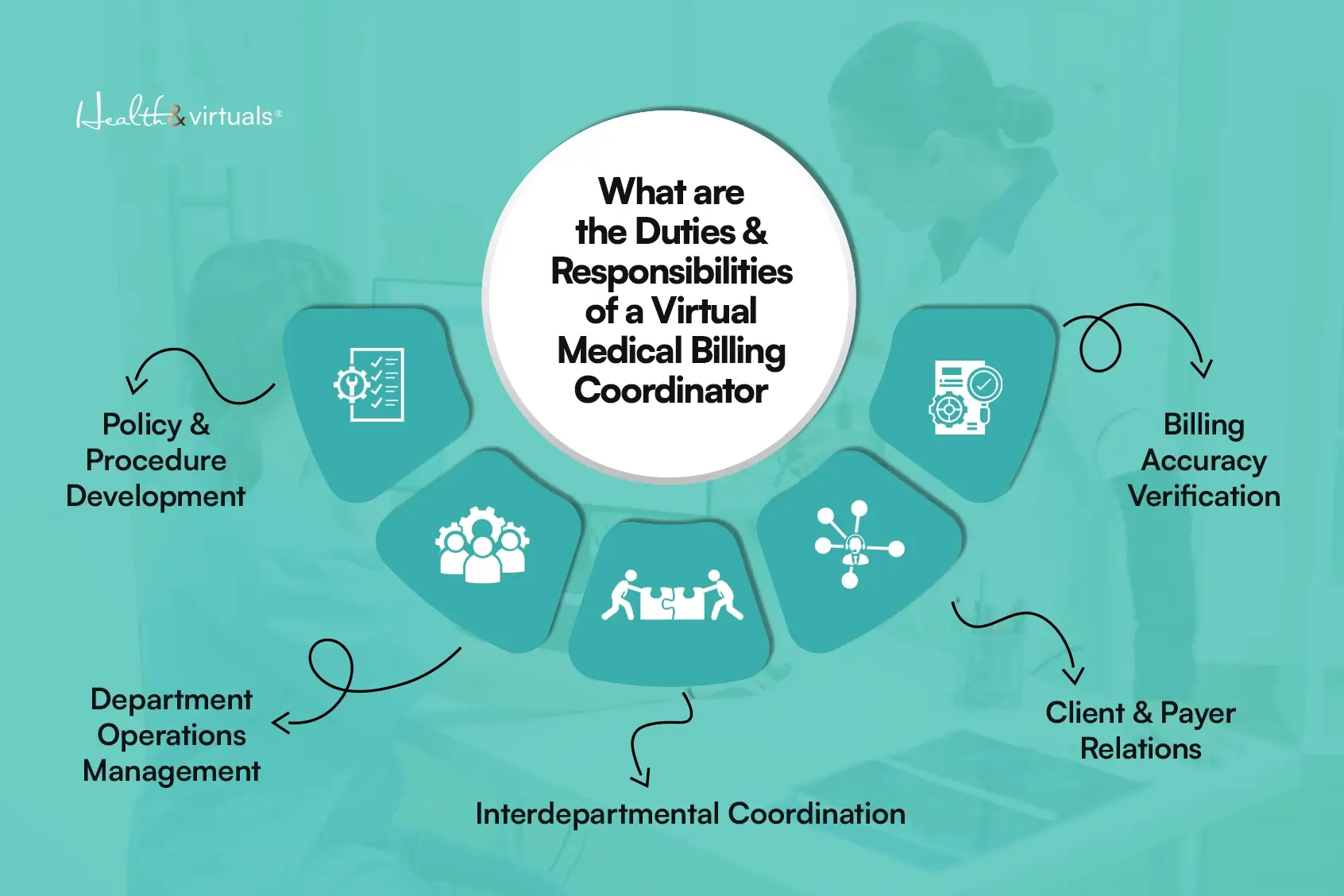
What-are-the-Duties-Responsibilities-of-a-Virtual-Medical-Billing-Coordinator-copy

A virtual medical billing coordinator is a virtual assistant who aids in various steps of the revenue cycle, which guarantees the smooth functioning of financial activities.

  • At the front end, they check patient insurance records and ascertain proper data entry. This action will stop several downstream claim rejections on its own.
  • As the process progresses, they engage in medical coding through standardized medical coding systems such as ICD-10 and CPT, and make sure that they meet the requirements of the payers. 
  • They work in coordination with medical scribes. They subsequently file and send claims using clearinghouses, monitor their status & resolve problems on the fly.
  • A medical billing specialist’s task is even more important in denial management. In case the claims are rejected, they determine the source of the rejection, rectify mistakes, and resubmit/appeal claims on time. 
  • They also control receivables by calling on the insurers and patients, which helps to decrease the balance and enhance the collection rates. 
  • Trained healthcare virtual assistants help in the communication of patient billing, sending reminders and handling payment plans.

This is the end-to-end engagement that renders them essential to the current healthcare finance teams.


The Benefits of Hiring a Virtual Medical Billing Assistant!

Cost savings are not the only advantages of employing a remote certified medical billing specialist. They essentially enhance the functioning of healthcare entities.

1. Accelerated Reimbursements

The other major advantage is the accelerated reimbursements. Regular submission of claims and follow-up results in reduced payment cycles and predictable cash flows.

2. Reduced Administrative Burden

Reduction in administrative burden is also noticeable. Physicians and in-house employees devote less time to billing matters, and they can concentrate on patient care. This not only increases productivity but also job satisfaction.

3. Scalability

Another significant benefit of hiring a virtual medical billing coordinator is scalability. 

Virtual assistants are easily scalable and do not need much infrastructure modification as the number of patients increases. This is especially useful when expanding practices.

4. Improved Financial Performance

Lastly, virtual billing services enhance financial performance. Healthcare providers can stabilize and maximize revenue cycle by enhancing collections, decreasing denials and streamlining workflows.


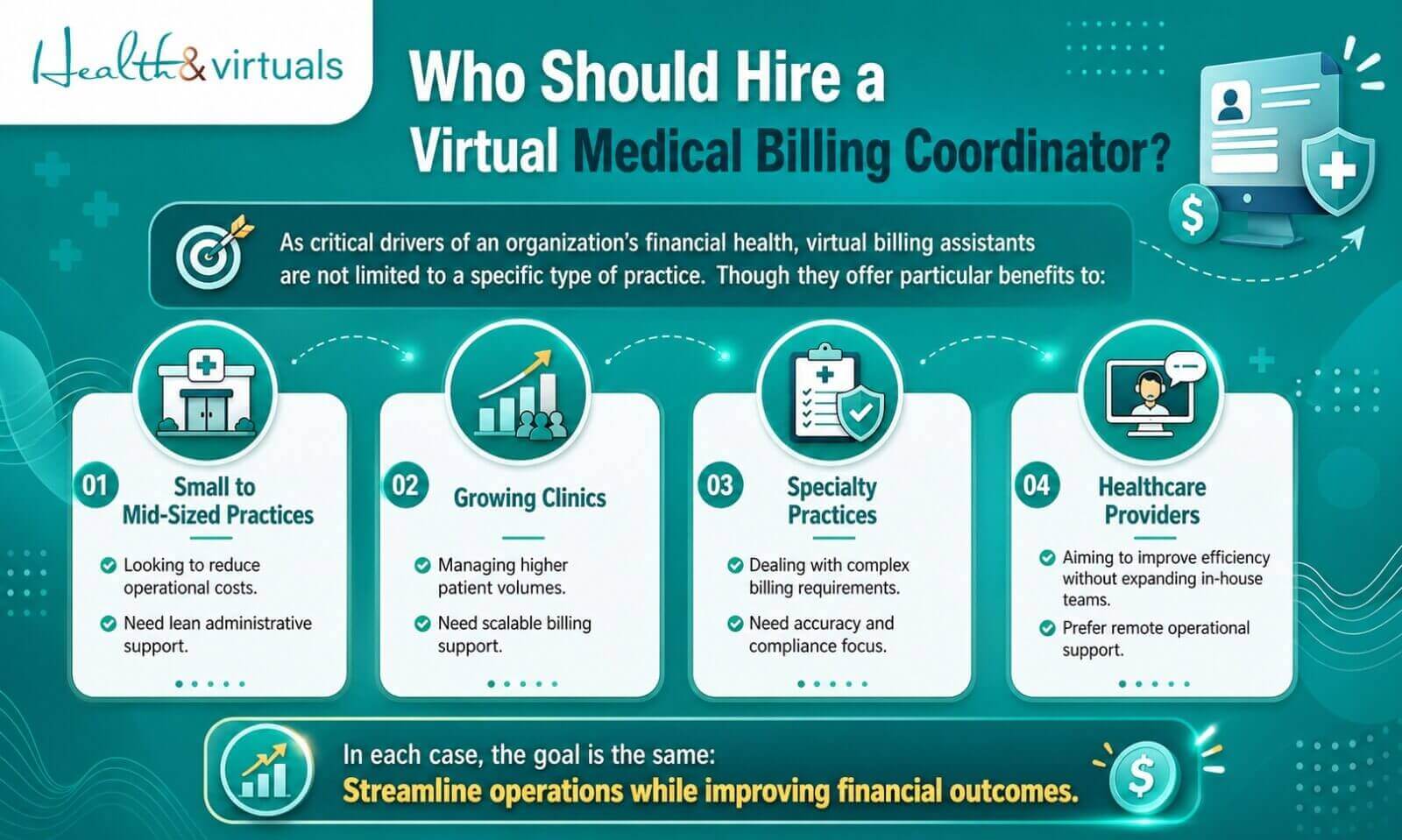
Who Should Hire a Virtual Medical Billing Assistant?

Big hospitals are not the only ones that can use virtual medical billing assistants. 

Actually, they are particularly useful for smaller practices that cannot afford a full in-house billing staff.

→ Individual Healthcare Providers

Healthcare team benefiting from virtual billing assistant with improved revenue and reduced workload

Medical billing coordinators can be beneficial to independent physicians, specialty clinics, telehealth providers, and multi-location practices. Virtual dental assistants are also proven to be beneficial in working remotely with dental clinics and help them progress. 

The same goes for wellness centers. A virtual wellness assistant, working as remote help in patient communication and also as billing personnel, can help your practice and cut in-house staffing costs up to 70%.

Billing complexity has grown as the use of telehealth is 38 times more than it was before the pandemic, and expert support is even more of a value now.

→ High Denial Claims Organizations

Healthcare organizations with high denials, lengthy accounts receivable periods, or staffing issues are good applicants. 

Moreover, virtual assistants are an affordable option in practices that seek to scale without adding overhead.

→ Large Healthcare Systems

Outsourcing models are becoming more popular with even large healthcare systems, with 70% of them having plans to expand RCM outsourcing in the coming years.


Future of Virtual Medical Billing in Healthcare!

illustration Healthcare professionals reviewing revenue cycle management data and rising administrative costs

The future of medical billing is computerized, remote, and digital. This change will be dominated by virtual medical billing administrative specialists.

Billing processes are already actively being transformed by artificial intelligence and machine learning and are already up to 75% error-reducing and highly efficient.

The cloud-based RCM systems have turned into the norm, allowing the teams to work in-house and remotely in cooperation. Meanwhile, AI-enabled solutions are aiding in detecting problems with claims prior to submitting them, cutting down on denials even more.

The move to value-based care is also making billing more complex and specialized knowledge is needed, which virtual professionals can deliver..


Hire Virtual Medical Billing Assistants with Health & Virtuals!

Remote medical billing assistant using cloud-based software for claims processing and coding

When your practice is experiencing slow payments, high denials, or increased administrative expenses, it could be time to re-evaluate your billing strategy.

Health &Virtuals links the medical professionals to the highly trained virtual medical billing coordinators who are conversant with the dynamics of RCM. 

Our trained professionals can make your operations smoother and maximize revenue, whether it is insurance verification or denial management.

Regardless of your business size, be it a small clinic or a developing healthcare institution, outsourcing your billing services to medical billing specialists may open the gateway to efficiency, cost reduction and better financial results.


FAQs

What does a virtual medical billing assistant do?

A medical billing specialist remotely handles the financial aspect of health care services, such as medical coding, submission of claims, tracking of payments, handling of denials, and billing to patients all remotely through digital systems.

Does virtual medical billing work with small practices?

No doubt that it is particularly helpful to small practices. It helps in cutting on overhead expenses, removes the necessity of having in-house billing personnel and helps in accessing professional personnel without any long-term contracts.

Does it mean that virtual billing can be used in different specialties?

Absolutely. The majority of virtual billing assistants are trained in various specialties and coding systems, which enables them to adjust to the specifics of various practices, such as cardiology, dermatology, orthopedics, and more.

13Apr

How to Scale Your Law Firm with Virtual Legal Support?

The transformation of the legal industry is both silent and mighty. Legal firms that used to be fixed in place with physical offices, in-house legal departments, and fixed staffing are becoming more and more flexible and remote-first. A virtual legal assistant is at the heart of this change as a solution that enables firms to expand without the typical overhead limitations.

Growing a law firm has never been an easy task. Full-time employees, administration, and retaining clients may cost a lot. A smarter solution to this is virtual legal assistants (VLAs), which is a combination of low cost, scalability & agility in your firm’s operations.


What Is Virtual Legal Support?

Law firm team collaborating with virtual legal assistants through online meeting platform

Virtual legal support is the administrative and legal outsourcing of remote professionals who are experts in the legal processes. These are known as off-site or virtual professionals, also referred to as remote assistants, virtual legal assistants or remote paralegals, who are employees of a law firm but operate remotely, seamlessly fitting into the daily routine of your law firm.

They generally deal with activities like:

  • Research and writing of documents in law.
  • Communication and intake with clients.
  • Management of calendar and deadlines.
  • Billing and administration.

Law firms are not restricted by geographical boundaries as they can tap talent across the world because they work remotely. This also helps firms to access specialized knowledge in various areas of law practice without necessarily employing full-time employees.


Why Law Firms Are Turning to Virtual Support?

The move towards virtual legal staffing is not merely a trend, but it is motivated by actual business demands and consumer expectations.

Client demand to have faster communication is one of the major factors. Research indicates that 79 percent of customers want their attorney to respond to them within a 24-hour time frame, but most companies fail to do so.

Meanwhile, lawyers are experiencing burnout. A report by 2024 revealed that half of lawyers suffer burnout because of workloads.

A virtual legal office assistant solves the two problems by:

  • Reducing workload pressure.
  • Improving response times.
  • Enabling lawyers to work on high-value legal work.

There are lots of differences between in-house staffing & outsourcing talent.

There are also cost pressures that contribute significantly. Conventional law firms are paying a lot of money to rent an office, salaries, and benefits, all of which are incredibly high costs that a virtual staffing team can help cut down on.


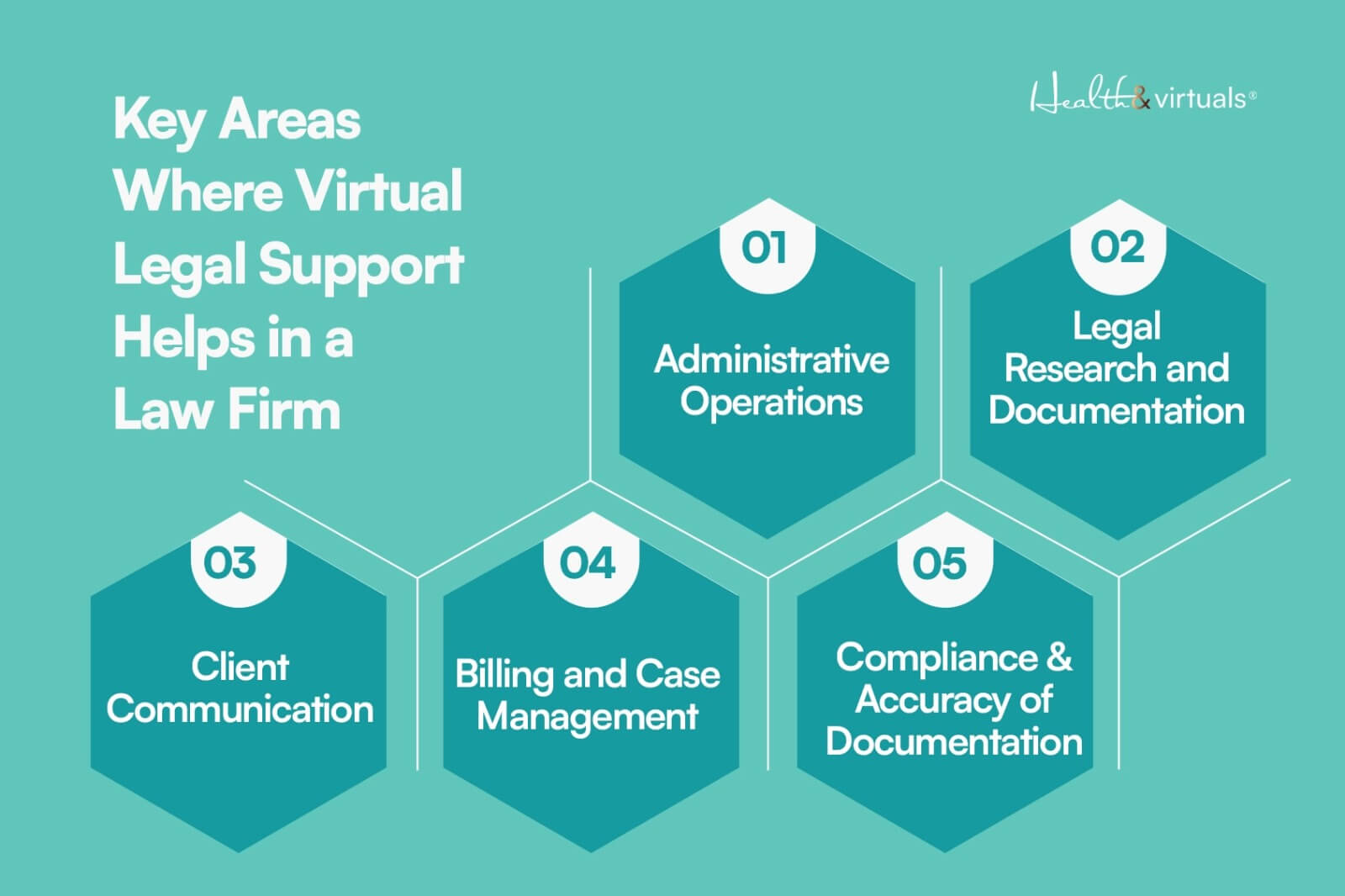
Key Areas Where Virtual Legal Support Helps in a Law Firm

VLA has the potential to assist almost all of the areas of operation of a law firm.
→ Administrative Operations

They are involved in scheduling, emails, files, and managing the day-to-day running of things.

→ Legal Research and Documentation.

Virtual assistants help to prepare contracts, create case briefs, and proofread documents.

→ Client Communication

A virtual assistant for legal planning deals with client intake, follow-ups, and updates, enhancing responsiveness and client satisfaction.

→ Billing and Case Management

A legal practice assistant assists in keeping deadlines and invoicing, among other tasks, and minimizes errors.

→ Compliance and Accuracy of Documentation

They assist in making sure that documents are of the required quality and adhere to the stipulated deadlines to avoid any failure.


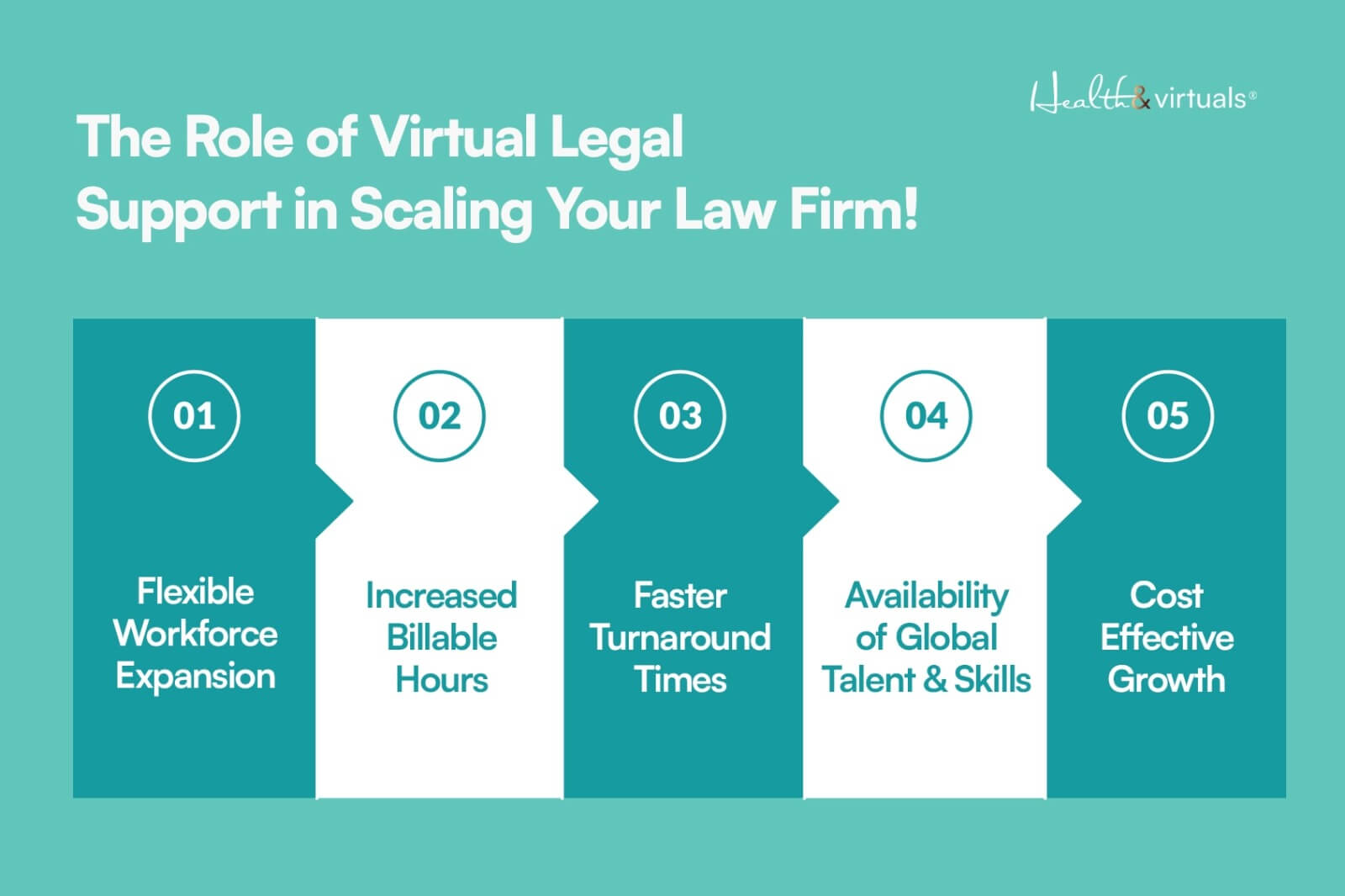
The Role of Virtual Legal Support in Scaling Your Law Firm!

To grow a law firm, one needs to do more than get clients; one needs to be able to manage the workload effectively. This is possible through virtual legal assistant services in a number of ways.
1. Flexible Workforce Expansion

Virtual assistants enable companies to adjust the number of workers down or up according to demand. This helps to avoid any long-term commitments in hiring since it is flexible and it is also productive.

2. Increased Billable Hours

Lawyers are able to delegate routine jobs in order to concentrate on billable work. The study indicates that the amount of billable hours may rise by 15-25%.

3. Faster Turnaround Times

Cases are faster with support that removes the administrative and repetitive tasks, enhancing efficiency and client satisfaction.

4. Availability of Global Talent & Skills

Companies no longer have to confine themselves to local recruitment. With virtual recruiting solutions, you are able to attract international professionals in the field, improving the quality and capacity of the services.

5. Cost-Effective Growth

Conventional scaling is a costly affair. Virtual staffing eliminates a lot of these hurdles and sustainable growth can be achieved without excessive financial hazard.


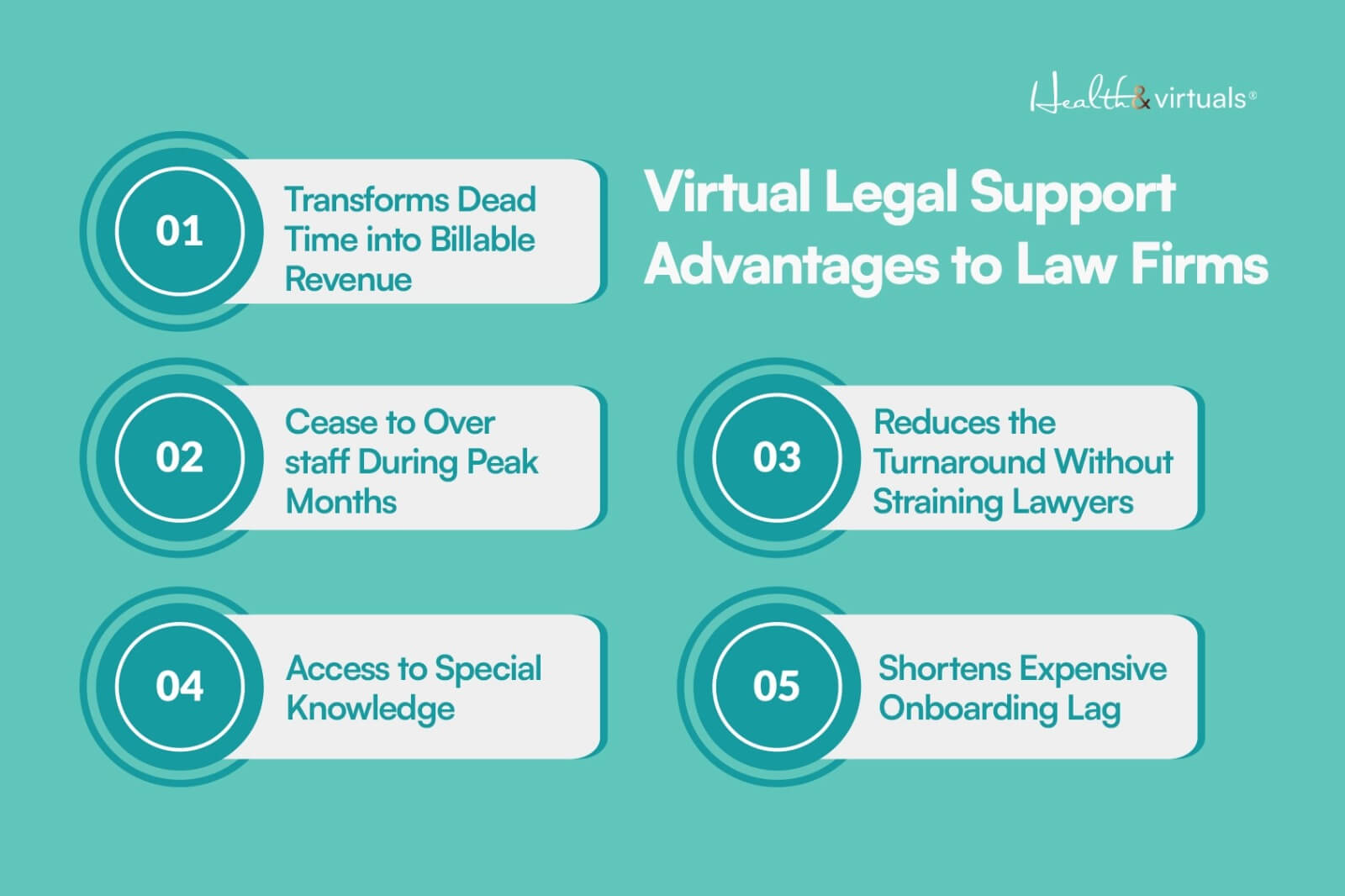
Virtual Legal Support Advantages to Law Firms

Virtual legal assistant handling client communication and intake services for law firm

When you hire a virtual legal assistant, you bmay be benefitted with following. As virtual legal assistant services can:


→ Transforms Dead Time into Billable Revenue

All lawyers underestimate the amount of time wasted in admin emails, formatting, and following up. Offloading this has the potential to add approximately 20 billable hours, which directly affects the revenue without necessarily increasing the client base.

→ Cease to Over-staff During Peak Months

The law firms tend to hire during their busiest season and end up paying for that throughout the year. The best virtual legal assistant inverts this- staffing is no longer fixed but variable, which stabilizes cash flow.

→ Reduces the Turnaround Without Straining Lawyers

Cases are faster when research, drafting & documentation are performed simultaneously (rather than consecutively). This will result in increased case throughput without exhausting your main legal team.

→ Access to Special Knowledge 

Require an individual who is familiar with immigration paperwork or IP paperwork? Multi-domain exposure that is realized through virtual teams is difficult to warrant as a permanent employee.

→ Shortens Expensive Onboarding Lag

Hiring internally may require weeks; one report suggests that recruitment of legal personnel requires an average of 27 days. Virtual professionals can begin right away and this implies that there is less momentum lost.


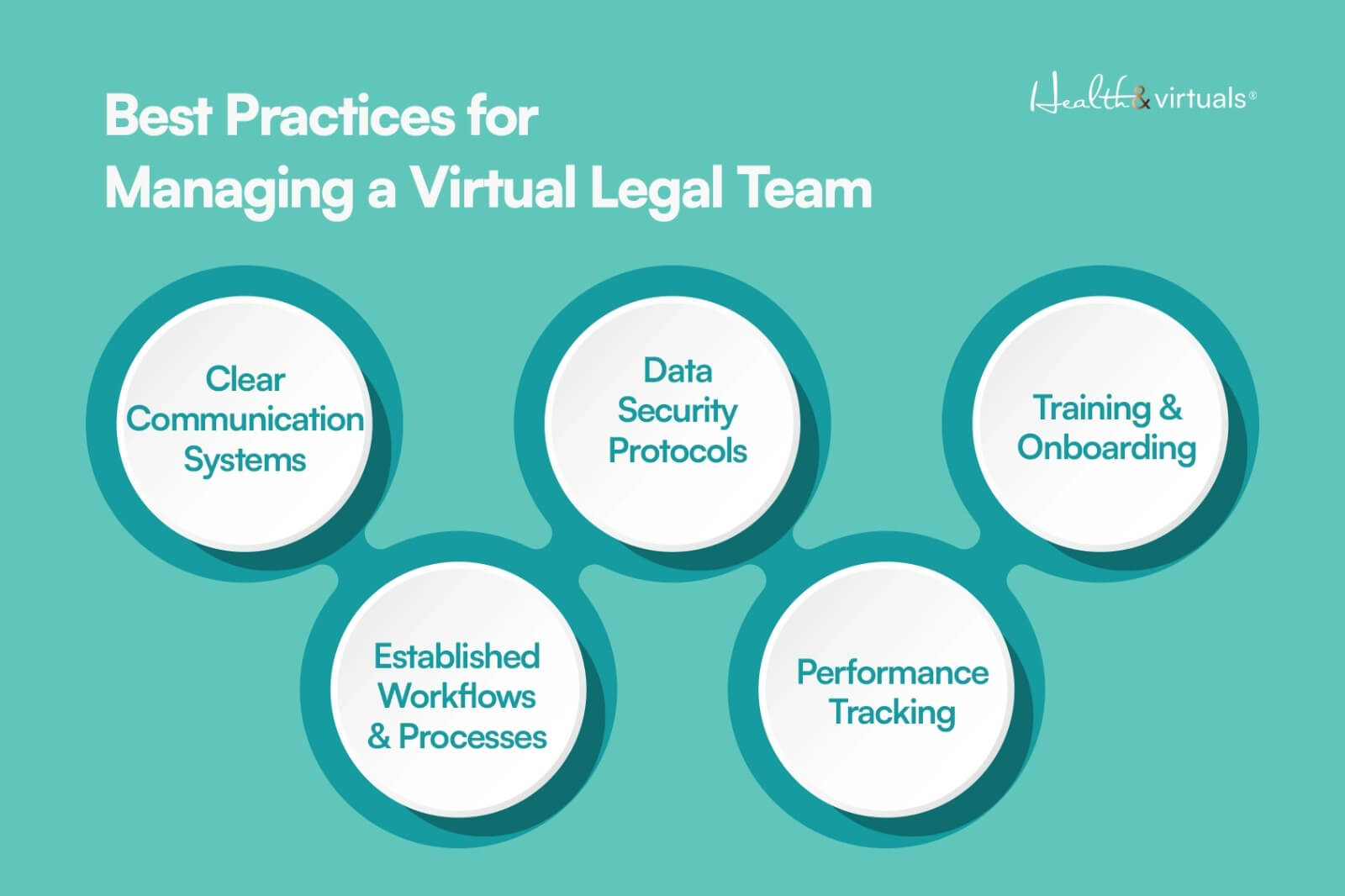
Best Practices for Managing a Virtual Legal Team 

Law firms should have organized systems and transparent management practices in order to maximize the benefit of virtual legal support.

  1. Clear Communication Systems. A virtual legal team holds meetings through Slack, Zoom, or legal management software on a daily basis. Regular communication minimizes mistakes and engages remote teams in the same direction.
  2. Established Workflows and Processes. They establish standardized processes of activities such as client intake and handling of documents. This guarantees uniformity, effectiveness and reduced operational bottlenecks.
  3. Data Security Protocols. The team adopts an encrypted platform, file sharing, and tight access control. Moreover, confidentiality contracts aid in safeguarding delicate legal and customer information.
  4. Performance Tracking. They establish quantifiable KPIs and measure the progress by checking in regularly. This enhances accountability and assists in sustaining productivity among teams.
  5. Training and Onboarding. They help with onboard assistance and provide a clear onboarding to align assistants to your firm’s workflow. The continuous training provides quality, consistency, and efficiency in the long run.

Future of Law Firms: Remote & Scalable with Legal Assistant Provider in the USA!

The legal sector is becoming more and more digital and decentralized. Virtual legal assistance is not to be considered a short-term solution; it is a long-term plan.

Further innovations in technology, such as AI and automation, will transform the legal workflows. According to some studies, as many as 22 percent of the work performed by a lawyer can be automated, signifying the increasing importance of support systems that are tech-enabled.

In addition, virtual staffing allows companies to access new markets and opportunities, serving their clients across geographical lines.

Those law firms that adopt remote and scalable models will be in a better position to compete in a changing legal environment.


Hire Virtual Legal Assistants to Scale Your Law Firm with Health & Virtuals!

illustration Virtual legal assistant managing client emails and follow-ups to improve responsiveness and service quality.

In case you are aiming at growth, then it is not optional anymore, but strategic to hire virtual legal assistants! 

At Health and Virtuals, we offer the best virtual pool of talent for your law firm. We are a renowned virtual help & legal assistant provider in the USA because we connect you with highly-qualified global talent with:

  • Legal expertise.
  • Strong communication skills.
  • Knowledge of legal software.

By hiring legal assistants with Health & Virtuals into your business, you will have a lean, nimble firm that can grow efficiently.


FAQs

Is it cost-effective to recruit virtual legal assistants?

Yes. Virtual lawyers save on costs such as office rent, benefits, and full-time wages. It is a highly economical option since firms only pay what they require.

Is virtual staffing of legal professionals secure?

When managed properly, virtual legal staffing is secure. The encrypted system, secure communication tools, and high levels of confidentiality are applied by most providers to safeguard sensitive client information.

How does virtual support help grow law firms?

Virtual support enables companies to manage additional cases, enhance efficiency, and cut down on costs. It directly increases billable hours and profitability by liberating the time of attorneys.

11Apr

How to Hire a Virtual Nursing Home Registered Nurse (RN)?

The population of the elderly is growing, and shortages of nurses continue to afflict nursing homes worldwide. In fact, it is estimated that up to 900,000 nurses will retire out of the healthcare industry by 2027 and staffing is one of the major operational risks of care providers.

To fill this gap, virtual nursing models have become popular in many facilities, with registered nurses remotely delivering care via telehealth technologies. In case you are thinking about this model, it is essential to learn how to recruit the correct virtual RN.


What Is a Virtual Nursing Home Registered Nurse (RN)?

Professional nurse working remotely with multiple healthcare systems

Virtual nursing home RN is a licensed nurse who delivers administrative and clinical care remotely through the application of digital technologies, including remote monitoring systems, video & electronic health records (EHRs).

As opposed to physical bedside nurses, virtual RNs are not on-site, but still participate intensely in patient care. They are able to retrieve real-time patient information, coordinate with on-site personnel & even inform clinical decision-making.


Why Hire a Virtual Nursing Home RN?

When it comes to hiring a virtual RN, it is not only about cost reduction, but also the enhancement of care delivery in the resource-limited environment.

→ Better Patient Outcome

Improved patient outcomes are some of the best reasons for hiring virtual registered nurses. In nursing homes, it has been reported that telehealth can reduce emergency department visits, which are 85 in every 1,000 residents

This means that the older patients will have reduced stressful hospital transfers and continuity of care.

→ Reduced Clinical Hours

An operation case is very strong too. Virtual nursing can relieve the administrative and repetitive workload on the bedside nurses and enable them to concentrate on practical care. 

Virtual nursing has helped to save tens of thousands of staff hours every year and increased patient satisfaction scores significantly in some healthcare systems.

→ 24/7 Patient Monitoring & Support

Virtual RNs enable round-the-clock monitoring. It is done without the need for additional in-house staff. They can track vital signs, respond to alerts, and provide immediate guidance to patients during clinical concerns.

This continuous oversight helps detect early warning signs of deterioration. Also prevents complications then ensures timely escalation when needed… ultimately improving patient safety, thus ultimately improving you revenue, helping your practice grow!

→ Enhanced Communication & Family Engagement

Virtual nurses also play a key role in improving communication between patients, families, and healthcare providers. They can conduct virtual check-ins. Providing updates and answering family concerns in real time enhances the availability of care at your facility.

This level of accessibility builds trust. Enhances transparency. Also ensures that families remain actively involved in the care process. Something especially valuable in long-term care settings.

→ Cost-Effective Without Compromising Quality

While cost reduction is not the only goal, it remains a significant benefit when you hire RN remotely. Virtual nursing reduces overtime expenses. Lowers your facility’s readmission costs and optimizes workforce utilization.

Facilities can achieve better financial efficiency while still maintaining… Or we can say, often improving, the quality of care delivered to residents.

→ Overcoming Staffing Shortages

Lastly, virtual nurses are useful in overcoming staffing shortages. According to surveys, three-quarters of healthcare leaders are convinced that virtual nursing is effective in finding nurses who are incapable of working bedside positions. 

This increases the pool of talent, such as qualified nurses who are available on a flexible or remote basis.


Core Responsibilities of a Remote RN

Nurse using laptop and headset for remote patient monitoring and EHR accessAlthough the demand for remote RNs is growing, it is crucial to understand how they can make a difference in the healthcare sector by knowing about their responsibilities.


→ Clinical Responsibilities

  • Clinical control maintenance: A virtual RN is critical to ensuring clinical control. They accompany patient vitals with remote systems, evaluate the symptoms with a video consultation, and offer early intervention. 
  • Diagnosis: Virtual nursing even has the ability in some systems to diagnose ailments like sepsis hours before the event, and built-in AI systems, which increase the survival rate.
  • Patient maintenance: This is also done when virtual care RNs perform a review of medications, revise care plans, and educate patients, in particular, about chronic conditions such as diabetes or heart disease. The complications can be prevented with the help of such interventions, and the hospital readmissions can be reduced.

→ Operational Responsibilities

  • Administrative work: At the operational level, virtual RNs are involved with documentation, admissions, discharges, and coordination of care. It is important work and can take a significant amount of time sometimes for bedside nurses.
  • Work reduction: Facilities can reduce work processes by outsourcing these duties to distant nurses. Other systems save up to two hours per nurse per shift due to virtual nursing support implementation.

Qualifications to Look for in a Virtual RN!

Remote patient monitoring system tracking vital signs in real time

Recruiting a virtual RN demands a slightly different perspective on recruitment than the traditional one. 

Here’s a list of qualifications or requirements mentioned in the Job description of a virtual registered nurse:

Here are the key qualifications to consider:

  1. Current RN License
    A valid and active Registered Nurse license is non-negotiable, ensuring compliance with healthcare regulations and standards.
  2. Educational Background (BSN or ADN)
    A Bachelor of Science in Nursing (BSN) is often preferred for its broader clinical training, though an Associate Degree in Nursing (ADN) can also be suitable depending on the role and responsibilities.
  3. 2–5 Years of Bedside Clinical Experience
    Hands-on experience in patient care equips virtual RNs with the clinical judgment needed to assess, triage, and support patients remotely with confidence.
  4. Telehealth & EHR Proficiency
    Familiarity with telehealth platforms and Electronic Health Records (EHR) systems is critical. Virtual nurses must be comfortable navigating digital tools, documenting care accurately, and communicating effectively through virtual channels.
  5. Strong Communication & Critical Thinking Skills
    Since virtual RNs rely heavily on verbal and digital interaction… clear communication, active listening, and quick decision-making are essential for safe and effective patient care.

Too Much To Do?

At first glance, this may seem like a demanding checklist, and in many cases, it is!

Finding candidates who meet all these criteria, especially in a competitive healthcare market, can be challenging and time-consuming.

Partnering with a remote staffing company like Health & Virtuals allows you to bypass the complexities of recruitment. 

We provide:

  • Pre-vetted and background-checked nurses and 7 remote professionals for all sizes of practices and businesses.
  • Professionals trained through our in-house digital programs.
  • Candidates already skilled in telehealth and remote care delivery.
  • Ready-to-perform, qualified, trained, virtual RNs who can integrate into your system from day one.

This not only reduces hiring time but also ensures you’re bringing in qualified, reliable talent without compromising on care quality.


What Are The Steps to Hire a Virtual RN?

Virtual registered nurse providing telehealth care to elderly patient in nursing home

If you’re thinking about hiring a Virtual RN, here’s how to get started.

→ Step 1: What Do You Need?

The first step in the hiring process is to define your needs. All nursing homes do not need the same amount of virtual support. 

Others might require assistance with the admissions and paperwork, and some might need complete clinical supervision.

→ Step 2: Hire Yourself and Contact a Staffing Company

After identifying your needs, you will then need to determine whether to recruit a full-time employee or engage a remote staffing company for virtual nursing services such as Health & Virtuals. Or you can do it yourself as well. 

→ Step 3: Screening

This is followed by candidate screening. In addition to licenses and certifications, screen applicants based on telehealth experience, communication skills, and problem-solving capacity. 

Carry out video interviews to determine their interaction in a virtual environment.

→ Step 4: Onboarding

Onboarding is critical after the hiring. Offer training on your facility systems, workflow, and patient care guidelines. Virtual nurses need to blend seamlessly with on-site teams to work.

→ Step 5: Performance Measures

Lastly, set performance measures. Measure success by tracking outcomes like patient satisfaction, decreased number of hospital visits, and improved workload on staff.


If you use the services of Health & Virtuals, we take care of all that. All you have to do is share your requirement with us, and get a system-ready candidate trained to incorporate into your team seamlessly. 

We take care of end-to-end hiring and recruitment management also. You just focus on your business. Rest is on us!


Cost of Hiring a Virtual RN

The price of a virtual home care RN may vary based on location, experience & agency or direct hiring.

But the actual worth is in saving on costs. The estimated cost of one registered nurse comes as around or above $52,000. Going remote can save significant dollars. 

Moreover, decreased hospitalization and enhanced care coordination may decrease total health care costs. A single study established that telehealth programs resulted in monthly savings per patient, as well as reduced emergency visits.

Considering the big picture, virtual telehealth nurses can be more economical than conventional staffing solutions.


Technology Requirements for Virtual Nursing Home RNs

Virtual registered nurse providing telehealth care to elderly patient in nursing home

There must be a strong technological base to implement virtual nursing. Here are some pointers:

→ Telehealth Platform Support

The telehealth platforms supporting secure video consultations are at the center stage. They should be in line with the healthcare data rules to guarantee patient privacy.

→ EHRs

The health records allow the RNs to quickly update the patient files and get the history when needed. 

→ Gadgets and Monitors

Remote registered nurses who are working remotely need gadgets and monitors for patient care. They can monitor using wearable watches and other sign monitors without physically being there. 

→ Internet and IT Support

Stable internet access and IT support are also a requirement. Even the most competent virtual telehealth nurse cannot be effective without them.


Best Practices for Hiring and Managing Virtual Nursing Home Registered Nurses

Making virtual nursing successful is not about hiring but a matter of careful integration.

Role clarity: Start by clearly defining roles. Confusion regarding the roles to be performed is among the largest problems that healthcare systems have been reported to experience, and it may restrict the success of virtual programs.

Communication: Effective communication schemes are also essential. Focus on it and don’t take it for granted because it helps in remote settings. 

Reviewing: The performance reviews and feedback loops that are conducted regularly will assist in finding the areas of improvement. Utilize statistics to optimize processes and efficiency.


Future of Virtual Nursing in Long-Term Care

Professional nurse helping elderly at nursing home

Virtual nursing is here to stay, not a fad, but a paradigm change in healthcare provision.

According to surveys, more than half of healthcare organizations intend to increase virtual nursing programs, and they are becoming increasingly confident in the model. 

Simultaneously, 66% of nurse leaders recognize telehealth as one of the main elements of a new model of care in the future.

With the rise of technology, virtual RNs and RN care coordinators will perform even more advanced functions, including predictive analytics and AI-based care monitoring. It will also increase patient outcomes and decrease operational strain.

In the case of nursing homes, virtual nursing is no longer a choice; it is now a requirement to remain viable.


Hire Skilled Virtual Nursing Home RNs with Health & Virtuals!

Professional nurse working remotely with multiple healthcare systems

Finding the appropriate virtual RN, home healthcare, and nursing services online? It may be difficult, particularly when the demand is growing and the supply is scarce.

At Health & Virtuals, we focus on matching nursing homes with highly trained virtual registered nurses who are aware of long-term care. 

Want to hire RNs? 

We are ready to help every facility located anywhere in the United States! Find Us!

Contact us! Get your custom quote, NOW.


FAQs

Is it cost-effective to hire a virtual RN?

Yes, particularly in long-term savings. Virtual RNs save the cost of hospital visits, promote efficiency, and can assist in reducing turnover costs, which is a cost-effective investment.

Can telehealth nursing be safe among the elderly?

When implemented correctly, telehealth is safe and effective. It allows the constant surveillance, a quicker response, and better coordination of care- in most cases, it has better results compared to the traditional models.

Why is it better to have a virtual RN hired by families?

Families enjoy enhanced communication and better monitoring and less frequent hospital visits for their loved ones. Education and support are also offered by virtual RNs, making the families feel more engaged and confident.

09Apr

Nurse Practitioner vs. Physician Assistant | Key Differences!

Physician Assistants (PAs) and Nurse Practitioners (NPs) are essential to providing solutions to the shortage of personnel in the health care system and enhancing access to care for patients. Statistics based on workforce estimates, the two are some of the fastest-growing healthcare professions, with the NP roles projected to increase by more than 40 percent and the PA roles by almost 30 percent within the next 10 years.

The differences between the roles of nurse practitioner vs physician assistants, although their functions are similar, can have a great influence on the functioning of healthcare practices, their magnitude, and patient care delivery. It is imperative to be aware of these differences, particularly in clinics that are contemplating virtual staffing solutions.

Virtual PAs and NPs can go a step further to increase their practice capacity through remote consultations and follow-ups, as well as documentation. 


What Is a Nurse Practitioner (NP)?

Physician assistant assisting surgeon during medical procedure in operating room

An advanced practice registered nurse who has finished graduate-level education, usually a Master of Science in Nursing (MSN) or Doctor of Nursing Practice (DNP). They need to qualify as registered nurses (RNs) prior to attaining this level, which may require years of clinical experience.

The nursing model is based on the training of NPs and their focus on patient-centered care, prevention, and holistic treatment. They may tend to focus on certain groups of patients, including family care, pediatrics, or geriatrics.

In most of the areas, especially in the U.S., nurse physicians have a great deal of autonomy- even to the extent of operating free-standing clinics.

Moreover, telehealth consultations, chronic care management, and preventive health programs can be supported by virtual NPs without having to visit the patient in person.

Key Responsibilities of an NP

Nurse Practitioners are deeply involved in both clinical and preventive aspects of care. Their roles are usually a combination of medical knowledge and patient education.

1. Testing and Diagnosis

They normally perform physical tests, diagnose diseases & prescribe drugs. 

Moreover, NPs are also significantly involved in the treatment of chronic conditions, including diabetes or hypertension, which require constant surveillance and involvement of the patient.

2. Patient Counseling

In contrast to most other providers, NPs take an intense interest in counseling patients on lifestyle, mental health, and long-term wellness interventions as well. This integrative method frequently predisposes them to be a favorite in primary care practices.

3. Remote Monitoring

Virtual NPs are especially useful in the area of continuous patient education, remote monitoring, and subsequent care programs.


What is a Physician Assistant (PA)?

Physician assistant working in a hospital emergency room assisting with patient treatmentA Physician Assistant is a licensed medical professional who is trained in the medical model, just like physicians. They undertake a master ‘s-level PA program, which incorporates considerable clinical rotations in several specialties.

In contrast to NPs, PAs receive training as generalists, i.e., they are not confined to a particular patient group and can transition to such specialties as surgery, emergency medicine, and internal medicine without any additional certification.

PAs are usually supervised by a physician, with the degree of supervision varying based on the regulations and the medical environment.

Remote virtual PAs would be useful to the physician because they would be able to help with their diagnostics, charting, and patient triage.

Key Responsibilities of a PA

Physician Assistants have numerous clinical duties with physicians and NPs; however, their efforts tend to be more of diagnosis and treatment.

1. Complete Patient Care

They conduct physical examination, order and interpret diagnostic tests, and prepare treatment plans in conjunction with physicians. PAs are often involved in surgeries and pre- and post-operative care in hospitals.

2. Versatile Duties 

PAs are also quite versatile and able to switch between departments as they are required due to their wide training and, therefore, are useful in the high-paced setting such as the emergency room.

3. Virtual Documentations and Coordination

Virtual PAs have the potential to optimize workflow by assisting physicians in documentation, laboratory reviews, and coordinating patients.


Key Differences and Similarities!

Aspect Nurse Practitioner (NP) Physician Assistant (PA)
Care Model Nursing, holistic Medical, disease-focused
Education Path RN → MSN/DNP Direct → PA Master’s
Clinical Hours 500–1,000 (typical) 2,000+
Specialization Early, population-based Generalist, flexible
Prescribing Yes (most regions) Yes (with supervision)
Work Settings Clinics, primary care Hospitals, surgery, ER
Approach Preventive, long-term Diagnostic, acute
Autonomy High (varies by law) Moderate (varies)
Core Duties Diagnose, treat, prescribe Diagnose, treat, prescribe
Education Level Master’s/Doctorate Master’s
Telehealth  In-house and virtual  In-house and virtual 

Nurse Practitioner vs Physician Assistant: Key Differences

While they both may seem similar in respect to duties, there are some differences between NP and PA. 

→ Education and Training

The academic courses of NPs and PAs are quite different. NPs start as registered nurses and continue with advanced nursing degrees, frequently focusing on a patient group at an early age.

In contrast, PAs are enrolled in master-level programs based on a medical school model, and graduate with approximately 2,000 clinical hours, as opposed to 500-1,000 clinical hours in many NP programs.

→ Scope of Practice

One of the most defining differences is autonomy. In several areas, NPs are allowed to work independently, diagnose, and prescribe drugs without being supervised by a physician.

A typical PA’s practice requires a collaborative agreement with a physician, although their practice is often quite independent.

→ Specialization Differences

NPs specialize early, deciding on such fields as family medicine or pediatrics as they train. This makes them very specialized yet less adaptable in moving across fields.

PAs are generalists, which means that they can move across specialties without further certification, which may be beneficial in dynamic healthcare settings.

→ Patient Care Approach

Nurse physicians have a patient-centered, holistic approach and focus on long-term wellness and prevention.

PAs are more of a disease-oriented approach to medicine, with more emphasis on diagnosis and treatment of conditions.


Similarities Between NPs and PAs

Although these two differ, there is a considerable overlap between the clinical duties of NPs and PAs. 

  • Same duties → Both are able to diagnose diseases, prescribe drugs & treat patients in different environments.
  • Same Wages →  They also receive similar wages, which are usually more than 120,000 per year, and are both highly sought after since there is a shortage of physicians.
  • Same professional goal →  Notably, the two roles also help in enhancing patient access, decreasing waiting time, and improving efficiency in healthcare delivery.
  • Potential virtual nature → Virtual staffing enables NPs, as well as PAs, to provide care virtually, enhancing accessibility and minimizing operational expenses.

What Role Is Fit for Your Healthcare Practice?

Nurse practitioner consulting and examining a patient in a primary care clinic

The decision of pros and cons of nurse practitioner vs physician assistant would greatly depend on the requirements of your practice.

An NP can be a more suitable option in case you are interested in primary care, chronic disease management, and patient education because of the holistic approach and the possibility of working independently.

Conversely, a generalist training and medical-model background of a PA can be more appropriate in the case of what can be referred to as flexibility in your practice or in the surgical assistance, as well as support in high-acuity environments.

Both roles are being used in many healthcare organizations to develop a balanced model of care- combining the strengths of each.

If you’re looking for a virtual medium for hiring healthcare professionals, you’ll be happy to know that virtual PAs and NPs are even more flexible in that practices can scale services without contributing to physical infrastructure.


How Health & Virtuals Helps You Hire the Right One?

At Health & Virtuals, we understand that hiring the right clinical support can directly impact patient outcomes and operational efficiency. We offer the best for your healthcare practice:

→ We are among the best-trusted remote staffing providers in Florida and across the United States.

→ We match you with pre-vetted virtual Nurse Practitioners and Physician Assistants who can seamlessly fit into your workflows. 

→ Telehealth support, patient follow-up, documentation, or care coordination, we assist you to grow smarter and not harder.

→ You can have a customized care team that meets your specific requirements—but without the cost of hiring in-house, with flexible hiring models and specialized talent pools.

If you’re looking to gather a virtual team of healthcare professionals, let us help you. Let’s sit and talk about how to take the work off your shoulders!


FAQs

What is the difference between an NP and a PA?

Their primary distinction is in the training and approach. NPs operate under a model of holistic care and can operate independently, whereas PAs operate under a medical model and usually are supervised by physicians.

Is NP superior to a PA?

There is no superiority of one role over another. They are separate careers, have different training options and roles, yet both offer advanced care to the patient, and they usually collaborate.

Is it possible to have an NP practice without a doctor?

Yes, in most areas, NPs are able to practice autonomously, such as diagnosis and prescription of medications. This is however subject to local regulations and licensing laws.

07Apr

Signs Your Chiropractic Practice Needs a Virtual Assistant!

Running a successful chiropractic practice is about more than delivering exceptional patient care… it also requires seamless coordination behind the scenes. 

Managing appointments and handling patient inquiries? Or busy in keeping up with documentation and billing? The administrative demands can quickly become overwhelming. 

In fact, administrative tasks account for nearly 25 to 30% of total healthcare operational costs, as claimed by U.S department of Health & Human Services (HHS). Placing a significant burden on clinics and staff.

When these responsibilities begin to compete with your time and attention, both your efficiency and patient experience can suffer. 

The impact? It goes beyond staff stress. 

Chiropractic practice aiming to grow but limited by lack of support staffMissed appointments alone can range between 15% to 30% of scheduled visits… leading to major revenue loss and disrupted workflows. 

Is your team constantly stretched thin? Or are appointments slipping through the cracks, or administrative tasks are taking priority over patient care? 

Your practice is not alone… these are common challenges across modern healthcare settings.

A virtual assistant can make a meaningful difference. All by handling routine administrative tasks remotely. 

Do you know your chiropractic virtual assistants can reduce workload by up to 35%, streamline operations, and allow your team to refocus on delivering high-quality, personalized care? 

Here are some signs your practice needs a one!


Your Front Desk Can’t Keep Up with Patient Flow?

Chiropractor managing paperwork and documentation instead of focusing on patient care

Front desk staff are typically hired to take on administrative tasks at a medical practice. These include responding to patients’ queries, appointment scheduling, managing billings, and more. 

On days of high patient flow, even the best team may feel behind. 

The overwhelming nature of the job may lead to missed calls, delayed responses, and scheduling errors. 

This can result in: 

→ Lost patient opportunities.

→ Frustrated patients.

Disorganized appointment management. 

Having a virtual chiropractic assistant at your disposal proves helpful as they can handle calls, bookings, and inquiries in real time, making sure no patient from your chiropractic practice is overlooked. 


Patient Follow-ups Are Inconsistent?

Busy chiropractic front desk struggling with patient calls, scheduling, and inquiries

Follow-ups with patients are extremely crucial for both the patients and your chiropractic practice. 

Timely communication with patients regarding recurrent treatment sessions or appointment reminders plays an important role in retaining and achieving treatment success. 

If follow-ups are missed: 

→ Patients may not return for sessions. 

→ Treatment plans may be disrupted. 

→ Patient satisfaction decreases. 

A virtual chiropractic assistant could help sustain your patients’ trust in the practice by carrying out timely reminders, check-ins, and communication with them. 


High No-Show Rates Are Affecting Your Schedule?

Chiropractic clinic staff overwhelmed with administrative tasks and patient management

Proper management of a healthcare provider’s calendar and patients’ appointment schedule has a direct impact on a practice’s revenue and workflow efficiency. 

The administrative team may end up lagging on the following causes behind the increasing no-show rates at the clinic. 

→ Lack of appointment reminders. 

→ Poor communication. 

→ Scheduling gaps. 

A virtual assistant may aid in the reduction of no-shows by sending automated reminders and confirming appointments in advance. 


Administrative Work Is Taking Time Away from Patient Care?

Chiropractic practice aiming to grow but limited by lack of support staff

Staffing shortages are a common occurrence at medical practices; thus, you may be forced to take on administrative tasks on top of performing your duties as a chiropractor.

This juggling of work leads to declining efficiency of a practice due to administrative overload, which includes: 

  • Scheduling. 
  • Data entry.
  • Documentation. 

Delegating these responsibilities to a virtual assistant allows you to focus on delivering quality care to the patients.


You Want to See More Patients… But Lack Support?

Chiropractic clinic staff overwhelmed with administrative tasks and patient management

As a chiropractic service provider weighed down by administrative overload, a chiropractor can only dream of growing their practice to serve more people. 

Growth often creates a bottleneck when there isn’t enough support staff. 

Without proper assistance: 

→ Patient load becomes unmanageable. 

→ Wait times increase 

→ Quality of care may decline. 

Your existing team can shift its focus to what truly matters… if they are assured that a virtual assistant will take care of the aforementioned issues. 


Hiring In-House Staff Isn’t Cost-Effective?

Your chiropractic practice might be short of staff, yet there is not enough budget to hire a full-time, in-house employee to perform the scut work you might be wasting your time on. 

There are many benefits of hiring virtual staff vs. in-house hiring for your business…

Full-time staffing often entails a higher salary range, benefits, office space and equipment, and training and onboarding costs. A remote assistant poses as a cost-effective alternative in this scenario, providing skilled support without overhead expenses. 


Billing and Insurance Tasks Are Slowing Down Cash Flow? 

Chiropractic practice aiming to grow but limited by lack of support staffAdministrative tasks at a healthcare facility include beyond just appointment scheduling and patient communication. Billing and insurance tasks are a crucial part of them. Errors pertaining to the two can disrupt a practice’s revenue cycle with long-term repercussions. 

Common issues include:

  • Insurance verification delays.
  • Claim submission errors.
  • Payment follow-up gaps.

Virtual assistants working as billing coordinators for your business help manage billing workflows efficiently, ensuring faster reimbursements and improved cash flow.


Do You Want to Improve the Overall Patient Experience?

Chiropractic patient receiving follow-up reminder call from virtual assistantA patient’s experience at a healthcare practice is not merely about the treatment they receive. 

It also includes how well they communicate, how easy it is to get things done, and how quickly they get help. 

If a patient’s questions are not fully answered, it can lead to: 

  • Negative reviews.
  • Low retention rates.
  • Reduced referrals.

Regardless, the experience of a patient can be enhanced by hiring a virtual wellness assistant through answering patients queris, timely communication, organized scheduling, and professional support.


Your Clinic Needs Flexibility Without Physical Expansion…

Healthcare billing and insurance processing handled efficiently by virtual assistant

A prerequisite for hiring a full-time, in-house employee is having adequate office space for their accommodation. 

However, physical expansion is not always possible for a small-scale practice looking to streamline operations. 

As a cost-effective alternative, virtual assistants adapted by many offer the flexibility that is ideal for growing chiropractic practices. It is proven that clinics can reduce operational costs by up to 70–80% and are offered many other benefits by hiring remote assistants

They allow you to:  

  • Scale operations remotely. 
  • Extend service hours. 
  • Handle increased workload without infrastructure changes. 

Virtual Chiropractic Assistant vs In-House Assistant: Key Differences

A virtual assistant at a chiropractic practice offers multiple such benefits that might convince you to hire them over an in-house employee. 

These include: 

Overhead Costs

A virtual assistant is typically hired at a lower salary range than a full-time employee working on-site. 

Moreover, you can evade additional expenses such as medical benefits and commuting allowances. 

Flexibility

Virtual assistants can work in a way that’s flexible because they do their job from home. This means you can give them as much or as little work as you need. 

On the other hand, in-house staff have set jobs and hours, which can make it harder to make changes.

Workspace

Virtual assistants do their job from home, so you do not need to give them a place to work or any equipment. 

An in-house assistant needs a physical space, tools, and other facilities to do their job.

Scalability

Virtual assistants are global talent, and they can work from anywhere. This means you can add help as your healthcare practice grows. 

Hiring and training in-house staff takes time and money, which makes it harder to grow quickly.

Availability

Virtual assistants can often work at times of the day or night, which means they can help patients outside of regular business hours. 

In-house assistants are usually confined to work during working hours.


How a Virtual Chiropractic Assistant Supports Chiropractors and Their Practice?

Happy chiropractic patient receiving seamless communication and care support by virtual chiropractic assistant

A virtual chiropractic assistant can support your practice in multiple ways:

  • Appointment scheduling and calendar management.
  • Patient communication and follow-ups.
  • Insurance verification and billing support.
  • Data entry and record management.
  • Handling inquiries and administrative coordination.

By managing these tasks, they improve workflow efficiency and reduce operational stress.


Bottom Line

A chiropractic practice is as good as its best resource. Thus, if your practice is struggling with inefficiencies, missed opportunities, or administrative overload, hiring a virtual chiropractic assistant from trusted remote hiring companies like Health & Virtuals can be a game-changer in improving the operations of your facility. 

They can help you communicate with patients better and make your office run smoothly. 

This way, you can focus on taking care of patients. This way, you can get back to what you do best: helping people feel better.

Get your custom quote for your practice, and know how Health & Virtuals gives you the best scalable and highly trained remote support for your practice and business of any size and anywhere in the United States.


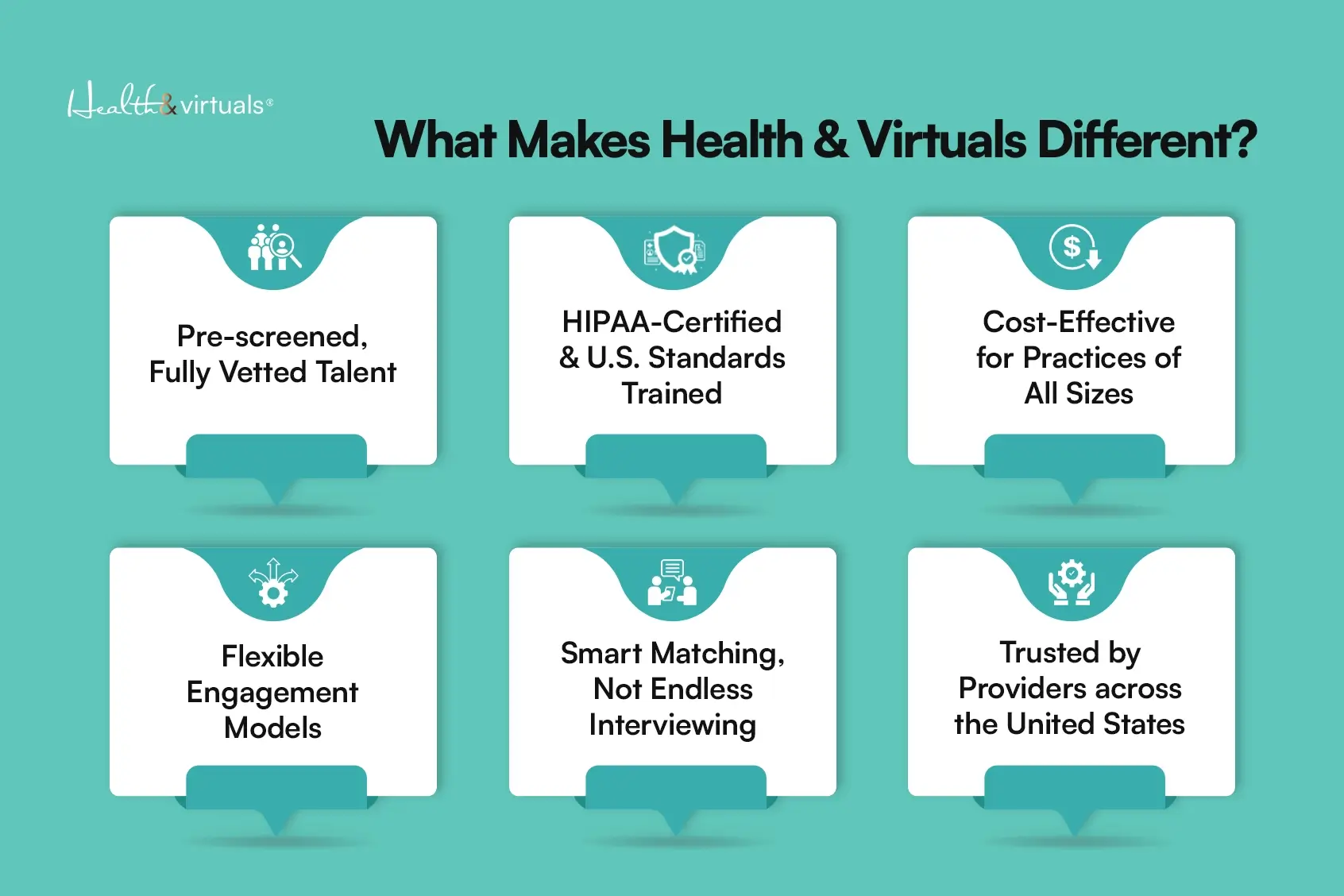
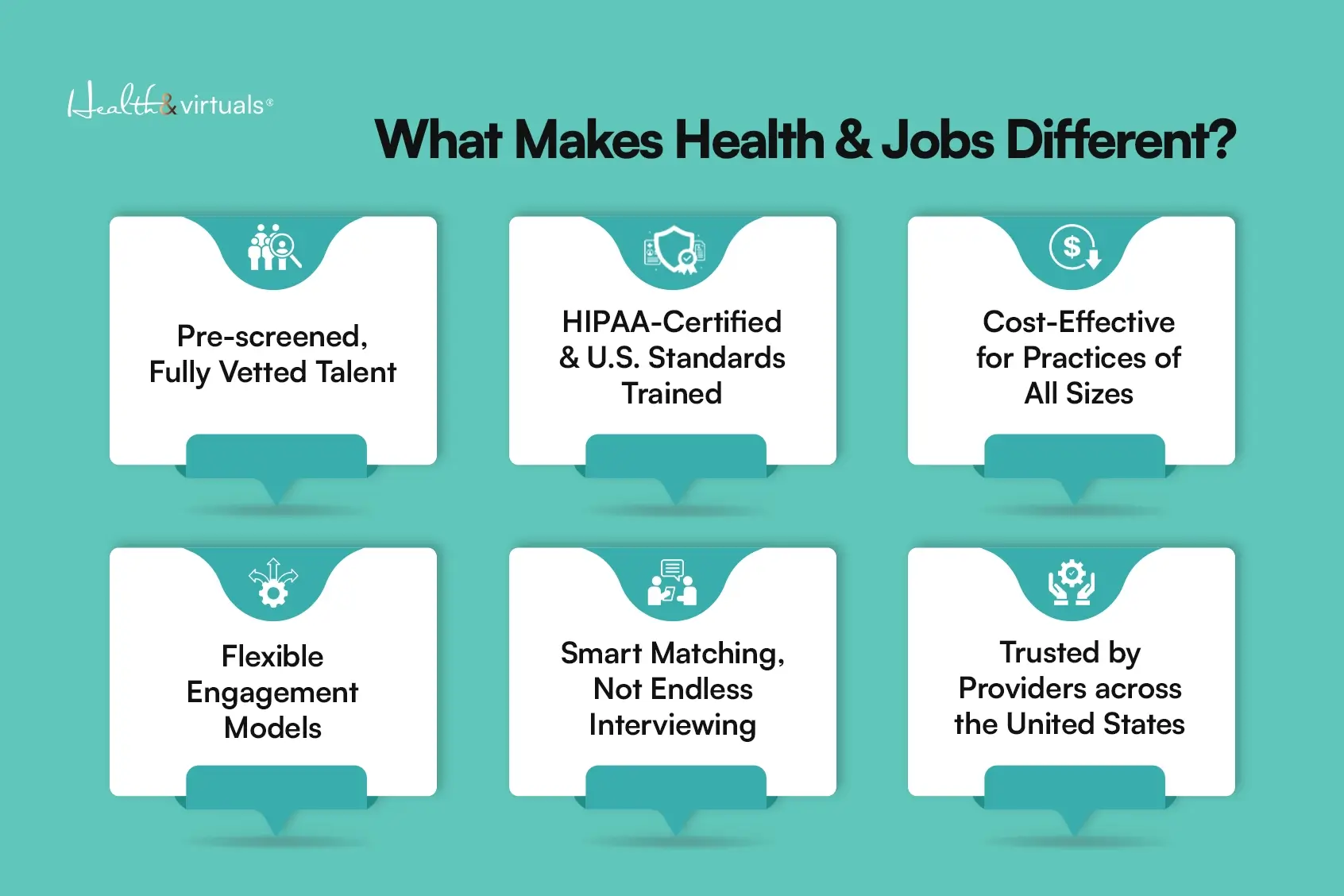
Why Hire With Health & Virtuals?

what makes health and virtuals different copy (1)

04Apr

In-House Hiring vs. Outsourcing Recruiting Services: Which One Is Better For Your Business?

One of the most exhausting corporate tasks is hiring. Finding employees today is no longer just about filling vacancies… It’s about building a system that drives development, productivity, and long-term sustainability. While companies are no longer limited to local talent pools, many still rely on traditional in-house hiring processes that are increasingly slow and inefficient.

On average, it takes 30 to 45 days to hire a candidate. At the same time, the full-time-to-fill cycle can stretch to 63–68 days depending on the industry. For senior and executive roles, this timeline can extend to 90–120 days, delaying business operations even further.

The complexity of modern hiring is a major contributor. 

Companies now conduct multiple interview rounds… often up to 20 per hire, significantly increasing delays. As a result, 60% of organizations report longer hiring timelines, and many fail to meet their hiring goals altogether.

What once emerged as a pandemic-era workaround, remote staffing, has now evolved into a strategic advantage. By tapping into global talent pools and streamlining recruitment processes, businesses can reduce hiring timelines by up to 20–50%, transforming hiring from a bottleneck into a competitive edge.

It does not matter which option is better in general. But which is better for your business model in the present? And the solution of agency vs. in-house recruitment lies in cost structure, operational requirements, and the definition of productivity.


What Is In-House Hiring?

in-person medical scribe documenting patient visit beside physician in clinic exam room

In-house hiring means hiring employees who are physically present in your organization, usually in your office premises. These workers belong to your internal team, usually on a full-time basis, and work in a structured setting.

This classical paradigm provides regulation, homogeneity, and immediate oversight, which is why the model remains popular in various sectors of the economy. Such as manufacturing, healthcare, and finance.

Pros of In-House Hiring

→ Control: It is one of the largest benefits of in-house hiring. Managers will be able to monitor work directly, give feedback in real-time, and maintain the correspondence to the company’s goals.

→ Cohesion: It also has better team cohesion. Workers residing in the same room are bound to establish relationships, which may enhance cooperation and communication.

→ Security: Data security is the other advantage. In sensitive industries, in-house teams are more favored since risks involved with external access are minimized.

→ Less complicated hiring: Finally, the process of onboarding and training is usually less complicated. Knowledge transfer and cultural integration are faster through face-to-face interaction.

Cons of In-House Recruiting

In spite of the advantages, there are serious disadvantages that are associated with in house recruitment.

→ Cost: Overheads, equipment, salaries, and office space can add up very fast. As reported by the Society of Human Resource Management, the average cost per hire may be higher than 4,700 dollars without considering the long term employment costs.

→ Accessibility: Talent is also not easily accessible. You can only have candidates who are within your geographic area, and this may be a significant drawback in niche jobs.

→ Time-consuming: Also, it is not as fast as scaling. Recruiting, training, and developing teams takes time and resources.


What Is Remote Staffing?

Remote professionals working from different locations worldwide

Remote staffing is a practice where professionals are employed even though they are not in your office physically. They are often located in different geographical areas, usually worldwide. These employees may be full-time, part-time and contractual.

Remote staffing is now a thing of the present as digital tools have advanced. Websites such as Upwork and Toptal have simplified the process of finding talented workers across the globe.

Pros of Remote Staffing

→ Cost Saving: The most visible benefit is a savings in costs. Businesses are able to save on office rent, electricity, and even wages when they employ in areas that have lower standards of living.

→ Access to Talent: Virtual staffing also provides access to an international talent pool. Businesses are able to recruit the most suitable individual to work in the organization instead of settling with the candidates who are available within the area.

→ Flexibility: The other significant advantage is flexibility. The remote teams are able to work in different time zones, which allows them to be productive 24 hours a day.

Productivity: A Stanford University study discovered that telecommuters are up to 13 percent more productive than their office colleagues.

Cons of Remote Staffing

Nonetheless, remote staffing is not a problem-free solution. 

→ Time Zone: The time zone difference or absence of a face-to-face interaction may create communication gaps.

→ Scattered Staff: Less team cohesion is also a possibility. Unwittingly, virtual staffing teams can be disconnected from the company culture.

→ Control Issues: It can also be difficult to control performance when not in the office. It involves powerful systems, effective KPIs, and leadership.

→ Security: Lastly, data security is something that may be a concern, particularly with the absence of proper protocols.


Key Differences Between In-House Hiring and Remote Staffing

At a basic level, the distinction between in-house vs external remote recruitment agencies is in place and type. Internal recruiting provides stability and control. Whereas remote staffing focuses on flexibility and scalability.

Internal talent acquisition teams are optimised using direct supervision and teamwork, but remote teams are optimised using digital communication and independence.

There is also a significant difference in cost structures, one of which is fixed overhead, whereas the other is more variable and, generally, lower.

In-House Hiring vs Remote Staffing: Quick Comparison

Factor In-House Hiring Remote Staffing
Cost Efficiency High overhead (rent, utilities, benefits)

Training & retention expenses

Lower operational costs

No office expenses

Productivity ⚖️ Direct communication advantage

No Office distractions

No Commute fatigue

Fewer distractions

No commute = more work time

91% higher job satisfaction

Efficiency Real-time decisions

Faster collaboration

Depends on tools & management

Can streamline workflows digitally

Flexibility Rigid structure

Hard to scale quickly

Highly flexible

Easy to scale up/down

Scalability Slow hiring & onboarding

Infrastructure limitations

Rapid hiring

No physical limitations

Access to Talent Limited to local talent pool

High competition in cities

Global talent access 🌍

Easier to find specialized skills

Employee Satisfaction Stable but routine-bound Higher satisfaction & work-life balance
Long-Term Sustainability Expensive to maintain Cost-effective & growth-friendly

Cost Comparison: Which Is More Affordable?

→ In-House Hiring Costs

In-house recruitment involves both expense visibility and invisibility. Only one aspect of the equation is salaries. You also have to include office rent, equipment, utilities, insurance and employee benefits.

As an example, an employee working in a mid-level position in a large city may attract 1.25-1.4 times his base salary with overhead factored.

They are further accompanied by the costs of training and retention, which are more pronounced in high-turnover industries.

→ Remote Staffing Costs

Overhead is saved greatly by remote staffing. Physical office area is not required, and the cost of operation is low.

Geographic salary arbitrage is also a good idea in many companies and that is, to get qualified professionals in areas where the wages are low, and talent is high.

Global Workplace Analytics estimates that companies could save more than 11000 US dollars annually per virtual staffing worker.


Efficiency and Productivity

→ In-House Teams

In-house teams have the advantage of direct communication and simpler collaboration. Meetings are easier to arrange, and decision-making can be done in real time.

Nevertheless, office distractions, long commutes and strict schedules might sometimes have an impact on productivity.

→ Remote Teams

Remote professionals working from different locations worldwide

Remote teams tend to be more effective as far as the concentration of work is concerned. Employees will be able to spend more time working without commuting and being interrupted by the office.

Buffer conducted a study that revealed that 91% of remote workers said they are more satisfied with their job, which correlates directly with productivity.

With this said, however, effective tools and management practices are essential to success.


Flexibility and Scalability

→ In-House Hiring

Ramping up internal recruiting is time-consuming. Recruitment, onboarding and setting up infrastructure may decelerate growth.

Flexibility is not very much, either. Demand-based adjustment of the workforce can be expensive and complicated.

→ Remote Staffing

Remote staffing is excellent in scalability. Companies are able to add or remove employees within a short time, depending on the project requirement.

This model is especially useful in a start-up or developing company that would require agility without significant commitment.


Access to Talent

→ In-House Hiring

In-house hiring has the limitation of talents pool being restricted to your locality. This may complicate the task of locating very specialized skills.

Salaries are also increased due to the competition for the best talent in big cities.

→ Remote Staffing

Virtual staffing for business growth i, lady working from different time xoneRemote staffing eliminates geographical boundaries. You are able to employ the best professionals throughout the world via remote channels.

It is particularly useful in such positions as tech, marketing, and customer support, where the global experience is plentiful.


When Should You Choose In-House Hiring?

In-house recruitment is best in cases where your company needs close oversight, excessive cooperation or where data security is paramount.

  • This model is beneficial to such industries as healthcare, manufacturing and finance.
  • It is also an excellent option when a powerful internal culture is one of the priorities.

When Should You Choose Remote Staffing?

Remote staffing is most effective when there are flexibility, cost reduction, and the availability of global talent.

  • This model is more efficient with startups, digital businesses, and companies that have project-based work.
  • It is also best suited to jobs that do not need physical presence like virtual assistants, developers and content creators.

Challenges of In-House Hiring

tired office staff due to work burden

In-house recruiting is associated with long-term obligations. After employees have been recruited, it may be challenging and expensive to downsize the workforce.

It is also the difficulty of keeping employees engaged and keeping up with overhead expenses. Moreover, companies can also find it challenging to meet the changing skills demands quickly.


Challenges of Remote Staffing

Remote staffing involves effective communication networks and expectations. In their absence, productivity is at risk of being affected.

The differences in time zones may cause delays, particularly in group projects. Moreover, a unified company culture cannot be established remotely without effort.


In-House vs Remote Staffing: Which One is the Best?

It’s difficult to choose one generalized answer. The right choice is determined by your business objectives, financial capacity, and business requirements.

In-house hiring is the best option in case you value control, stability, and face-to-face cooperation. On the other hand, remote staffing is the wiser option in case you want flexibility, cost effectiveness, and access to talent globally.

In most instances, a hybrid solution, which involves a combination of the two models, can present the best of the two worlds.


Searching for Remote Talent? Hire with Health & Virtuals!

Health and Jobs offering remote staffing solutions for medical virtual assistant and coordination roles

Remote staffing can be a major move in today’s global situation. In case you are willing to expand your business without the overhead associated with conventional hiring, we’re here to help. 

Health & Virtuals is the place where you can find pre-vetted remote professionals who are trained to provide an effective contribution to your business operations. You can get administrative help, find healthcare personnel, or hire specialists, all in one place. 

The right remote team can assist you in developing more rapidly, without sacrificing quality! 

Contact us today


FAQs

Is remote hiring cost-effective?

Yes, particularly with the consideration of decreased overhead, decreased costs of hiring, and the availability of international salary scales. The net present value of the savings can be high.

Can small businesses benefit from recruitment agencies?

Small businesses are the ones who usually gain the most. Agencies save on the time spent in hiring and also assist small groups in getting access to talent that they would otherwise not easily get without the assistance of the agency.

What industries benefit most from remote staffing?

Digital workflow industries, such as technology, marketing, finance, and customer service, are the most likely to experience the largest improvements.

Can businesses use both in-house and remote staffing?

Yes, they can, and many of them do. The default of hybrid models is based on the fact that they are not only stable but flexible.

02Apr

How Virtual Payroll Assistants Improve Accuracy, Timeliness, and Payroll Efficiency?

Payrolls play an integral role in the relationship between a business and its employees. Yet the errors pertaining to them are more common than the former realizes. A 2022 Ceridian survey concluded that nearly 33% of employers make mistakes each year due to compliance issues and technological limitations. 

To avoid employee dissatisfaction due to such errors and delays, businesses are now hiring virtual payroll assistants to ensure payroll tasks such as salary calculations, tax deductions, and payment processing are executed accurately while reducing administrative workload. 

Here’s what you need to know about a virtual payroll assistant to find out if they are the right fit for your company.


What Is a Virtual Payroll Assistant?

family nurse practitioner helping patient onlineA virtual payroll assistant is a remote professional who manages payroll processes of a business using digital tools and cloud-based systems. 

They typically handle the following tasks: 

  • Salary calculations and processing. 
  • Tax deductions and compliance.
  • Payroll data entry and recordkeeping.
  • Pay slip generation. 
  • Payment scheduling.

In simple terms, a virtual payroll assistant is hired to ensure employees are not only paid correctly but also on time. The remote nature of employment is an added bonus – helping businesses save on costs associated with in-house staff. 


Why Payroll Accuracy and Timeliness Matter?

skills for remote payroll assistant

Payroll is more than just paying employees. The whole process of remuneration for the workers has a direct impact on the business’s credibility and compliance. 

A payroll specialist is employed solely to handle issues pertaining to it, reinforcing the importance of hiring one. 

By ensuring accurate and timely payroll, a business is able to: 

→ Maintain employee trust and satisfaction. 

→ Avoid legal penalties and compliance issues. 

→ Ensure correct tax filings.

→ Prevent financial discrepancies.

→ Improve overall operations.

Do you know that even the smallest of payroll errors can lead to major consequences, such as employee disputes and regulatory fines, among others? 


Common Payroll Mistakes Businesses Make!

billing errors can be reduced by hiring virtual payroll assistantMost businesses struggle with the payroll part of their organization due to a lack of access to the right resources

The payment-related tasks are mostly dealt with manually by the company’s administrative staff, who are in no way experts in the matter. Thus, they may end up making the following mistakes:

Incorrect salary calculations

Mistakes in calculating wages, overtime, or bonuses can lead to underpaying or overpaying employees.

Missed or late payments 

Delays in payroll processing directly affect employees’ trust and morale due to late salary receipt.

Errors in tax deductions

Businesses suffer compliance issues and potential penalties from tax authorities due to incorrect tax withholdings.

Misclassification of employees

Wrongly categorizing employees can result in legal and tax complications.

Poor recordkeeping

Inaccurate or incomplete payroll records can cause issues in audits, reporting, and compliance.


How Virtual Payroll Assistants Improve Accuracy and Timely Payments?

A virtual payroll assistant plays a key role in minimizing the aforementioned errors and ensuring smooth operations. 

Automated and Accurate Calculations

Payroll assistants operating virtually have strong command over advanced digital softwares to ensure precise salary, tax, and deduction calculations.

Timely Payroll Processing

They follow strict payroll schedules to ensure employees are paid on time.

Compliance Management

Virtual assistants are mandated to stay updated with tax laws and labor regulations to reduce future compliance risks.

Organized Payroll Records

They are equipped to maintain accurate and well-structured payroll data that are beneficial for company audits and reporting.

Error Reduction

By eliminating manual data entry and double-checking information, they significantly reduce payroll mistakes.

In short, hiring remote payroll assistants is the fastest track to ensuring accurate and stress-free payroll management.


Cost Benefits of Virtual Payroll Assistants 

Cost Benefits of Virtual Payroll Assistants 

The ever-changing world of businesses has witnessed a growing trend of remote hiring in the last decade… This shift is often ascribed to substantial cost-saving at the organization’s end while ensuring the work quality remains the same, if not better. 

Thus, you are looking at several cost benefits should you decide to hire a remote payroll assistant. 

These include: 

  • No need for office space or equipment. 
  • Reduced employee benefits and overhead costs. 
  • Pay only for required services. 
  • Lower risk of costly payroll errors.
  • Increased operational efficiency.

Additional Business Benefits of Virtual Payroll Assistants

Significant Reduction in Operating Costs. Do you knowtaht you businesses can reduce operational expenses by 50% to 78% compared to full-time in-house employees. By using virtual assistants. 

Lower Payroll & Employment Expenses. Virtual assistants typically cost 50% less than full-time staff, as companies avoid expenses related to benefits, taxes, insurance, and paid leave.

Annual Savings Per Employee. According to experts, average companies can save up to $40-000 to $65,000 per year by hiring a virtual assistant instead of a traditional in-house employee.

Reduced Payroll Processing Costs. Outsourcing payroll functions can lower processing costs by 15% to 25% or more!

Making it a cost-efficient alternative… to maintaining an internal payroll department.

Minimized Risk of Costly Errors & Penalties. Payroll outsourcing reduces errors. How much? By up to 80%!!! It’s proven. 

Significantly lowering the risk of compliance fines and financial discrepancies.

Faster ROI and Financial Efficiency. Businesses adopting virtual assistants often see a return on investment within 45 to 90 days.

It is driven by immediate cost savings and productivity gains.

Improved Productivity = Indirect Cost Savings. Companies report up to a 30% increase in productivity when virtual assistants handle routine tasks.

This allows internal teams to focus on revenue-generating activities.

Reduced Administrative Time Costs. Payroll automation and outsourcing can cut processing time by up to 60%, translating into measurable labor cost savings.

Virtual payroll assistants are not just a cost-saving alternative… they represent a high-ROI operational strategy. 

By reducing labor costs, minimizing compliance risks, and improving efficiency, businesses can achieve both immediate financial relief and long-term scalability.


Virtual Payroll Assistants vs In-House Payroll Assistants 

Remote medical scribe representing technology to document live telehealth patient consultation

A payroll assistant working virtually or hired in-house essentially performs the same tasks. These include timely payment processing, recordkeeping, salary disbursement, and tax deductions. 

However, their site of work and setups make a huge difference in their overhead costs compared to employers. 

Here’s a quick comparison: 

→ Cost

Virtual payroll assistants cost significantly less because employers are saving on expenses like office space and employee benefits, both of which are non-negotiable for in-house staff. 

→ Flexibility

Virtual admin assistants can be hired on-demand or scaled as needed, as opposed to office-based employees who usually work fixed roles and schedules. 

→ Accessibility 

One of the most beneficial reasons why businesses may opt for a virtual role for a payroll assistant is that they can work across time zones and be available beyond standard work hours. 

→ Tools 

Virtual assistants have access to an array of updated, cloud-based payroll systems, while in-house teams may be forced to rely of varying or outdated tools provided by the company. 

→ Setup 

The onboarding process for a virtual payroll assistant requires minimal effort, while recruiting and training an in-house employee takes significantly more time and resources. 


When Should You Hire a Virtual Payroll Assistant? 

A business might consider hiring a virtual payroll assistant if:

  • Payroll errors are becoming frequent.
  • Employees are experiencing delayed payments.
  • Your team is overwhelmed with administrative tasks.
  • You want to reduce payroll-related costs.
  • Your business is scaling and payroll complexity is increasing.

Recognizing these signs early can help prevent bigger financial and compliance issues.


Streamline Your Payroll Process with Trusted Virtual Payroll Support from Health & Virtuals!

Efficient management of payroll is not easy; it requires accuracy, consistency, and up-to-date knowledge of global workplace regulations. Payroll assistants are the safest bet to ensure the provision of expertise and support needed to simplify payroll operations. In case of virtual hiring, it also significantly reduces administrative burden on the in-house staff. 

At Health & Virtuals, we connect businesses with experienced virtual payroll professionals who handle everything from salary processing to compliance management. Our experts ensure your payroll runs smoothly, accurately, and on time, every time.

Why Choose Health & Virtuals?

what makes health and virtuals different copy (1)

Choose Health & Virtuals to find the next best hire for your organization with a promise of: 

  • Skilled and experienced payroll professionals.
  • Accurate and compliant payroll processing.
  • Flexible and scalable solutions.
  • Secure and reliable systems.
  • Dedicated support tailored to your business needs.

We help you focus on growing your business while we take care of your payroll.

If you are ready to simplify your payroll process and eliminate costly errors, Health & Virtuals is at your service to connect you with trusted virtual payroll assistants who ensure accurate, timely, and efficient payroll management.


FAQs

What does a virtual payroll assistant do? 

A virtual payroll assistant manages payment-related tasks of a company. These include salary processing, tax deductions, and keeping payment records for audits and reporting.

How can a payroll virtual assistant help with taxes? 

A virtual payroll assistant is well-versed in finance regulations and may help in managing compliance, calculating deductions, and preparing tax documents.  

Can virtual payroll assistants handle multi-state payroll? 

Yes, virtual payroll assistants are remote specialists who can manage multi-state payroll by ensuring compliance with different state tax, regulations, and filing requirements.

What types of businesses benefit from virtual payroll assistants?

Small to mid-sized businesses, startups, and growing companies benefit most from hiring payroll assistants remote to streamline their operations.

01Apr

How Virtual HR Assistants Improve Recruitment and Hiring Efficiency?

Hiring today is not what it used to be in earlier days… It’s faster. More competitive. And honestly, more overwhelming than ever.

A single job post can attract hundreds, sometimes thousands of applications. 

Sorting through them, that’s not just time-consuming… It’s inefficient. And costly.

According to industry reports, the average time-to-hire globally ranges between 36 to 44 days, while top candidates are often off the market within almost 10 days. That gap is where any businesses or your business, can lose talent.

Here, your virtual HR assistants make a real difference. Not as an extra layer… but as a smarter system. They can streamline, filter, organize, and accelerate every stage of your recruitment with quite precision.

Your virtual assistamt hr can reduce your workload and transform hiring.


What Is a Virtual HR Assistant?

Remote virtual hr assistant scheduling patient appointments and updating electronic health records from a home office workspace.

A virtual HR assistant works as a human resource coordinator remotely, professionally supporting your hiring and other human resource functions. All without being physically present in your office..

They handle tasks like:

  • Screening resumes.
  • Posting job listings.
  • Coordinating interviews.
  • Communicating with candidates.
  • Managing applicant tracking systems (ATS).

And the best part? They work across time zones, tools, and platforms.. keeping your hiring pipeline moving 24/7.


Why Recruitment Efficiency Matters for Businesses?

Digital hospitality management system improves guest service efficiency and profit your hotel business.Hiring delays don’t just slow down operations. They can impact your revenue, morale, workflow, and growth.

Here are some facts:

→ Unfilled roles directly impact productivity and revenue, with hiring delays causing measurable business losses and reduced output across teams.

→ Do you know that 57% of job seekers lose interest when hiring processes take too long? It can thus increase candidate drop-offs and reduce your chances of securing top talent

A bad hire can cost up to 30% of an employee’s first-year salary, according to estimates from the U.S. Department of Labor.

Efficiency provided by virtual assistant hr support isn’t a luxury anymore. It’s a necessity for your business and growth…

Fast, structured hiring means:

  • Better candidate experience.
  • Higher acceptance rates.
  • Stronger employer branding.
  • Lower hiring costs.

And in a world where talent has options, speed wins.


How Remote HR Assistants Improve Recruitment and Hiring Efficiency?

Image describing Benefits of using remote HR assistant for your business

Let’s get into the real value. Not theory. The actual impact.

1. Faster Resume Screening

Manually reviewing resumes is one of the biggest bottlenecks in hiring.

A remote HR assistant can:

→ Filter candidates based on predefined criteria.

→ Shortlist qualified applicants within hours.

→ Eliminate irrelevant profiles quickly.

Instead of reviewing 300 resumes, you review 20. That’s not just efficiency. That’s clarity.

2. 24/7 Recruitment Workflow

For efficient and fast workflow, hiring doesn’t have to stop when your office closes.

Your remote HR assistants often work in different time zones. 

That means:

  • Your job postings go live faster.
  • With hr assistant remote responses, candidate queries get answered instantly.
  • Interview scheduling continues overnight, decreasing candidate drop-off.

Your recruitment process stays active around the clock, keeping talent engaged and opportunities moving forward…. even when your office is closed.

3. Streamlined Interview Coordination

Scheduling interviews sounds simple. It’s not!

Between candidate availability, hiring manager calendars, and rescheduling chaos, it becomes a full-time job.

A virtual HR administrative assistant handles:

  • Calendar coordination.
  • Automated reminders.
  • Rescheduling requests.
  • Interview confirmations.

What this means for your business: efficient scheduling, lower no-show rates, and a polished candidate journey…

4. Improved Candidate Communication

Candidates expect quick responses. Silence? That’s a red flag.

Remote assistants hr support ensure:

→ Timely follow-ups.

→ Status updates.

→ Personalized communication.

This keeps candidates engaged and reduces drop-offs.

And here’s a fact: Companies with strong communication see up to 70% higher candidate satisfaction rates.

5. Better Use of HR Leaders’ Time

Your HR managers shouldn’t spend hours on admin tasks.

With a virtual assistant handling repetitive work, your team can focus on:

  • Strategic hiring decisions.
  • Culture fit assessments.
  • Final interviews.
  • Employer branding.

Less time spent on scheduling, tracking, and follow-ups means more energy for evaluating talent, shaping your company culture, and making hiring choices that accelerate business success.

6. Data-Driven Hiring Support

Modern remote HR assistants are not just task-doers. Many are trained in tools and analytics.

They can:

  • Track applicant metrics.
  • Monitor time-to-hire..
  • Analyze sourcing channels.

This helps you refine your hiring strategy over time.

7. Scalability Without Overhead

Hiring needs change. Sometimes fast.

Instead of hiring full-time HR staff, you can scale with HR virtual assistants, with reputable hr assistant recruitment agencies like Health & Virtuals

With virtual support, you can:

  • Increase support during hiring spikes.
  • Reduce costs during slow periods.
  • Avoid long-term commitments.

It’s flexible. And smart!!!


How HR Recruitment Agencies Help You Hire Remote HR Assistants?

a group of people with headset doing their job virtuallyFinding the right virtual HR assistant can be challenging. Every business has unique needs. Your business must have them too.

And candidates’ skills, experience, and work style can vary widely. Choosing the wrong fit can cost time, money, and momentum.

The reputable virtual HR recruitment agencies can make a difference for you when you want to hire hr assistant!. They bridge between businesses and pre-vetted talent, ensuring that the virtual assistants you hire are ready to deliver from day one.

Agencies provide a range of support, including:

→ Pre-vetting candidates to ensure qualifications and experience align with your requirements.

→ Assessing communication and technical skills to guarantee smooth collaboration across remote workflows.

Matching assistants with your industry and company needs, ensuring cultural and operational fit.

→ Offering onboarding support. So your new hr assistant remote can integrate seamlessly and start contributing immediately.

By working with a talent recruitment agency, you minimize hiring risks. 

Instead of spending weeks… or months, on trial and error, you gain access to skilled, reliable talent that can hit the ground running.

In short, agencies streamline the hiring process, reduce uncertainty, and give your business the confidence that your virtual HR assistant is not just capable… but the right fit.


Key Benefits of Using Remote HR Assistants for Your Business!

Let’s summarize the real advantages… clearly.

Cost Efficiency. Hiring a remote HR assistant can reduce recruitment costs by 30% to 60% compared to in-house staff.

No office space. No equipment. No benefits or overhead.

Speed. From posting jobs to onboarding candidates… everything moves faster. And in hiring, speed equals success.

Flexibility. Need help for one role? Or scaling a team of 50?

Remote HR office assistants hired from hr recruitment agencies can adapt to your needs.

Access to Global Talent. With hr assistant remote hiring, you’re not limited to local hiring anymore.

You can work with skilled HR professionals from around the world.. All often at a fraction of the cost.

Reduced Hiring Errors. Better screening and structured processes mean fewer bad hires.

And that saves money and a lot of your precious time…


When Should Businesses Consider a Virtual HR Assistant?

Not every company knows the exact moment to hire a virtual HR assistant… but the signs are unmistakable. 

If any of the following resonate, it’s likely time to consider remote hr office support:

→ Does your hiring process feel slow, disorganized, or inconsistent, causing bottlenecks and missed opportunities?

→ Is your HR team overwhelmed with administrative tasks and repetitive workflows?

→ Your business is scaling rapidly. So it must need more hands on deck without adding permanent overhead?

→ You may be losing top talent because hiring cycles are too long or candidate communication lags.

→ Are recruitment costs spiraling higher than expected, eating into your budget?

Even smaller businesses can benefit from hiring a remote hr assistant. 

In fact, startups often see the biggest returns because they require fast, efficient hiring without the burden of large HR teams or high fixed costs.

In short, a remote HR assistant is a strategic investment. They can accelerate hiring, enhance candidate experience, and keep your business agile as it grows.


Future of Recruitment with Remote HR Assistants!

future of hr assistant

The shift is already underway. Remote work is no longer a temporary trend… It’s the new standard, and HR and many departments are evolving to keep pace. 

The future of recruitment is increasingly digital, automated, and globally connected, with virtual assistants for healthcare and other businesses…

Virtual HR assistants are leveraging AI-powered tools to screen candidates faster and more accurately, combining human judgment with intelligent automation. 

Entire hiring pipelines… from sourcing and screening to interviewing and onboarding, are moving fully online, enabling end-to-end digital workflows → this accelerates hiring cycles dramatically, often reducing processes that once took weeks to just days.

At the same time, companies are tapping into global talent pools with global virtual recruitment agencies. Breaking geographic barriers and accessing skilled professionals anywhere in the world. 

In fact, Future of Job Reports 2023 predicted that by 2023 there will be around 92 million digital jobs by 2030… It says that over 70% of recruitment processes will involve remote or virtual support roles, making early adoption a clear competitive advantage.

Businesses that embrace these innovations now will not only hire faster and smarter.. they will position themselves as leaders in attracting and retaining top talent in a rapidly evolving job market.


Find the Right Remote HR Assistants with Health & Virtuals Today!

Hiring doesn’t have to be stressful. Or slow. At Health & Virtuals, you get access to:

  • Pre-vetted remote HR assistants.
  • Recruitment-focused professionals.
  • Flexible hiring solutions.
  • Scalable support for growing teams.

Whether you’re hiring one role or building an entire workforce, having the right support changes everything…


Ready to simplify your hiring process?

Stop spending weeks on tasks that can be done in hours.

Partner with Health & Virtuals today and build a faster, smarter recruitment system…without the overhead.


FAQs

How do remote HR assistants improve hiring efficiency?

When you hire remote HR assistants, they will handle time-consuming tasks like resume screening, interview scheduling, and candidate communication. 

This speeds up the hiring process. Reduces delays and allows HR teams to focus on strategic decisions.

What does a remote HR assistant do in recruitment?

They support various recruitment tasks. Including job posting, applicant screening, interview coordination, candidate follow-ups, and maintaining recruitment databases or ATS systems.

Are remote HR assistants cost-effective?

Yes. Businesses can save between 30% to 60%. Compared to hiring in-house HR staff, while still maintaining high efficiency and productivity.

Should businesses hire remote HR assistants through recruitment agencies?

Working with recruitment agencies is often a smarter choice. Agencies provide pre-vetted candidates, reduce hiring risks, and ensure you get skilled professionals who match your business needs quickly.


25Mar

Medical Scribe vs Medical Transcriptionist | A Guide for Healthcare Practices!

Accurate medical documentation is the backbone of efficient healthcare delivery…

Why?

Because it supports clinical decision-making. Proper documentation also ensures regulatory compliance and protects patient data. It directly impacts provider productivity and patient outcomes.

 As healthcare systems increasingly rely on digital records and virtual care models, documentation responsibilities have expanded… often placing a heavy administrative burden on physicians and clinical staff.

To address this challenge, many practices turn to specialized documentation professionals. The most common ones are medical scribes and medical transcriptionists

A virtual medical scribe is a documentation professional who helps a healthcare provider by completing records for patient interactions as soon as they happen. Scribes usually assist during patient interactions. Either face-to-face or virtually. They enter data into the electronic health records (EHRs) systems.

Medical transcription workflow using audio dictation and transcription software

Scribes usually document patient medical records, complaints, history, and results of the examination, as well as the provider’s clinical impressions and plans for management. This helps physicians prioritize patient care over documentation. 

As telehealth has become more common, virtual scribe services have been provided for telehealth consultations as well, and these virtual medical scribes perform the same duties remotely.

While a medical transcriptionist converts VoC (voice of customer) recordings made by medical professionals into text documents. Examples of such recordings include operative notes, discharge summaries, consultation reports, and progress notes.

Transcriptionists, unlike scribes, usually work after the patient encounter. Because of this, the job has a high demand for listening, medical terminology, and attention to detail. They have to review audio files, transcribe them, and edit them to comply with clinical standards before the documents can be submitted to the medical record.

Both roles aim to maintain clear, complete, and compliant medical records. Although they differ significantly in how, when, and where documentation is created. 

If your healthcare practice is looking to optimize workflows, reduce burnout, and choose the most effective documentation support model, you should understand the clear medical scribe vs transcriptionist. 


Medical Scribe vs Medical Transcriptionist: Quick Comparison

Aspect Medical Scribe Medical Transcriptionist
Timing Real-time documentation Post-visit documentation
Interaction Direct interaction with providers No direct patient interaction
Work Style Live or virtual presence Audio-based transcription
Primary Focus Supporting clinical workflow Converting dictation into text

Key Differences Between Medical Scribe and Medical Transcriptionist

Key Differences Between Medical Scribe and Medical Transcriptionist

Primary Role

Medical Scribe: Documents patient encounters in real time during visits.

Medical Transcriptionist: Converts recorded physician dictations into written medical reports.

Work Setting

Medical Scribe: Works on-site or virtually alongside providers during patient care.

Medical Transcriptionist: Typically works remotely, after patient encounters.

Timing of Documentation

Medical Scribe: Real-time, during the patient visit.

Medical Transcriptionist: Post-visit, based on audio recordings.

Interaction Level

Medical Scribe: Direct exposure to clinical workflows and patient interactions.

Medical Transcriptionist: No direct patient or provider interaction during care.

Skill Focus

Medical Scribe: EHR navigation, clinical terminology, multitasking.

Medical Transcriptionist: Listening accuracy, grammar, formatting, medical terminology.

Impact on Providers

Medical Scribe: Reduces physician burnout by handling live documentation.

Medical Transcriptionist: Ensures accurate, finalized medical records.

→ The main difference is when and how each professional does healthcare documentation. Medical scribes document encounters in real-time and have immediate records available. Medical transcriptionists work at different times and turn voice memos into structured documents.

→ Another difference is how they interact with the providers. Scribes interact with the physicians directly during clinic hours, whereas transcriptionists do not. Scribes are embedded into the daily routine, while transcriptionists usually work in the background.


Work Environment And Interaction Of Medical Scribe And Transcriptionist

Remote medical scribe assisting a physician through virtual healthcare documentation

Medical Scribe Work Environment

Medical scribes can work in a variety of settings, like hospitals, clinics, and outpatient centers. A virtual medical scribe can work remotely in a remote capacity, reducing your in-house staffing costs… 

Remote medical scribes connect securely to your practice’s EHR platforms and communication systems. It allows them to document your patient encounters in real time from off-site locations. 

Because scribes consistently work with the same providers, they adapt to individual documentation styles and clinical workflows.

Medical Transcriptionist Work Environment

Medical transcriptionists work from home or a remote office. They listen to recordings and documents. This job is more isolated because there is more communication with the recorded dictations and less with actual people. Their role centers on reviewing audio recordings and producing accurate, finalized reports. 

The interaction of a transcriptionist is limited to recorded dictation and quality checks. It makes this position less collaborative but highly detail-oriented…


Which Should You Choose for Your Practice? A Medical Scribe or A Transcriptionist?

medical scribe smiling with a stethoscope Different practices will have different needs when it comes to documenting workflows. Practices looking for supp312ort in real-time while reducing burnout for physicians and improving patient engagement may find value in medical scribing

Practices looking for accurate documentation production based on recorded dictation may find value in transcription services.

Practices almost always prefer medical remote scribing services due to being able to integrate into the workflows of practice seamlessly without the need for someone to be on-site.


Future of Medical Documentation!

With the rapid advancement of technology, telemedicine, and automation, documentation in the healthcare industry is improving. The importance of real-time documentation support is increasing alongside the relevance of transcription services. 

Virtual medical scribing is a flexible and scalable answer to the needs of today’s healthcare environment.

Health & Virtuals provides fully HIPAA-compliant, trained professionals to serve your practice’s needs. Our remote medical scribing is designed to fit the needs of various healthcare practices. No matter whether you need full-time, part-time, or project-based support, our flexible model is for you to serve you without any hassle.

With different documentation support models to choose from, your practice can optimize its workflow without compromising its clinical workflow.


Improve Your Practice Documentation with Health & Virtuals!

Remote medical scribe assisting a physician through virtual healthcare documentationTake the burden of clinical documentation off your providers and restore focus to patient care. Health & Virtuals’ HIPAA-compliant remote medical scribes integrate seamlessly into your workflow, delivering accurate, real-time documentation without the cost or complexity of on-site staffing.

Whether you need full-time, part-time, or flexible support, our remote scribing solutions are designed to improve efficiency, reduce burnout, and maintain the highest documentation standards.

Get started today!

Schedule a consultation with Health & virtuals and discover how remote medical scribing can transform your practice!


FAQs

What is the difference between a medical scribe and a medical transcriptionist?

A medical scribe, unlike a medical transcriptionist, converts the patient encounter into documentation in real time, while a medical transcriptionist does it after the encounter and converts anecdotal dictation into written reports.

Which is more beneficial for healthcare practices?

The two serve entirely different purposes. Real-time documentation is an immediate concern for the practice when it is in progress, and as a result, medical scribes are preferred. For documentation that is needed after the encounter, transcriptionists are more beneficial.

Which option is more cost-effective?

It all depends on the workflow requirements. Remote medical scribes have the potential to reduce the administrative burden on staff and increase the productivity of the medical provider, which may sufficiently compensate for the expense.

Can virtual medical scribes work as effectively as in-person scribes?

Yes, virtual medical scribes complete the same level of documentation using various secure digital and real-time communication tools.

Do medical scribes and transcriptionists work under HIPAA?

Yes. Both roles adhere to HIPAA regulations when properly trained and when the organizations they work for are HIPAA compliant.

Which practices benefit more from medical scribes?

Real-time scribe support is beneficial for telehealth practices, high-volume clinics, and specific medical specialties.

How do I determine the best documentation solution for my practice?

Consider the aspects of your workflow, the time required to create documentation, the burden on the provider, and your tech infrastructure.

How can Health & virtuals help with medical scribes?

Health&virtualss offers HIPAA-compliant remote medical scribes who can work full-time, remotely, or on a project basis, with different engagement options.