

Healthcare organizations have been crippled by huge financial constraints. Revenue cycle management (RCM) is now harder than ever due to rising administrative expenses, escalating complexity of claims, and a shortage of staff. Indeed, administrative costs are now over 40 percent of hospital costs, as quoted by the American Hospital Association, and billing inefficiencies alone cost billions per year.
Meanwhile, the efficiency requirement is increasing. Financial optimization is becoming very crucial in healthcare, and thus, the global RCM market will grow to over $117 billion by 2030.
To cut the administrative costs, healthcare organizations in the United States and around the globe are using virtual staffing. In such a domain, a medical billing assistant comes in, not only in the form of administrative support, but as a strategic resource.
A medical billing virtual assistant can cut your in-house staffing costs, directly enhance the revenue, minimise errors, and optimise the operations.
What is a Virtual Medical Billing Assistant?

A virtual medical billing assistant is a distant administrative help, working as a remote medical billing professional who aids healthcare providers with medical billing and coding procedures and insurance claims, but operates off-site.
These specialists work remotely, using cloud-based solutions and automating programs, unlike the traditional in-house billing personnel who work in the office.
A remote medical billing coordinator has the responsibility to manage end-to-end billing processes; verification of patient data, submission of claims & follow-ups on payments. As almost 65 percent of billing professionals are now working remotely, virtual staffing is no longer an exception but a growing trend in healthcare activities.
What Is Revenue Cycle Management (RCM)?

Revenue Cycle Management can be defined as the whole financial journey of a patient: appointment scheduling and insurance coverage, until the final payment is made.
It makes sure that the healthcare providers are properly reimbursed for the services they provide.
A standard RCM procedure would involve:
- Patient registration,
- eligibility checks,
- coding,
- submitting claims,
- posting payment, and
- collections.
All these stages may cause delays in payment or loss of revenue due to inefficiencies occurring in any of the stages.
To give an example, up to 42 percent of billing mistakes are due to manual billing errors during its RCM processes, and the average healthcare provider takes approximately 52 days to collect payment.
Given these challenges, optimizing RCM is not just about efficiency—it is essential for financial survival.
How a Virtual Medical Billing Assistant Transforms Your Revenue Cycle?

The power of a medical billing virtual assistant is reflected when you consider quantifiable results. These professionals bring uniformity, speed & accuracy in a process that is usually fragmented.
→ Provides Accuracy
One of the most significant transformations is in claim accuracy. The virtual billing assistants working as medical billing coordinators or billing specialists take time to examine documentation and coding and subsequently submit them, resulting in increased clean claims and reduced rejection.
Claim rejections have been reduced up to 40 percent in real-life applications by incorporating virtual support.
→ Speed Up Billing Processes
They also speed up the billing cycle. The timeliness of submissions and timely follow-ups cut down on delays, enhancing cash flow. In other healthcare organizations, virtual billing workflows have resulted in a 25 percent decrease in revenue cycle time.
→ Cost-Saving
Cost efficiency is another transformation that is critical. By outsourcing the billing, the company can save on the operational expenses of 15-20 percent on average, not to mention the overhead of having to hire and train its own staff.
→ Maximized Revenue
Finally, the virtual assistants make RCM not a reactionary process but a proactive mechanism that is able to maximize revenue at all times.
Tasks Handled by a Virtual Medical Billing Assistant!
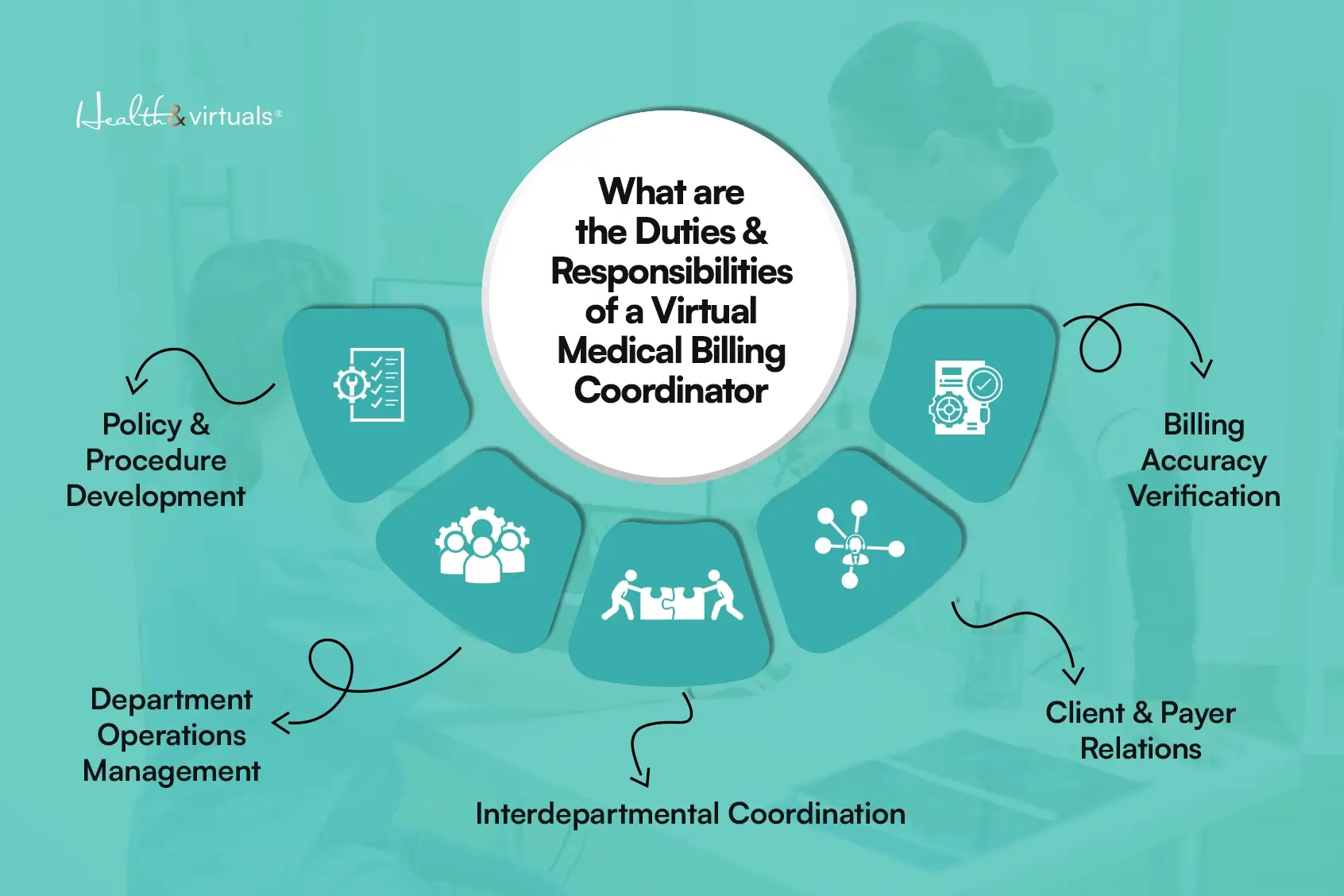
A virtual medical billing coordinator is a virtual assistant who aids in various steps of the revenue cycle, which guarantees the smooth functioning of financial activities.
- At the front end, they check patient insurance records and ascertain proper data entry. This action will stop several downstream claim rejections on its own.
- As the process progresses, they engage in medical coding through standardized medical coding systems such as ICD-10 and CPT, and make sure that they meet the requirements of the payers.
- They work in coordination with medical scribes. They subsequently file and send claims using clearinghouses, monitor their status & resolve problems on the fly.
- A medical billing specialist’s task is even more important in denial management. In case the claims are rejected, they determine the source of the rejection, rectify mistakes, and resubmit/appeal claims on time.
- They also control receivables by calling on the insurers and patients, which helps to decrease the balance and enhance the collection rates.
- Trained healthcare virtual assistants help in the communication of patient billing, sending reminders and handling payment plans.
This is the end-to-end engagement that renders them essential to the current healthcare finance teams.
The Benefits of Hiring a Virtual Medical Billing Assistant!
Cost savings are not the only advantages of employing a remote certified medical billing specialist. They essentially enhance the functioning of healthcare entities.
1. Accelerated Reimbursements
The other major advantage is the accelerated reimbursements. Regular submission of claims and follow-up results in reduced payment cycles and predictable cash flows.
2. Reduced Administrative Burden
Reduction in administrative burden is also noticeable. Physicians and in-house employees devote less time to billing matters, and they can concentrate on patient care. This not only increases productivity but also job satisfaction.
3. Scalability
Another significant benefit of hiring a virtual medical billing coordinator is scalability.
Virtual assistants are easily scalable and do not need much infrastructure modification as the number of patients increases. This is especially useful when expanding practices.
4. Improved Financial Performance
Lastly, virtual billing services enhance financial performance. Healthcare providers can stabilize and maximize revenue cycle by enhancing collections, decreasing denials and streamlining workflows.
Who Should Hire a Virtual Medical Billing Assistant?
Big hospitals are not the only ones that can use virtual medical billing assistants.
Actually, they are particularly useful for smaller practices that cannot afford a full in-house billing staff.
→ Individual Healthcare Providers

Medical billing coordinators can be beneficial to independent physicians, specialty clinics, telehealth providers, and multi-location practices. Virtual dental assistants are also proven to be beneficial in working remotely with dental clinics and help them progress.
The same goes for wellness centers. A virtual wellness assistant, working as remote help in patient communication and also as billing personnel, can help your practice and cut in-house staffing costs up to 70%.
Billing complexity has grown as the use of telehealth is 38 times more than it was before the pandemic, and expert support is even more of a value now.
→ High Denial Claims Organizations
Healthcare organizations with high denials, lengthy accounts receivable periods, or staffing issues are good applicants.
Moreover, virtual assistants are an affordable option in practices that seek to scale without adding overhead.
→ Large Healthcare Systems
Outsourcing models are becoming more popular with even large healthcare systems, with 70% of them having plans to expand RCM outsourcing in the coming years.
Future of Virtual Medical Billing in Healthcare!

The future of medical billing is computerized, remote, and digital. This change will be dominated by virtual medical billing administrative specialists.
Billing processes are already actively being transformed by artificial intelligence and machine learning and are already up to 75% error-reducing and highly efficient.
The cloud-based RCM systems have turned into the norm, allowing the teams to work in-house and remotely in cooperation. Meanwhile, AI-enabled solutions are aiding in detecting problems with claims prior to submitting them, cutting down on denials even more.
The move to value-based care is also making billing more complex and specialized knowledge is needed, which virtual professionals can deliver..
Hire Virtual Medical Billing Assistants with Health & Virtuals!

When your practice is experiencing slow payments, high denials, or increased administrative expenses, it could be time to re-evaluate your billing strategy.
Health &Virtuals links the medical professionals to the highly trained virtual medical billing coordinators who are conversant with the dynamics of RCM.
Our trained professionals can make your operations smoother and maximize revenue, whether it is insurance verification or denial management.
Regardless of your business size, be it a small clinic or a developing healthcare institution, outsourcing your billing services to medical billing specialists may open the gateway to efficiency, cost reduction and better financial results.
FAQs
What does a virtual medical billing assistant do?
A medical billing specialist remotely handles the financial aspect of health care services, such as medical coding, submission of claims, tracking of payments, handling of denials, and billing to patients all remotely through digital systems.
Does virtual medical billing work with small practices?
No doubt that it is particularly helpful to small practices. It helps in cutting on overhead expenses, removes the necessity of having in-house billing personnel and helps in accessing professional personnel without any long-term contracts.
Does it mean that virtual billing can be used in different specialties?
Absolutely. The majority of virtual billing assistants are trained in various specialties and coding systems, which enables them to adjust to the specifics of various practices, such as cardiology, dermatology, orthopedics, and more.