

Are you among the many qualified candidates who are still facing frustrating job search struggles? Hospitals, clinics, private practices & telehealth companies urgently need your talent. But you need to know how to approach them and make their struggle to get hired in healthcare successful.
According to the U.S. Bureau of Labor Statistics, healthcare occupations are growing. And it is reported to grow much faster than average over the next decade. Of course, it will be adding millions of new jobs globally.
Demand for nurses, allied health professionals, healthcare administrators, therapists, and remote care specialists will be more than before!
However, the hiring process has become more technical. It is more competitive and increasingly digital. So, now candidates must understand how to tackle their healthcare job search struggles. So they may get hired in healthcare for the best and most suitable role.
Understanding Today’s Healthcare Job Market!

The healthcare labor market has changed dramatically in recent years.
Why?
Because of aging populations, rising chronic disease rates… digital healthcare expansion & workforce shortages have accelerated hiring demand. It is evident across nearly every healthcare specialty.
At the same time, healthcare employers have become more selective. They can give a hard time about hiring due to budget pressures, staffing shortages, and rising patient care standards.
Research from global healthcare workforce studies shows that:
→ Occupations related to healthcare remain among the fastest-growing job categories…
→ Nursing shortages continue across multiple countries. WHO & ICN predict for 2030, an upcoming shortage of up to 4 million nurses.
→ Telehealth and remote healthcare careers are expanding rapidly. By 2032, its market is expected to rise to $790 billion of growth. Of course, due to increased demand for telehealth, telepsychiatry & other online health related fielsds.
→ Healthcare employers increasingly prioritize soft skills alongside clinical expertise
→ ATS-based recruitment systems now filter the majority of healthcare applications before human review. It is a highlight in job search tips to have an ATS-friendly, proper CV.
What Are the Common Healthcare Job Search Struggles?
If you are among those candidates who are applying to dozens of jobs. Please be aware that it is not enough now… You need to refocus your healthcare job search struggles. Get a proper healthcare job search guide, as modern healthcare recruiting does not work that way anymore.
It is said that recruiters receive and review hundreds of applications. Only for a single opening. So, it’s obvious technology is involved. No matter whether you are a qualified professional. It is possible your cv may never reach the interview stage if not properly optimized.
That is why understanding modern healthcare recruiting trends is critical. Let’s learn about the challenges before knowing the solution & best job search tips and effective healthcare job interview tips…
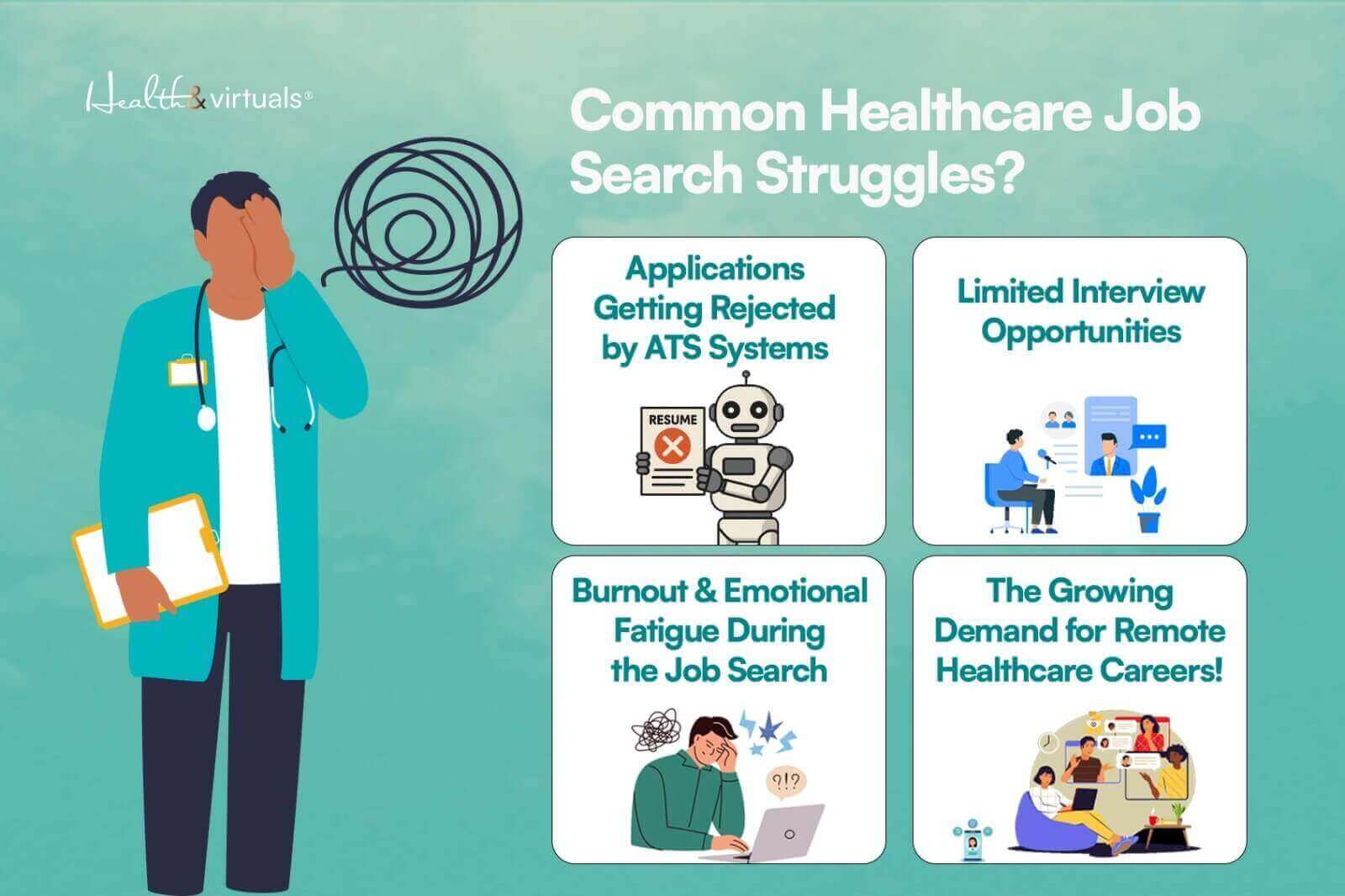
1. Applications Getting Rejected by ATS Systems
It is one of the biggest job struggles today. Healthcare job search guides highlight the importance of ATS, which is; applicant tracking systems.
Most hospitals, staffing firms, and healthcare organizations use ATS software. It is to scan a resume. They scan it before a human eye ever sees them.
These systems search for specific keywords, certifications, job titles, and experience matches.
So, you must know that a resume lacking proper formatting or targeted keywords may be automatically rejected.
For example:
- “Registered Nurse” may not match “RN”.
- Missing certifications may lower ranking scores.
- Generic resumes reduce visibility.
- Complex graphics or tables may break ATS readability.
2. Limited Interview Opportunities
Many candidates apply repeatedly… But they face job search struggles because only a few get interview invitations.
Several factors contribute to this issue:
- Highly competitive urban healthcare markets.
- Insufficient specialization.
- Weak resume summaries.
- Lack of measurable achievements.
- Poor online professional presence.
- Incomplete credential documentation.
Healthcare employers increasingly seek professionals who demonstrate both technical competency and adaptability.
Simply listing duties is no longer enough.
Instead of saying:
“Responsible for patient care.”
Candidates should write:
“Managed care for 25+ patients per shift while maintaining 98% patient satisfaction scores.”
Specificity improves recruiter confidence.
3. Burnout and Emotional Fatigue During the Job Search
Job searching itself can become emotionally exhausting.
Research on employment stress consistently shows that prolonged job searches negatively impact confidence and motivation.
This often causes candidates to:
- Stop tailoring resumes.
- Apply impulsively.
- Underperform during interviews, forgetting useful job interview tips.
- Lose networking momentum.
- Accept poor-fit positions.
Consistency matters more than volume. A focused healthcare job search strategy can perform better for you… It’s way better than mass applications.
4. The Growing Demand for Remote Healthcare Careers!
Remote healthcare work is no longer limited to administrative positions.
Today, telehealth has transformed patient care delivery worldwide.
Healthcare organizations increasingly hire remote professionals for:
- Care coordination
- Behavioral health services
- Medical transcription
- Insurance verification
- Medical coding
- Nurse triage
- Virtual assistance
This shift has created new opportunities for candidates facing geographic limitations or seeking better work-life balance.
Remote healthcare recruiting continues growing because organizations aim to reduce staffing shortages while expanding patient access.
Tips for Improved Healthcare Recruiting Success

Following job search tips will be very helpful for healthcare candidates to get a better job:
1. Building a Strong Healthcare Resume
Your resume remains your most important marketing tool.
Healthcare recruiters often spend less than 10 seconds during the first screening review. That means clarity and structure are essential.
Key Elements of a Strong Healthcare Resume
1. Professional Summary
Start with a concise, achievement-focused summary…This immediately communicates expertise.
2. Certifications and Licenses
Healthcare employers prioritize credentials.
Clearly list:
- Licensure
- Board certifications
- Clinical specializations
- CPR/BLS/ACLS certifications
- Software competencies
- Language proficiency
Place these near the top for visibility.
3. Quantifiable Achievements
Statistics create credibility.
Instead of generic descriptions, include measurable impact.
Examples:
- Reduced patient wait times by 20%
- Managed 40+ daily patient interactions
- Improved documentation accuracy by 30%
- Assisted in achieving compliance audit success
Numbers strengthen professional authority.
2. Optimizing Your Resume for Healthcare Jobs and Recruiters
As technology is involved, your resume should be optimized. It goes with ATS optimization. As it has become essential in modern healthcare recruiting.
Use Relevant Keywords Naturally
Include keywords directly related to the role, such as:
- Patient care coordination
- Electronic health records (EHR)
- Clinical documentation
- Telehealth support
- Healthcare compliance
- Infection control
- Medical billing
- Behavioral health support
This improves ATS matching scores.
3. Avoid ATS Formatting Mistakes
Many healthcare candidates unknowingly damage ATS readability. It is done by using:
| DONT’S | DO THIS INSTEAD! |
|
Simple formatting performs better. Use:
|
4. Customize Every Application
Remember! One generic resume rarely succeeds. They are smart. Your healthcare recruiters can immediately identify copy-paste applications.
Although it takes time, but never compromise on tailoring your resume for each job. It will improve interview rates significantly because it aligns directly with employer priorities.
5. Develop In-Demand Healthcare Skills
It is an advanced era. Technology-related skills can not be left behind with your healthcare skills if you want to get hired in healthcare. Recruiters increasingly seek professionals who combine both; technical and interpersonal strengths.
Most In-Demand Healthcare Skills
| Technical Skills | Soft Skills |
|
|
6. Learn Digital Healthcare Skills
Remote healthcare careers have expanded dramatically. They are more convenient, reducing commute efforts. Telehealth usage surged globally after the pandemic and remains a major hiring sector today.
Healthcare organizations now recruit for:
- Virtual medical assistants
- Remote nurses
- Telehealth coordinators
- Virtual Medical Billing Specialists, Virtual Scheduler, Virtual Scribes
- Remote patient monitoring specialists
- Virtual healthcare staffing roles, sync as Virtual dental assistant, virtual wellness assistant, virtual chiropractic assistant, and more
Candidates with digital communication skills and remote workflow experience are favored now. They hold a competitive advantage.
7. Networking in the Healthcare Industry
YES! Networking remains one of the most underrated job search tips.
A large percentage of healthcare roles are filled through referrals. They use internal recommendations or professional connections before public advertising gains traction.
Effective Healthcare Networking Strategies
| 1. | Join Professional Associations | Industry organizations help candidates access:
|
| 2. | Strengthen LinkedIn Presence | Recruiters actively search LinkedIn for healthcare talent.
An optimized profile should include:
Profiles with active engagement typically receive more recruiter visibility. |
| 3. | Reconnect With Former Colleagues | Many healthcare opportunities emerge through trusted referrals. Reconnet with:
Sometimes one conversation creates the breakthrough an online application never could. |
8. Preparing for Healthcare Job Interviews
Strong interviews often determine who gets hired in healthcare.
Healthcare employers assess more than qualifications. They evaluate professionalism, communication, critical thinking, empathy, and reliability.
Essential Job Interview Tips
- Research the Employer Thoroughly
Understand:
- Facility type
- Patient population
- Core services
- Organizational values
- Recent news
- Accreditation status
Candidates who demonstrate preparation appear more invested.
- Practice Behavioral Interview Questions
Healthcare interviews frequently use behavioral formats.
Examples include:
- Describe a difficult patient interaction
- Tell us about handling workplace conflict
- Explain a high-pressure clinical situation
- Discuss a medical error and resolution
- Share an example of teamwork
Use the STAR method:
- Situation
- Task
- Action
- Result
Structured responses sound more professional and credible.
- Prepare Questions for the Interviewer
Strong candidates ask thoughtful questions.
Examples:
- What qualities make employees successful here?
- How does your organization support professional growth?
- What challenges is the team currently facing?
- What does onboarding look like?
This demonstrates genuine interest.
High-Impact Healthcare Job Search Tips!
→ Apply Selectively. Quality applications outperform mass submissions… Tailor each resume carefully.
→ Track Applications. Maintain a spreadsheet including: Employer name, position title. application date, follow-up timeline, interview status & some job interview tips you have learnt from the current interview.
Organization prevents missed opportunities and prepares you better for the next!
→ Upskill Continuously. Healthcare evolves rapidly.
Short certifications, software training, and continuing education increase competitiveness.
→ Improve Interview Confidence. Practice aloud. Record responses. Conduct mock interviews.
Preparation reduces anxiety significantly.
→ Maintain Professional Online Presence. Recruiters frequently review online profiles before scheduling interviews.
Professionalism across LinkedIn and other platforms matters.
How Healthcare Staffing Agencies Can Help?
Healthcare staffing agencies play a growing role in modern recruitment. They can accelerate your job search… How?
As many hospitals and clinics rely on staffing firms to fill urgent shortages quickly.
Working with healthcare staffing agencies can provide candidates with:
- Faster hiring access
- Exclusive openings
- Resume guidance
- Interview preparation
- Flexible scheduling opportunities
- Temporary-to-permanent pathways
Healthcare staffing agencies often help professionals enter competitive healthcare environments more efficiently.
They also provide access to remote healthcare careers and contract-based opportunities that many candidates would not discover independently.
For new graduates, career changers, or professionals re-entering the workforce, staffing firms can reduce many common healthcare job search struggles. Learn tips you should know to get hired faster with a staffing firm…
Healthcare remains one of the world’s most essential and fastest-growing industries. Yet finding the right role still requires strategy, persistence, and adaptability.
Get Hired with Health & Virtuals!

The good news is this: demand for qualified healthcare professionals continues to rise.
Whether your job struggle is about pursuing clinical positions, administrative roles, or remote healthcare careers, candidates who approach the process strategically improve their chances of success dramatically.
Get hired in healthcare may feel overwhelming at times, but the right preparation transforms frustration into opportunity.
If you are considering remote options. You can opt for the best and most trusted staffing agency, Health & Virtuals.
No matter where you are located, we connect you with the best Healthcare practices, legal practices, and other businesses across the United States, matching and most suitable for your skills.
We also train candidates on our Digital Training System, which is US standard, to make you worthy of a long-term hire, strengthening your career!
Get Hired in Healthcare! Apply here…
FAQs
Why is it difficult to get hired in healthcare even during staffing shortages?
Many healthcare organizations use ATS software and highly selective hiring processes. Candidates may struggle if resumes are not optimized, certifications are missing, or applications lack role-specific customization.
What are the best healthcare job search tips?
The most effective job search tips include tailoring resumes, optimizing for ATS systems, networking strategically, practicing interviews, and continuously developing healthcare-related skills.
How can healthcare staffing agencies help job seekers?
Healthcare staffing agencies connect candidates with employers, provide career guidance, improve hiring speed, and offer access to exclusive healthcare job opportunities.
What skills are most important for healthcare careers today?
Healthcare employers value both technical and soft skills, including patient care, electronic medical records, communication, adaptability, teamwork, and telehealth experience.
Are remote healthcare careers growing?
Yes. Telehealth expansion has significantly increased demand for remote healthcare positions, including medical coding, virtual nursing, patient coordination, and healthcare administration.