

In the first hour of a clinic opening, everything happens at once.
Phones start ringing… Appointment requests accumulate overnight… A patient rings for a missed prescription… Or a last-minute reschedule…?
The front desk is already overwhelmed with check-ins, and the doctors are busy saving lives.
From the outside, it might look organized with the way appointments move forward, patients are seen, and records are regularly updated. However, behind the apparent order is a constant process of sorting, prioritizing, and responding in real time.
A healthcare virtual assistant (VA) exists at the center of it, who effectively manages the flow of a clinic’s day in addition to scheduling, communicating with patients, follow-ups, coordination & serving other specialized Virtual medical assistant types & the roles, such as Virtual dental assistant (VDA), Physician Assistants (PA), Virtual Nursing Home Assistant, Wellness Assistant……
Because in a healthcare setting, it’s not the visible work alone that keeps things running. It’s the unseen consistency behind it.
What Can a Healthcare Virtual Assistant Do?

There is a range of administrative and patient-facing responsibilities carried by a healthcare virtual assistant that keep a clinic running efficiently.
These typically include:
- Appointment scheduling and calendar management.
- Patient communication and follow-ups.
- Insurance verification and data entry.
- Managing electronic health records (EHRs).
- Handling billing coordination and documentation.
Each of these tasks might overlap with the other, requiring vigilance and adaptability from virtual assistants.
Thus, if you are a job seeker looking to dip your toes into the healthcare pool or a clinic owner wondering if hiring a healthcare VA is worth it, it might help to look at what their day actually looks like.
A Typical Day for a Virtual Medical Assistant!
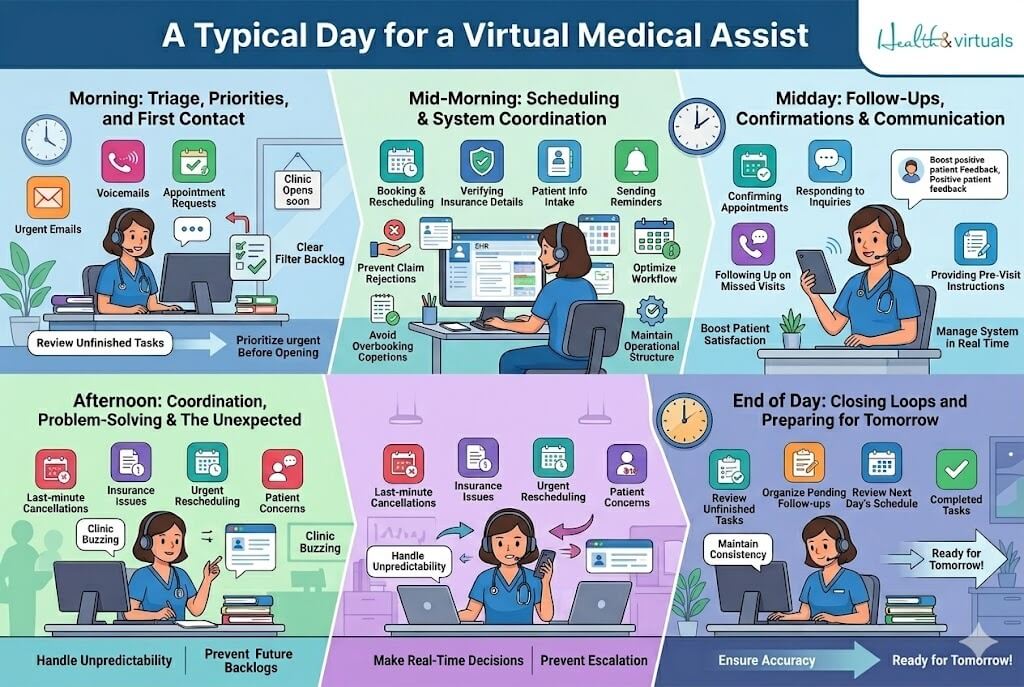
The Morning: Triage, Priorities, and First Contact
More often, healthcare virtual assistants begin their day by resolving unfinished tasks. It may include tasks such as reviewing appointment requests. The missed calls, voicemails, and urgent patient queries….
What is important at this stage, it is that a remote medical assistant has a sense of which tasks to prioritize!!!
These decisions ensure no bookings are pending. Calls are timely returned, and time-sensitive concerns are dealt with.
Why? Because even a minor oversight can result in patient dissatisfaction.
By the time the clinic officially opens, the backlog is already under control with your VMA skills.
Mid-Morning: Scheduling, Intake, and System Coordination
As the clinic day starts buzzing, the virtual assistant shifts into administrative mode. They take on tasks such as:
- Booking and rescheduling appointments.
- Verifying insurance details.
- Entering patient information into EHRs.
- Sending appointment reminders.
So the work continues. Steady, careful, and consistent.
Each of these tasks forms the operational structure of a clinic or any healthcare facility. It is evident that even small inconsistencies can disrupt workflows.
An incorrect insurance entry? can result in claim rejections later.
Or a poorly managed schedule? can lead to either overbooking or idle time which is a loss.
Midday: Follow-Ups, Confirmations, and Patient Communication
By midday, most remote administrators shift their focus toward patient interactions.
This typically involves:
- Confirming upcoming appointments.
- Responding to patient inquiries.
- Following up on missed visits.
- Providing pre-visit instructions.
These tasks are meant to maintain the operational efficiency of a clinic while simultaneously improving patient satisfaction.
A healthcare virtual assistant significantly influences how patients experience the clinic through responsiveness and reliability.
From the patient’s perspective, it feels simple—timely reminders, quick responses, clear guidance.
What they don’t see is the system behind it, being managed in real time.
Afternoon: Coordination, Problem-Solving, and the Unexpected
As the day progresses, unpredictability becomes the norm in the hustle of the clinic. This is where the services of a virtual assistant come in handy. As remote warriors, they handle:
- Last-minute cancellations.
- Insurance issues.
- Urgent rescheduling requests.
- Patient concerns.
In the high-paced environment of healthcare, VAs master the art of making real-time decisions that prevent disruptions from escalating.
End of Day: Closing Loops and Preparing for Tomorrow
As the clinic day winds down, so do the things a VA does. All that’s left is the completion of the current day tasks and preparation for tomorrow.
This includes:
- Reviewing unfinished tasks.
- Organizing pending follow-ups.
- Ensuring the next day’s schedule is accurate and manageable.
This step plays a crucial role in maintaining consistency across the day-to-day operations of a clinic. Just as a well-prepared schedule reduces next-day confusion, completed tasks prevent a backlog.
What does Being Medical VA Really Mean?

Most patients never see this side of healthcare operations.
They don’t see the coordination, the prioritization, or the constant adjustments happening behind the scenes.
But they experience it.
In shorter wait times.
In timely responses.
In appointments that simply… work.
That’s the impact of a healthcare virtual assistant.
Key Roles a Healthcare Virtual Assistant Plays
As a VMA, you can be assigned to play any of these roles in a healthcare facility:
- Administrative Support → manages appointments, scheduling, and daily calendars.
- Patient Communication → handles calls, messages, reminders, and follow-ups.
- Billing & Insurance Assistance → verifies coverage and supports claims processing.
- EHR Management → updates and maintains accurate patient records.
- Clinical Support (Non-Hands-On) → prepares charts and assists with documentation.
- Workflow Coordination → keeps schedules balanced and operations running smoothly.
- Telehealth Coordination → organizes and supports virtual consultations.
- Patient Experience Management → ensures timely responses and consistent communication.
- Referral Coordination → manages specialist referrals and documentation flow.
- Prescription Support → assists with refill requests and pharmacy coordination.
Specialized Roles of a Healthcare Virtual Assistant
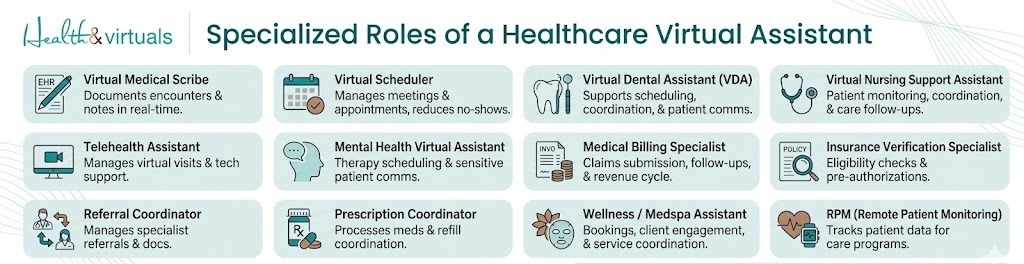
The following are specialized roles a Healthcare virtual assistant can be trained for, and serve any practice with:
Virtual Medical Scribe → documents patient encounters and physician notes in real time.
Virtual Scheduler → schedule your meetings, appointments, and avoid no-shows, protecting your revenue.
Virtual Dental Assistant (VDA) → supports dental scheduling, treatment coordination, and patient communication
Virtual Nursing Support Assistant → assists with patient monitoring, coordination & care follow-ups
Telehealth Assistant → manages virtual visits, patient onboarding, and technical support
Mental Health Virtual Assistant → schedules therapy sessions and handles sensitive patient communication
Medical Billing Specialist → focuses on claims submission, follow-ups, and revenue cycle tasks
Insurance Verification Specialist → handles eligibility checks and pre-authorizations
Referral Coordinator → manages specialist referrals and documentation flow
Prescription Coordinator → processes medication requests and refill coordination
Wellness / Medspa Assistant → manages bookings, client engagement, and service coordination
Remote Patient Monitoring (RPM) Assistant → tracks patient data and supports ongoing care programs
Care Coordinator → ensures communication between providers, patients, and departments
Why Healthcare Virtual Assistants Matter for a Practice?

The services of a virtual assistant are often overlooked as a mere collection of tasks. However, their real value lies in how these tasks connect and aid in the smooth operation of the clinic.
The inefficiency of a medical practice rarely comes from major failures. Instead, small, repeated issues, including missed confirmations and delayed responses, add to the sour experience of a patient.
Furthermore, without a virtual assistant to manage these tasks increases the workload on the healthcare staff, which may affect the operational consistency of a clinic.
Key Benefits of Hiring a VMA for a Medical Facility
Skimming through the day in the life of a virtual healthcare administrator does not fully explain their impact on a clinic’s overall functioning.
First things first, a remote medical assistant offers an immediate benefit, which is the reduction in costs of hiring an in-house staff. If the clinic management opts to go for remote hiring of the healthcare assistant, they are essentially saving on employee benefits they must offer to in-house staff, such as commute allowance, medical benefits, office space, and more.
Other key benefits include:
Improved Operational Efficiency
Workflows become more structured and less fragmented across staff members. Fewer Scheduling Errors. Also, the consistent coordination between the patient and the clinic reduces overbooking and missed appointments.
Faster Patient Communication
Queries, confirmations, and follow-ups are handled in real time.
Better Staff Productivity
Internal teams are no longer stretched across multiple administrative layers
These improvements don’t just reduce pressure on the clinic; they reshape how it functions on a day-to-day basis.
Build a Career as a Healthcare Virtual Assistant

Behind every efficient healthcare facility. Of any size! is a team of trained professionals who keep things organized, responsive, and running smoothly. You can be a part of it…
If you’re detail-oriented, comfortable with communication, and interested in healthcare operations, working as a healthcare virtual assistant can be a highly rewarding career path.
This role goes beyond routine administrative work. It places you at the center of real-time decision-making… supporting patients, assisting providers, and ensuring that care delivery stays consistent and efficient.
Why Consider Becoming a Virtual Medical Assistant?
Work Remotely → build a stable career without being tied to a physical clinic.
High Demand Skillset → healthcare support roles continue to grow globally.
Diverse Career Paths → specialize in areas like medical billing, scribing, telehealth, or patient coordination.
Meaningful Work → contribute to patient care without being on the clinical frontlines.
Career Growth Opportunities → expand into advanced healthcare administrative roles…
Who Is This Role Ideal For?
This career path is especially suitable for individuals who:
- Have a background in healthcare, administration, or customer support.
- Possess strong organizational and communication skills.
- Are comfortable working with digital tools and healthcare systems.
- Prefer structured, process-driven work environments.
- Want to build a long-term remote career in healthcare.
Start Your Journey with Health & Virtuals!

Whether you’re beginning your career or looking to transition into a remote healthcare role, the demand for skilled virtual assistants continues to grow.
At Health & Virtuals, we connect motivated individuals with opportunities to work alongside healthcare providers, gain hands-on experience, and build a sustainable remote career.
Step into a role, Get Hired! where you connect with a team to work directly supports patient care…while giving you the flexibility and growth you’re looking for.