

A Sales Development Representative (SDR) is someone who identifies prospective clients for a business. They are responsible for engaging them through outreach (calls, emails, or LinkedIn), and determining whether they are a good fit before passing them to a closing sales representative.
In simple Terms, an SDR does not close deals… instead, they: generate leads, start conversations, qualify prospects & book meetings for the sales team. They must have proven experience in B2B lead generation, outbound prospecting, or sales support roles.
In a revenue-driven business environment, companies can no longer rely on passive lead generation alone. A structured and predictable sales pipeline is essential… so a Sales Development Representative (SDR) becomes indispensable.
According to research by HubSpot, organizations that prioritize lead nurturing generate 50% more sales-ready leads. All at 33% lower cost. This highlights the growing importance of SDRs as a strategic function, not just a support role.
What Is a Sales Development Representative (SDR)?

A Sales Development Representative (SDR) serves as the strategic engine behind a company’s sales pipeline. In easy words thy are responsible for ensuring that businesses have a consistent pipeline of high-quality leads. As it directly supports revenue growth and sales efficiency.
This role focuses on identifying, engaging, and qualifying potential clients before handing them off to closing teams.
SDRs manage outbound campaigns. They conduct discovery conversations and act as the first professional touchpoint for prospective clients.
Their work ensures that only high-quality yet sales-ready opportunities move forward in the funnel.
Why SDRs Are Critical to Business Growth?

SDRs directly impact your business’s revenue predictability and scalability. Without them, sales teams often waste valuable time on unqualified prospects.
Key impact areas:
- Consistent pipeline generation.
- Improved lead quality.
- Reduced customer acquisition cost.
- Faster deal cycles.
A report from Salesforce indicates that high-performing sales teams are 2.3x more likely to use structured prospecting processes… a core responsibility of SDRs.
About the Role: What Do Sales Development Representatives Do?

An SDR works as a Lead Development Representative, ensuring a steady flow of qualified opportunities to grow your revenue. It is done through structured outreach and disciplined execution.
Core function of the role:
- Manage outbound and inbound prospecting campaigns.
- Conduct initial discovery calls. To identify business needs.
- Execute multi-channel sales cadences (email, LinkedIn, phone).
- Maintain accurate CRM data. Also the engagement tracking.
- Bridge the gap: Between cold leads and sales-ready opportunities.
A Sales development representative, remote or in-house, is an essential role for today’s businesses’ growth for maintaining predictable and scalable revenue generation.
SDRs identify operational gaps. They track engagement signals. Also, they ensure consistent follow-ups across all prospect interactions.
Key Roles & Duties of Sales Development Representatives
Their work revolves around structured outreach and intelligent qualification. If you hire a sales development representative, they are ofthen take care of the following daily responsibilities:
- Identifying decision-makers within Ideal Customer Profiles (ICPs).
- Conducting outreach via email, calls, and LinkedIn.
- Qualifying leads based on fit, need, and timing.
- Scheduling meetings for Account Executives.
- Tracking and updating CRM data.
- Monitoring engagement and optimizing outreach strategies.
They ensure no opportunity is lost due to poor follow-up or lack of structure…
Core Responsibilities of Sales Development Representatives
Sales development representative responsibilities help define their strategic importance. They are useful in building a predictable and scalable sales pipeline. Whether in-house or through remote staffing solutions.
→ Execute Structured Multi-Channel Outbound Campaigns
SDRs run organized outreach campaigns. Across email, phone, and LinkedIn. It is to consistently engage potential prospects.
Remote or outsourced sales development representatives (SDRs) leverage digital tools. They are trained to manage these campaigns efficiently from anywhere. More cost-effectively for your business. Ensuring continuous outreach without geographical limitations.
→ Conduct Discovery Conversations To Uncover Client Needs
Business development sales representatives initiate early-stage conversations to understand a prospect’s business challenges, goals, and pain points.
Remote SDRs maintain the same level of professionalism. Their engagement is flawless through virtual communication channels.
This helps determine whether there is a genuine opportunity for the company’s solution.
→ Qualify Leads Using Defined Frameworks And Criteria
SDRs assess prospects based on factors like budget. Also, the authority, need, and timing (BANT).
This is a famous yet structured approach. Trained on that, sales development representative skills ensure only high-potential leads move forward.
→ Route Qualified Opportunities With Detailed Handoff Notes
Once a lead is qualified, SDRs pass it to Account Executives. With clear context. Including insights and communication history.
Remote SDR teams outsourced from a trusted sales development representative staffing recruitment agencies ensure seamless collaboration. Done through CRM systems and shared platforms. This enables a smooth and informed transition.
→ Maintain Pipeline Visibility And CRM Accuracy
They regularly update CRM systems. With accurate data. Maintaining useful information on leads, interactions, and deal stages. Remote SDRs rely heavily on these systems. It is to maintain transparency and real-time visibility across distributed teams.
This ensures transparency. Helping sales teams make data-driven decisions.
→ Collaborate With Marketing To Refine Messaging
SDRs work closely with marketing teams. To improve outreach strategies and messaging. Remote environments enable ongoing collaboration through digital communication tools and shared workflows.
This collaboration helps improve targeting. Also, the messaging effectiveness.
→ Track Outreach Performance And Engagement Signals
They monitor key metrics. Such as open rates, response rates, and engagement levels. For optimizing performance. Continuous tracking allows SDRs to improve conversion outcomes over time. Remote SDRs use advanced analytics tools to continuously refine their outreach approach.
Essential Skills of a Sales Development Representative
Strong sales development representative skills combine communication, strategy, and persistence.
Core Skills include:
- Exceptional verbal and written communication.
- Clear articulation of value propositions.
- Strong lead qualification and analytical thinking.
- High discipline in managing outreach volume.
- Resilience in handling rejection and follow-ups.
- Effective time and pipeline management.
According to LinkedIn’s State of Sales Report, top-performing sales professionals are 88% more likely to prioritize relationship-building. They have good communication skills. Whether working as an on-site or sales development representative, or remotely for a business. Reinforcing the importance of these competencies.
Qualifications & Requirements for SDR

1. Educational Background
Qualification of and SDR must be a Bachelor’s degree in Business, Marketing, or a related field (preferred).
2. Professional Experience
As mentioned in SDR job descriptions, a qualifying sales development representative’s experience includes:
- Proven experience in B2B lead generation or outbound prospecting.
- Familiarity with sales cadences and structured multi-touch outreach sequences.
- Experience in sales support or pipeline management roles, including CRM usage and lead tracking.
- Exposure to remote sales operations or virtual selling environments (preferred in modern SDR roles).
- Experience in qualifying leads and scheduling meetings for Account Executives.
- Ability to work in target-driven environments with measurable KPIs and performance metrics.
3. Technical Proficiency
Whether working on-site or remote, SDRs must be technically skilled to compete in the digital, innovative business world. An SDR must be equipped with the knowledge of:
- CRM platforms such as Salesforce or HubSpot.
- Prospecting tools and data platforms like LinkedIn Sales Navigator, Apollo, or ZoomInfo.
- Communication and outreach systems, including email sequencing tools, dialers, and LinkedIn messaging platforms.
- Sales engagement platforms such as Outreach or Salesloft for managing cadences and follow-ups.
- Data tracking and analytics tools to monitor engagement rates, conversions, and campaign performance.
- Virtual collaboration tools like Slack, Zoom, or Microsoft Teams are especially important for remote SDR teams.
- AI-powered sales tools for lead scoring, personalization, and outreach optimization.
Tools That SDRs Commonly Use!
Modern SDRs rely heavily on technology to scale their efforts efficiently.
Key tools include:
- CRM systems (Salesforce, HubSpot)
- Outreach platforms (Outreach, Salesloft)
- LinkedIn Sales Navigator
- Lead intelligence tools (ZoomInfo, Apollo)
- Communication tools (Zoom, Slack)
Companies using CRM systems effectively see up to 29% increase in sales productivity (Salesforce data).
SDR Career Path and Growth Opportunities
The SDR role is often the entry point into high-level sales careers.
Your career can progress as:
- SDR → Senior SDR
- Account Executive
- Sales Manager
- Business Development Leader
This role builds foundational skills in communication, strategy, and revenue generation.
Challenges Faced by SDRs

Sales Development Representatives operate in a highly structured, performance-driven environment. Their consistency and discipline are critical.
Whether working on-site or as a remote SDR, they face several operational challenges. That directly impacts productivity and pipeline outcomes.
→ High-volume outreach demands. SDRs are expected to manage large-scale daily outreach. Across email, phone, and LinkedIn. This requires strong time management and sustained focus.
→ Rejection and low response rates. Cold outreach often results in frequent rejection. Or no response. Making resilience and persistence essential traits for success.
→ Maintaining CRM accuracy and data discipline. SDRs must consistently update CRM systems. All with correct and timely data. For ensuring pipeline visibility. And to avoid gaps in reporting.
→ Meeting strict performance KPIs. SDRs are often measured on calls. On emails sent, meetings booked, and conversion rates. Thus, facing constant performance pressure.
→ Managing multi-channel coordination. Coordinating outreach across multiple platforms. Email, LinkedIn, calls… require strong organization and structured workflows.
→ Remote communication and alignment (for remote SDRs)
Remote SDRs must stay closely aligned with sales and marketing teams. Using digital tools. That can be challenging without in-person interaction.
→ Handling shifting buyer behavior. Prospects are increasingly informed and selective. Requiring SDRs to continuously adapt messaging and outreach strategies.
Benefits of Hiring an SDR for Your Business
Hiring an SDR, especially a remote sales development representative…offers measurable business advantages.
Key benefits of an SDR include:
- Scalable lead generation.
- Improved sales efficiency.
- Lower customer acquisition costs.
- Higher conversion rates.
- Better alignment between sales and marketing.
- Faster sales cycle.
- Stronger pipeline visibility through accurate CRM tracking.
- Increased revenue predictability with consistent qualified leads.
- Improved targeting of Ideal Customer Profiles (ICPs).
- Flexibility to support remote and outsourced SDR staffing models for scalable growth.
Many companies now prefer outsourced sales development representatives hired from trusted sales development representative staffing and recruitment agencies, such as Health & Virtuals, to access skilled talent without increasing overhead.
Build a Strong Sales Pipeline with Skilled SDRs from Health & Virtuals
At Health & Virtuals, our SDRs are trained. They are here to deliver consistent, high-quality pipeline generation through structured processes and professional engagement.
They specialize in:
- Multi-channel outbound campaigns.
- Data-driven prospecting.
- Lead qualification and CRM management.
- Sales pipeline optimization.
Why Choose Health & Virtuals for Hiring SDRs?
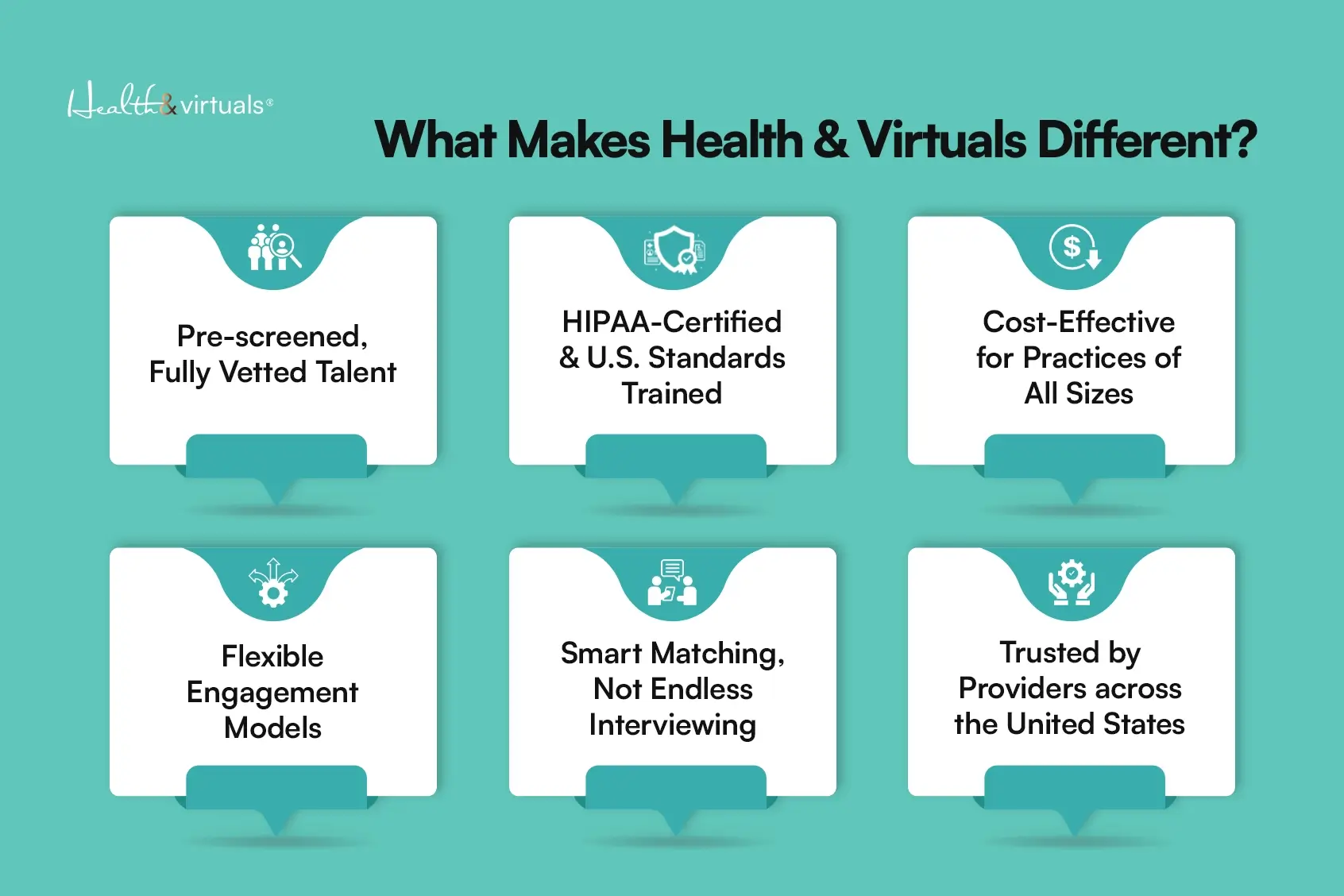
→ Elite Talent
Only the top 2% of applicants are selected and rigorously trained.
→ Comprehensive Training
All professionals undergo an American-Certified Academy program covering U.S. standards, documentation, and compliance.
→ Risk-Free Hiring
Start with a 1-week trial before full onboarding.
→ End-to-End Support
We handle onboarding, scheduling, performance tracking, and quality control.
→ Scalable Workforce
Easily scale your SDR team up or down as your business grows.
→ Global Expertise, Local Standards
Our professionals align with U.S. business practices, ensuring seamless integration into your workflow.
Ready to build a predictable and scalable sales pipeline?
Hire a Sales Development Representative and remote staffing from Health & Virtuals today and turn prospects into revenue.
FAQs
What is the difference between an SDR and a BDR?
An SDR focuses on lead qualification. On early-stage outreach. Well, a BDR typically handles strategic partnerships and broader business growth initiatives.
How much does an SDR earn?
SDR salaries typically range between $40,000 and $70,000 annually. It varies. With additional performance-based incentives depending on results.
What industries hire SDRs?
SDRs are widely used across SaaS, healthcare, finance, e-commerce, real estate, and professional services industries.