
You’ve probably done the same as Google “BDR vs SDR” and ended up more confused than when you started. In fact, you might be one of many who have done the same. Even the large-scale industry names like Salesforce don’t really agree — while they consider reps as moving from SDR to BDR as a progression up the career ladder, HubSpot, G2 & LeadFuze have seen BDR as a continuation of outbound, and sales development representative remote or onsite as inbound.
Before you publish a job description or redesign your team, let’s take a closer look at the different roles of sales development representative vs business development representative, and which one your business should be looking for now.
What is a BDR (Business Development Representative)?
A business development representative BDR is someone who creates new business by initiating outbound prospecting. A business development representative, remote or onsite, seeks out potential customers that are not already aware of your business, researching target accounts, initiating cold outreach via email, phone, and LinkedIn, and opening doors that marketing doesn’t.
BDRs do not make sales. They are qualified to be interested in early-stage and transfer the leads to Account Executives (AEs) who are interested in pursuing them. You should think of them as demand creators – they create a pipeline from scratch every single day.
→ BDR core responsibilities:
Do research and create a strategic list of target accounts that relate to your ICP.
Tap into buyer-specific messaging to address specific industries and buyer personas.
Give AE’s time-sensitive qualifications and book discovery.
Give insight into what prospects are interested in hearing.
What are SDRs? (Sales Development Representatives)
A sales development representative (SDR) filters out inbound leads, which are those individuals who have already indicated that they are interested in your product by completing a form, signing up for a trial, downloading content or requesting a demo.
It is not the SDR’s responsibility to seek out interest; it is available. Their task is to quickly respond to reply to the inquiry, and if it is a true sales opportunity, to efficiently send the appropriate leads to the AEs. SDRs are demand generators – sales development representative skills work the pipeline that marketing has created.
→ Sales development representative responsibilities:
Answer inquiries promptly (preferably within minutes)
Develop warm leads that aren’t yet in the buying stage
Delegate qualified opportunities with context to AEs
Maintain accurate and up-to-date CRM information.
BDR vs SDR: Key Differences
Even though both roles of sales and business development representatives are inbound and outbound, there are several key differences between them, and it is their split that really marks the beginning.
Voice input: Generated by SDRs’ work leads. BDRs create their list of prospects from the ground up.
Nature of conversations: SDR conversations begin warm: The prospect already knows your company. BDR calls are going cold start – the rep will have to gain qualification in order to be allowed to talk first in the conversation.
Volume vs. precision: SDRs will be able to process higher volume with speed. BDRs work on fewer accounts but for a longer period of time, researching, personalizing, and following up.
Metrics used to measure performance: SDRs are measured by speed-to-lead, MQL-to-SQL conversion rate, and meetings booked. BDRs are judged SALa (sales Accepted Leads) & on the number of accounts they touch, the number of SQLs they produce from cold outreach and the amount of pipeline value they generate.
One of the most frequent team-building errors is to use the same scorecard for both positions.
Relationship to marketing: SDRs are marketing’s best ally in sales — they complete the sales funnel by providing the feedback on the quality of leads. Better times for cold outreach, thanks to marketing’s brand and content, make BDRs more independent.
SDR vs. BDR at a Glance!
Factor
SDR
BDR
Primary Motion
Inbound qualification
Outbound prospecting
Lead Source
Marketing-generated
Self-sourced target accounts
Prospect Awareness
Already knows you
Cold or unaware
Key Skill
Fast qualification, active listening
Persistence, research, and personalization
KPIs
Speed-to-lead, meetings booked
Pipeline created, SQLs generated
Best For
High inbound volume
New markets, enterprise, low inbound
BDR vs SDR: Which Role Does Your Sales Team Need?
The first step in tackling your real pipeline challenge is to find the issue.
→ Hire an SDR when:
Marketing is generating 30+ MQLs per month but they aren’t being followed up on fast enough
Your own AEs are qualified leads for a longer period of time than closing every one of them.
Your AEs are complaining about the quality or lack of volume in their inbound qualified leads.
No one’s working the good inbound leads, which is causing them to go cold.
→ Hire a BDR when:
You’re submitting little to no inbound volume, or the volume you’re submitting is inconsistent.
You are targeting Enterprise or Mid-Market accounts that have a complex, multi-buyer buying process.
You are entering into a new market or enterprise accounts, which will never fill out a web form.
You always have a small amount of pipe and you must make space; you don’t just find it.
When scaling up, and when in parallel inbound/outbound motions are preferred, hires are required, but separately. A hybridity of both features combined tends to lose out on either.
→ Stage-based guidance:
Pre-$1M ARR: It is advisable to have the founder do both functions in order to create ICP clarity before hiring in.
$5M ARR and above: One SDR, two to four BDRs (depending on pipeline needs)
$5M-$20M ARR: Divide the motions along with all the roles with different KPIs and playbooks.
Over $20M ARR: Structured SDR and BDRs with team leads, team SLA, and aligned comp plans
BDR vs SDR Salary and Career Outlook
Both of these jobs are clearly roles that are intended to be a launch pad and not a position to stay in. The average length of time before promotion or drop out is 12-18 months.
Role
Base Salary
On-Target Earnings
SDR
$45,000–$65,000
$60,000–$85,000
BDR
$50,000–$70,000
$70,000–$95,000
Business development representative skills also make a bit more than their warm lead counterparts due to the difficulty of cold outreach and the experience it demands. According to The Bridge Group’s Sales Development report, the median OTE is in the $80,000 range for both roles & there’s a roughly 68:32 ratio of base to variable.
In both, their career ladder would be Account Executive to Senior AE to Account Manager or Sales Lead.
Should You Hire an SDR or a BDR First?
If you do have a marketing engine that is creating inbound leads but not qualified, hire a sales development representative first. If inbound is under a certain amount and you need to go out and try to create a pipeline, hire a sales development representative first.
Prior to hiring, make sure you have: a clearly defined ICP, a qualification framework, a basic playbook, CRM in place, and AE capacity to do the meetings that are booked. Good or bad, the quality of your hire doesn’t matter if these underpinning foundations are not in place and you will waste time and money on blaming the hire instead of the lack of infrastructure.
Build a High-Performing Sales Team with Health & Virtuals
At Health & Virtuals, we assist B2B companies to create remote SDR and BDR plays and programs that truly execute, from ICP definition to playbook creation, help hiring and enablement.
This could be your inaugural sales hire or your first separation of inbound and outbound motions; either way, we will help you get it right.
Talk to our team, we, as a remote staffing agency, provide trained professionals, highly qualified pre-vetted remote workers, including Healthcare VAs, Admin Staff, ready to integrate in your system from day 1…
Salesforce business development representatives answer incoming leads from those who have expressed an interest in your business. BDRs initiate contact with the cold prospect who is not engaged yet. SDRs document the demand, BDRs build it!
Is BDR higher than SDR?
Yes, in many organizations. Inbound prospecting is usually a more junior task than outbound prospecting, and even Salesforce is pushing SDRs into more senior positions, such as BDR. This is different for different companies, however, and both positions are found in the entry-to-mid-level sales career.
Should I connect to an SDR or BDR first?
Get an SDR when you have leads coming in that are not being followed up on. If you have a pipeline that relies on going outbound to find new business, hire a BDR. Regardless of the outcome, get your ICP, playbook and CRM in place before you hire.
Do “BDR” and “SDR” collaborate?
Yes, they complement each other in companies that have both positions. SDRs are responsible for the marketing lead, while BDRs pursue accounts that are not being pursued by marketing. Both feed pipelines to the same AEs and there are handoff rules in clear and unambiguous terms in the best setups, so there is no chance of a handoff getting lost.
Are you among the many qualified candidates who are still facing frustrating job search struggles? Hospitals, clinics, private practices & telehealth companies urgently need your talent. But you need to know how to approach them and make their struggle to get hired in healthcare successful.
According to the U.S. Bureau of Labor Statistics, healthcare occupations are growing. And it is reported to grow much faster than average over the next decade. Of course, it will be adding millions of new jobs globally.
Demand for nurses, allied health professionals, healthcare administrators, therapists, and remote care specialists will be more than before!
However, the hiring process has become more technical. It is more competitive and increasingly digital. So, now candidates must understand how to tackle their healthcare job search struggles. So they may get hired in healthcare for the best and most suitable role.
Understanding Today’s Healthcare Job Market!
The healthcare labor market has changed dramatically in recent years.
Why?
Because of aging populations, rising chronic disease rates… digital healthcare expansion & workforce shortages have accelerated hiring demand. It is evident across nearly every healthcare specialty.
At the same time, healthcare employers have become more selective. They can give a hard time about hiring due to budget pressures, staffing shortages, and rising patient care standards.
Research from global healthcare workforce studies shows that:
→ Occupations related to healthcare remain among the fastest-growing job categories…
→ Nursing shortages continue across multiple countries. WHO & ICN predict for 2030, an upcoming shortage of up to 4 million nurses.
→ Telehealth and remote healthcare careers are expanding rapidly. By 2032, its market is expected to rise to $790 billion of growth. Of course, due to increased demand for telehealth, telepsychiatry & other online health related fielsds.
→ ATS-based recruitment systems now filter the majority of healthcare applications before human review. It is a highlight in job search tips to have an ATS-friendly, proper CV.
What Are the Common Healthcare Job Search Struggles?
If you are among those candidates who are applying to dozens of jobs. Please be aware that it is not enough now… You need to refocus your healthcare job search struggles. Get a proper healthcare job search guide, as modern healthcare recruiting does not work that way anymore.
It is said that recruiters receive and review hundreds of applications. Only for a single opening. So, it’s obvious technology is involved. No matter whether you are a qualified professional. It is possible your cv may never reach the interview stage if not properly optimized.
That is why understanding modern healthcare recruiting trends is critical. Let’s learn about the challenges before knowing the solution & best job search tips and effective healthcare job interview tips…
1. Applications Getting Rejected by ATS Systems
It is one of the biggest job struggles today. Healthcare job search guides highlight the importance of ATS, which is; applicant tracking systems.
Most hospitals, staffing firms, and healthcare organizations use ATS software. It is to scan a resume. They scan it before a human eye ever sees them.
These systems search for specific keywords, certifications, job titles, and experience matches.
So, you must know that a resume lacking proper formatting or targeted keywords may be automatically rejected.
For example:
“Registered Nurse” may not match “RN”.
Missing certifications may lower ranking scores.
Generic resumes reduce visibility.
Complex graphics or tables may break ATS readability.
2. Limited Interview Opportunities
Many candidates apply repeatedly… But they face job search struggles because only a few get interview invitations.
Several factors contribute to this issue:
Highly competitive urban healthcare markets.
Insufficient specialization.
Weak resume summaries.
Lack of measurable achievements.
Poor online professional presence.
Incomplete credential documentation.
Healthcare employers increasingly seek professionals who demonstrate both technical competency and adaptability.
Simply listing duties is no longer enough.
Instead of saying:
“Responsible for patient care.”
Candidates should write:
“Managed care for 25+ patients per shift while maintaining 98% patient satisfaction scores.”
Specificity improves recruiter confidence.
3. Burnout and Emotional Fatigue During the Job Search
Job searching itself can become emotionally exhausting.
Research on employment stress consistently shows that prolonged job searches negatively impact confidence and motivation.
This often causes candidates to:
Stop tailoring resumes.
Apply impulsively.
Underperform during interviews, forgetting useful job interview tips.
Lose networking momentum.
Accept poor-fit positions.
Consistency matters more than volume. A focused healthcare job search strategy can perform better for you… It’s way better than mass applications.
4. The Growing Demand for Remote Healthcare Careers!
Remote healthcare work is no longer limited to administrative positions.
Today, telehealth has transformed patient care delivery worldwide.
Healthcare organizations increasingly hire remote professionals for:
Care coordination
Behavioral health services
Medical transcription
Insurance verification
Medical coding
Nurse triage
Virtual assistance
This shift has created new opportunities for candidates facing geographic limitations or seeking better work-life balance.
Remote healthcare recruiting continues growing because organizations aim to reduce staffing shortages while expanding patient access.
Tips for Improved Healthcare Recruiting Success
Following job search tips will be very helpful for healthcare candidates to get a better job:
1. Building a Strong Healthcare Resume
Your resume remains your most important marketing tool.
Healthcare recruiters often spend less than 10 seconds during the first screening review. That means clarity and structure are essential.
Key Elements of a Strong Healthcare Resume
1. Professional Summary
Start with a concise, achievement-focused summary…This immediately communicates expertise.
2. Certifications and Licenses
Healthcare employers prioritize credentials.
Clearly list:
Licensure
Board certifications
Clinical specializations
CPR/BLS/ACLS certifications
Software competencies
Language proficiency
Place these near the top for visibility.
3. Quantifiable Achievements
Statistics create credibility.
Instead of generic descriptions, include measurable impact.
Examples:
Reduced patient wait times by 20%
Managed 40+ daily patient interactions
Improved documentation accuracy by 30%
Assisted in achieving compliance audit success
Numbers strengthen professional authority.
2. Optimizing Your Resume for Healthcare Jobs and Recruiters
As technology is involved, your resume should be optimized. It goes with ATS optimization. As it has become essential in modern healthcare recruiting.
Use Relevant Keywords Naturally
Include keywords directly related to the role, such as:
Patient care coordination
Electronic health records (EHR)
Clinical documentation
Telehealth support
Healthcare compliance
Infection control
Medical billing
Behavioral health support
This improves ATS matching scores.
3. Avoid ATS Formatting Mistakes
Many healthcare candidates unknowingly damage ATS readability. It is done by using:
DONT’S
DO THIS INSTEAD!
Complicated Graphics
Too many icons
Many Columns
Extra Text boxes
Fancy templates
Simple formatting performs better. Use:
Standard fonts
Clear headings
Bullet points
Reverse chronological order
4. Customize Every Application
Remember! One generic resume rarely succeeds. They are smart. Your healthcare recruiters can immediately identify copy-paste applications.
Although it takes time, but never compromise on tailoring your resume for each job. It will improve interview rates significantly because it aligns directly with employer priorities.
5. Develop In-Demand Healthcare Skills
It is an advanced era. Technology-related skills can not be left behind with your healthcare skills if you want to get hired in healthcare. Recruiters increasingly seek professionals who combine both; technical and interpersonal strengths.
Most In-Demand Healthcare Skills
Technical Skills
Soft Skills
Electronic Medical Records (EMR/EHR)
Telemedicine platforms
Clinical documentation
Patient assessment
Coding and billing systems
Infection prevention protocols
Communication
Empathy
Adaptability
Time management
Team collaboration
Crisis response
6. Learn Digital Healthcare Skills
Remote healthcare careers have expanded dramatically. They are more convenient, reducing commute efforts. Telehealth usage surged globally after the pandemic and remains a major hiring sector today.
Candidates with digital communication skills and remote workflow experience are favored now. They hold a competitive advantage.
7. Networking in the Healthcare Industry
YES! Networking remains one of the most underrated job search tips.
A large percentage of healthcare roles are filled through referrals. They use internal recommendations or professional connections before public advertising gains traction.
Effective Healthcare Networking Strategies
1.
Join Professional Associations
Industry organizations help candidates access:
Job boards
Conferences
Certifications
Recruiter connections
Career development resources
2.
Strengthen LinkedIn Presence
Recruiters actively search LinkedIn for healthcare talent.
An optimized profile should include:
Professional headline
Certifications
Relevant keywords
Clinical expertise
Recommendations
Volunteer work
Profiles with active engagement typically receive more recruiter visibility.
3.
Reconnect With Former Colleagues
Many healthcare opportunities emerge through trusted referrals. Reconnet with:
Past coworkers
Instructors
Your supervisors
Clinical mentors
Sometimes one conversation creates the breakthrough an online application never could.
8. Preparing for Healthcare Job Interviews
Strong interviews often determine who gets hired in healthcare.
Healthcare employers assess more than qualifications. They evaluate professionalism, communication, critical thinking, empathy, and reliability.
Essential Job Interview Tips
Research the Employer Thoroughly
Understand:
Facility type
Patient population
Core services
Organizational values
Recent news
Accreditation status
Candidates who demonstrate preparation appear more invested.
Practice Behavioral Interview Questions
Healthcare interviews frequently use behavioral formats.
Examples include:
Describe a difficult patient interaction
Tell us about handling workplace conflict
Explain a high-pressure clinical situation
Discuss a medical error and resolution
Share an example of teamwork
Use the STAR method:
Situation
Task
Action
Result
Structured responses sound more professional and credible.
Prepare Questions for the Interviewer
Strong candidates ask thoughtful questions.
Examples:
What qualities make employees successful here?
How does your organization support professional growth?
What challenges is the team currently facing?
What does onboarding look like?
This demonstrates genuine interest.
High-Impact Healthcare Job Search Tips!
→ Apply Selectively. Quality applications outperform mass submissions… Tailor each resume carefully.
→ Track Applications. Maintain a spreadsheet including: Employer name, position title. application date, follow-up timeline, interview status & some job interview tips you have learnt from the current interview.
Organization prevents missed opportunities and prepares you better for the next!
Short certifications, software training, and continuing education increase competitiveness.
→ Improve Interview Confidence. Practice aloud. Record responses. Conduct mock interviews.
Preparation reduces anxiety significantly.
→ Maintain Professional Online Presence. Recruiters frequently review online profiles before scheduling interviews.
Professionalism across LinkedIn and other platforms matters.
How Healthcare Staffing Agencies Can Help?
Healthcare staffing agencies play a growing role in modern recruitment. They can accelerate your job search… How?
As many hospitals and clinics rely on staffing firms to fill urgent shortages quickly.
Working with healthcare staffing agencies can provide candidates with:
Faster hiring access
Exclusive openings
Resume guidance
Interview preparation
Flexible scheduling opportunities
Temporary-to-permanent pathways
Healthcare staffing agencies often help professionals enter competitive healthcare environments more efficiently.
They also provide access to remote healthcare careers and contract-based opportunities that many candidates would not discover independently.
For new graduates, career changers, or professionals re-entering the workforce, staffing firms can reduce many common healthcare job search struggles. Learn tips you should know to get hired faster with a staffing firm…
Healthcare remains one of the world’s most essential and fastest-growing industries. Yet finding the right role still requires strategy, persistence, and adaptability.
Get Hired with Health & Virtuals!
The good news is this: demand for qualified healthcare professionals continues to rise.
Whether your job struggle is about pursuing clinical positions, administrative roles, or remote healthcare careers, candidates who approach the process strategically improve their chances of success dramatically.
Get hired in healthcare may feel overwhelming at times, but the right preparation transforms frustration into opportunity.
If you are considering remote options. You can opt for the best and most trusted staffing agency, Health & Virtuals.
No matter where you are located, we connect you with the best Healthcare practices, legal practices, and other businesses across the United States, matching and most suitable for your skills.
We also train candidates on our Digital Training System, which is US standard, to make you worthy of a long-term hire, strengthening your career!
Why is it difficult to get hired in healthcare even during staffing shortages?
Many healthcare organizations use ATS software and highly selective hiring processes. Candidates may struggle if resumes are not optimized, certifications are missing, or applications lack role-specific customization.
What are the best healthcare job search tips?
The most effective job search tips include tailoring resumes, optimizing for ATS systems, networking strategically, practicing interviews, and continuously developing healthcare-related skills.
How can healthcare staffing agencies help job seekers?
Healthcare staffing agencies connect candidates with employers, provide career guidance, improve hiring speed, and offer access to exclusive healthcare job opportunities.
What skills are most important for healthcare careers today?
Healthcare employers value both technical and soft skills, including patient care, electronic medical records, communication, adaptability, teamwork, and telehealth experience.
Are remote healthcare careers growing?
Yes. Telehealth expansion has significantly increased demand for remote healthcare positions, including medical coding, virtual nursing, patient coordination, and healthcare administration.
Walk into a dental practice, and the patient feels the pressure right away – not just in the treatment rooms, but at the front desk too. The staff is often inundated with appointments that need scheduling, insurance verification, claims submitted, and queries of patients answered. This adds to the operational challenges for many practices, leading to staff burnout, inefficiencies, and revenue loss.
A virtual dental assistant as a helping hand here… There must be a reason that more and more dental practices are turning to remote dental administration support and hire a dental virtual assistant to handle time-intensive, non-clinical tasks.
The strategic approach is aimed at improving the efficiency of a practice, reducing staffing costs, and ensuring optimal patient experience.
What Is Virtual Dental Administration?
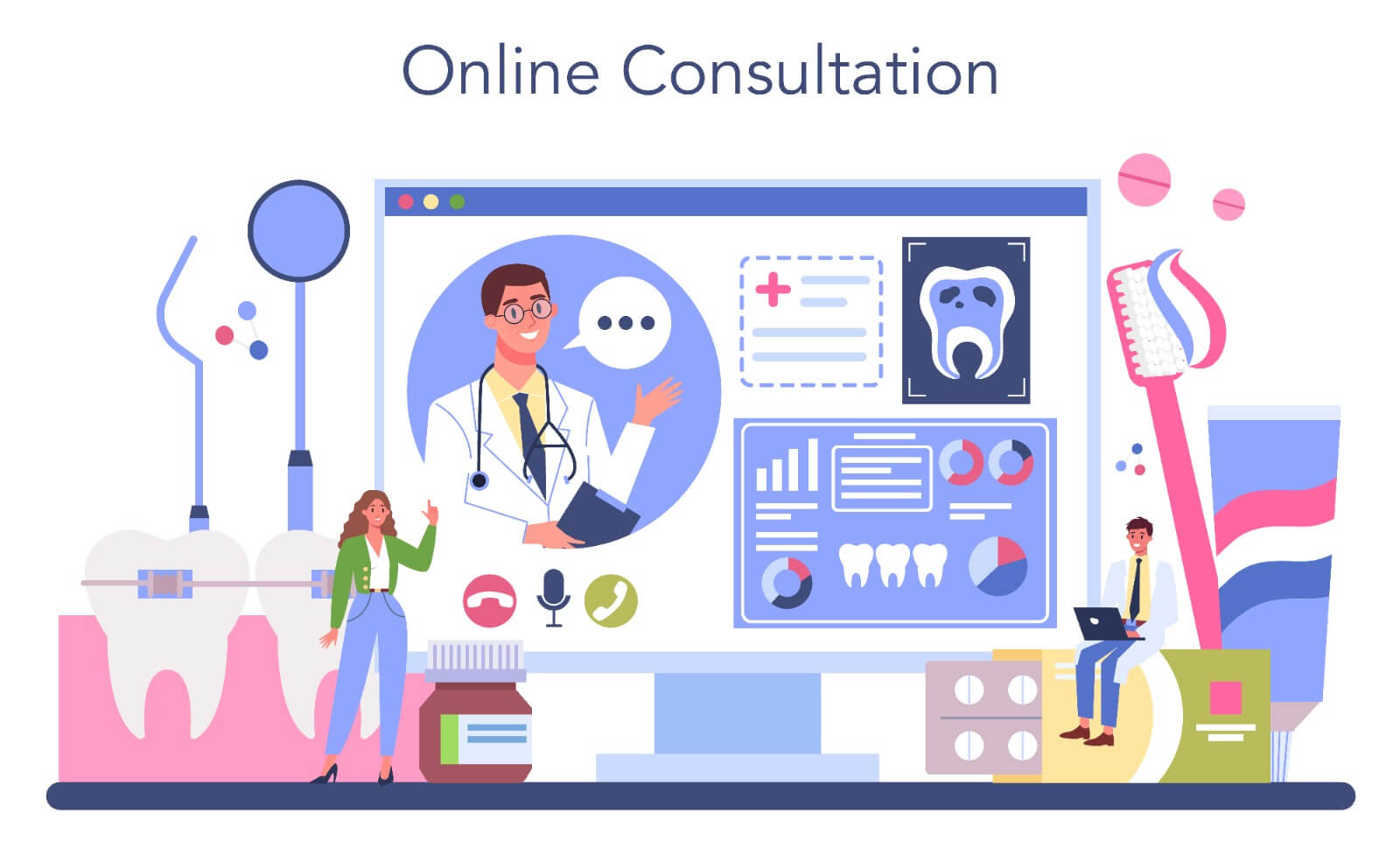
Virtual dental administration is the remote management of non-clinical operations of a dental practice. These include tasks that are too time-consuming to be handled by in-house staff.
Since they are specifically hired for dental practices, these virtual assistants are required to be familiar with:
Basic dental terminology.
Insurance processes.
Practice management software.
Why Is Virtual Dental Administration Growing in Dentistry?

Hiring a virtual assistant for busy dental practice has become the new normal. This change is particularly driven by structural challenges within the industry. These include:
→ Staffing Shortages
Most dental practices struggle with hiring and retaining skilled staff for front-desk operations. This is due to the high turnover of employees and the limited talent pool.
→ Increase in Operational Costs
There is a separate set of expenses beyond salaries associated with hiring in-house staff. This includes training, benefits, workspace, and equipment.
Administrative tasks such as insurance processes, compliance requirements, and patient communication demands have only gotten more complex in the wake of modern healthcare.
This puts more administrative work on staff, pulling focus away from clinical tasks.
→ Shift Toward Digital Workflows
As practices adopt digital tools for scheduling, billing, and communication, hiring online assistants often makes the most sense for managing these processes.
→ Demand for Efficiency and Scalability
Virtual assistants for dental professionals are a practical solution to growing their practice without proportionally increasing operational costs.
How Virtual Dental Administration Is Reshaping Modern Dentistry?

There are many ways virtual dental administration is contributing to making the operations of a dental practice more efficient.
In fact, the remote professionals are not just replacing tasks; they are also changing how these clinics operate at a structural level.
1. Decoupling Clinical and Administrative Functions
Traditional front-desk staff at a dental office is expected to handle multiple responsibilities – sometimes both clinical and non-clinical tasks – within the physical space.
A virtual dental executive assistant is only meant to handle backend operations while clinical teams focus on patient care.
2. Improving Operational Efficiency
Staff shortage is a universal problem in healthcare. Dedicating a remote team to administrative work only, such as insurance verification or schedule management, improves overall practice performance by ensuring:
Faster turnaround times.
Fewer errors.
More consistent workflows.
3. Extended Availability
An online dental assistant offers an advantage in terms of operating across different time zones. This availability beyond office hours enables:
After-hours appointment scheduling.
Faster response to patient inquiries.
Reduced backlog of administrative tasks.
This helps foster a more responsive and accessible patient experience.
4. Enhancing Patient Experience
Patient satisfaction is key to a successful healthcare practice. Hiring virtual support ensures smooth functions within a dental practice, including:
Benefits of Remote Dental Administration for Your Dental Practice
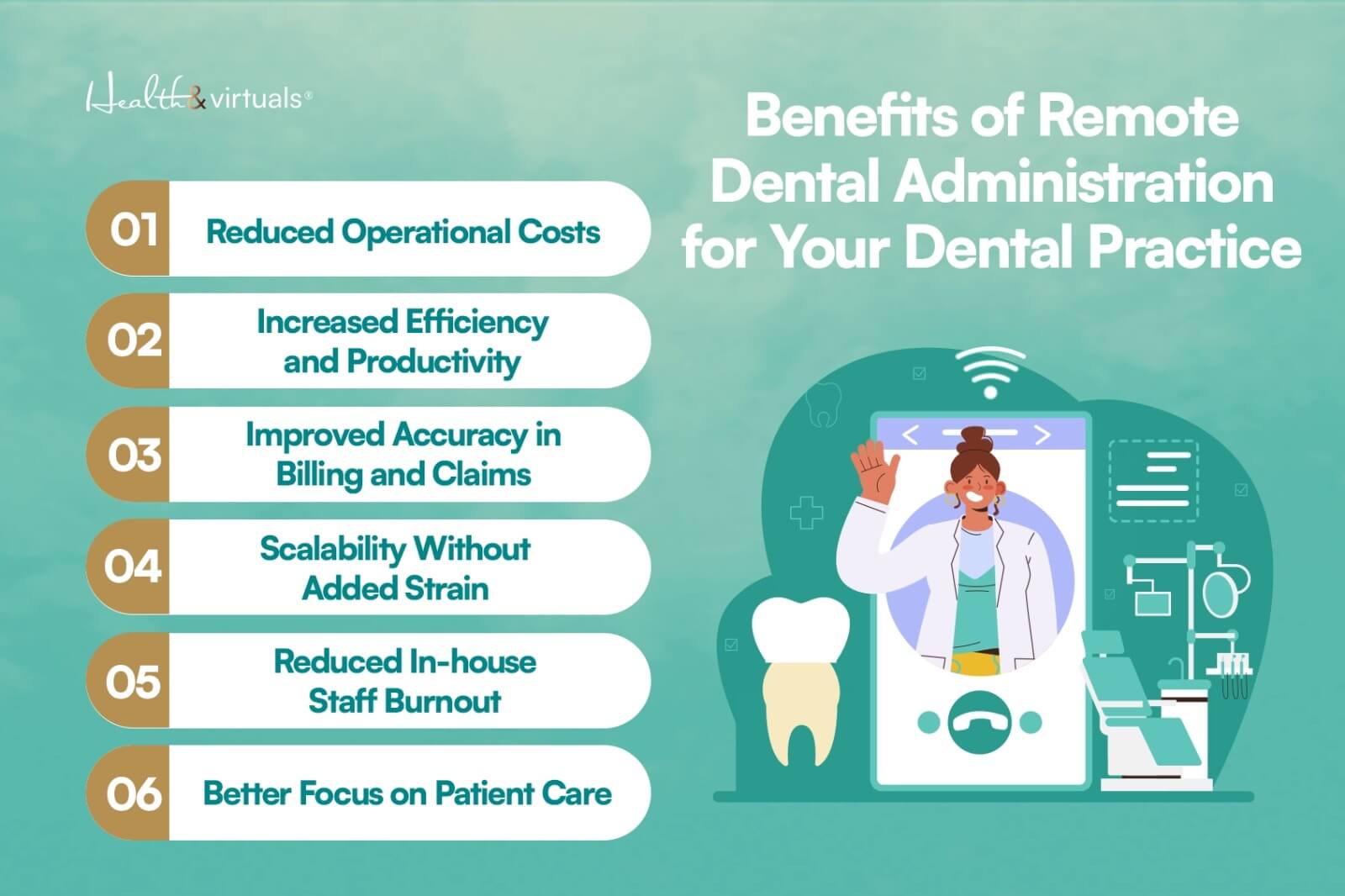
A dental practice is only as good as its operational efficiency. Remote staffing is already proven to be more beneficial than in-house staffing in some aspects. Thus, the impact of virtual dental administration is most visible in its tangible benefits.
This leads to fewer denials and faster reimbursements.
4. Scalability Without Added Strain
Practices rely on virtual support to scale operations as patient volume grows. This refers to expanding administrative capacity without physical constraints.
5. Reduced In-house Staff Burnout
Administrative overload is a major contributor to burnout among staff at a dental practice.
By offloading repetitive tasks, they can:
Improve staff satisfaction.
Reduce turnover.
Maintain a more balanced work environment.
6. Better Focus on Patient Care
When administrative responsibilities are handled efficiently by remote dental assistants, dentists and clinical staff can dedicate more time to treatment and patient interaction.
The Future of Virtual Dental Administration

With more and more healthcare practices turning toward hiring virtual support, it ought to become a standard component of modern dental practice management. However, the shift will not be void of future developments. These include:
Greater integration with AI-driven scheduling and billing tools.
More specialized remote roles (e.g., insurance specialists, RCM experts).
Hybrid administrative models combining in-house and virtual teams.
Increased reliance on data analytics for operational decision-making.
As technology continues to evolve, the line between in-house and remote operations will become less distinct.
Bottom Line

Virtual dental administration is no longer just a temporary solution to staffing challenges. It is evidence of a strategic shift in how dental practices operate.
By improving efficiency, reducing costs, and enhancing patient experience, it addresses some of the most pressing challenges in modern dentistry.
The practices that adapt early are not just solving today’s operational issues – they are building more flexible, scalable systems for the future.

Administrative overload shouldn’t slow down your practice. And the clinical team should be focusing on care, not coordination.
With your trusted remote staffing agency, Health & Virtuals, hire virtual dental assistants… Our talent pool has pre-vetted, highly qualified professionals trained in streamlining scheduling, billing, and patient communication for your clinic.
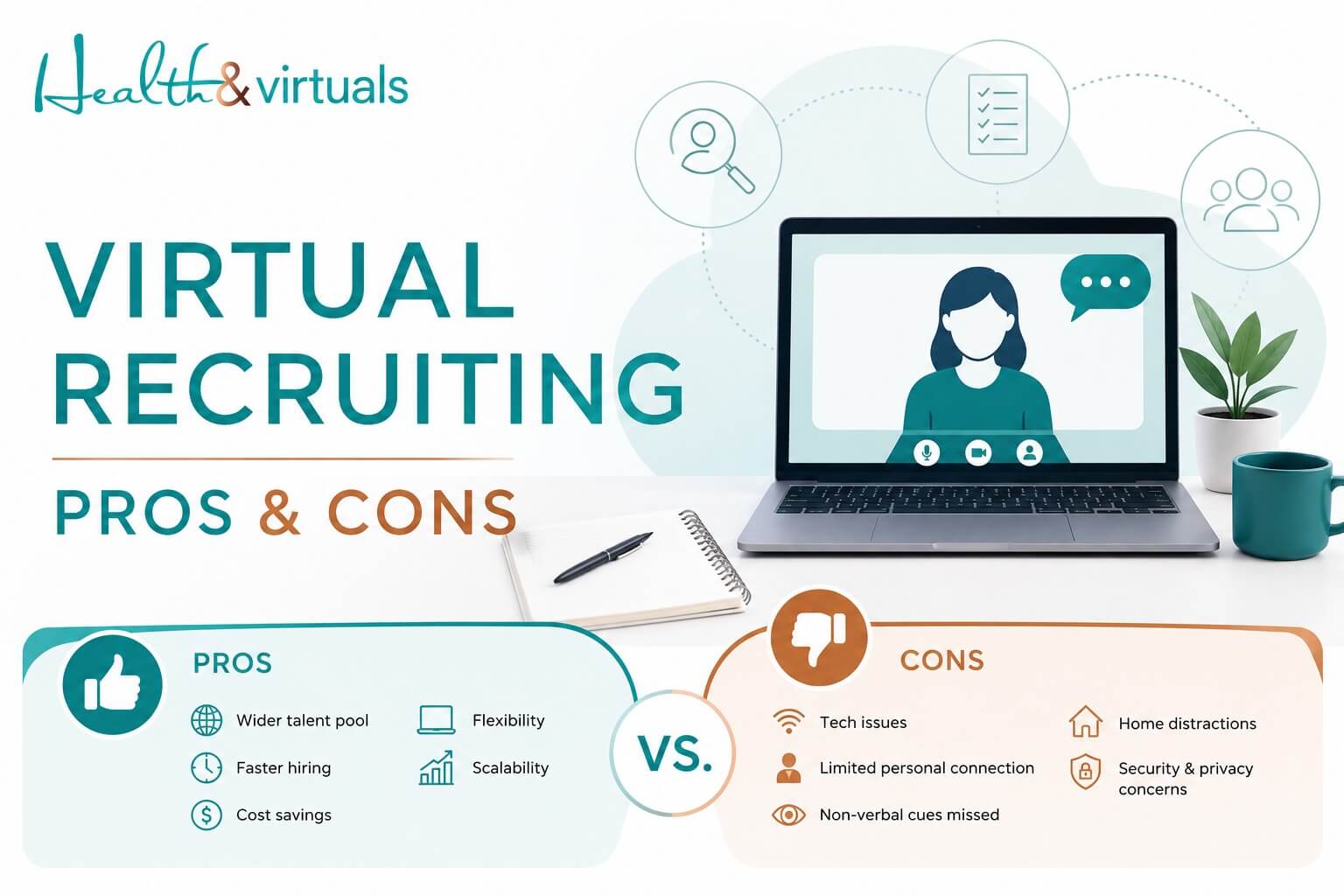
Hiring has seen its biggest shift since the COVID-19 lockdown six years ago. The era of long waits for in-person interviews, unnecessary office visits and geographic limitations is over. In addition to hiring virtual support for their businesses, employers are now increasingly relying on more flexible hiring processes that include virtual recruiting methods such as remote interviews, digital assessments, and online onboarding.
A report by the Society for Human Resource Management backs this shift with data that over 82% of employers have adopted virtual interviews for the hiring process, including sourcing to onboarding. While beneficial in many ways, there is a substantial set of challenges associated with it. Knowing about the both sides is key to building a recruitment strategy that actually works.
What Is Virtual Recruiting?
Virtual recruiting is a digital hiring process of hiring candidates for a business using online tools. It makes hiring easier for employers as it involves sourcing, screening, and evaluating candidates without in-person interaction.
Candidates no longer have to wait in line for walk-in interviews, visit offices for assessments, and scour job fairs. Instead, they can hunt for a job as per their specialty from the comfort of their home, send application via online forms, and wait out for a response from the business.
Common Virtual Recruiting Methods
The most common online recruiting methods include:
These methods have become the standard for recruiters to manage the entire hiring process remotely, only calling in the candidate in case of a final selection.
Why Is Virtual Recruiting Becoming More Popular?
Online recruitment is not just a trend. Instead, it is a response to evolving dynamics of a workplace that relies on an efficient mode of operations.
The following factors are the biggest drivers of growth in virtual recruiting:
→ Increase in Remote Work Opportunities
Companies are no longer limited to hiring within a specific location.
→ Access to Global Talent
With online recruiting and virtual opportunities, the organizations can reach candidates across regions and time zones without concern for geographic limitations.
→ Faster Hiring Cycles
Digital tools are an efficient way to reduce scheduling delays and manual processes of onboarding.
→ Cost Efficiency
A virtual hiring process is a great way to minimize commute difficulties & expenses on the candidate’s end. It also lifts administrative burden off the hiring staff.
More importantly, virtual recruiting allows candidates flexibility, speed, and convenience.
How Virtual Recruiting Works?
At its core, online recruiting of any type of virtual assistants is not much different from traditional hiring. It essentially involves the same steps, albeit executed digitally.
Job posting and sourcing: Businesses advertise roles online through job boards and platforms such as LinkedIn.
Application screening: Employers review applications with the help of automated tools.
Virtual interviews: Candidates are assessed through video meeting platforms.
Skills evaluation: Online tests or assignments are prepared to measure the capability of a candidate.
Final selection and offer: Once selected, candidates are presented with an offer via email.
Digital onboarding: New hires are integrated into the organization virtually.
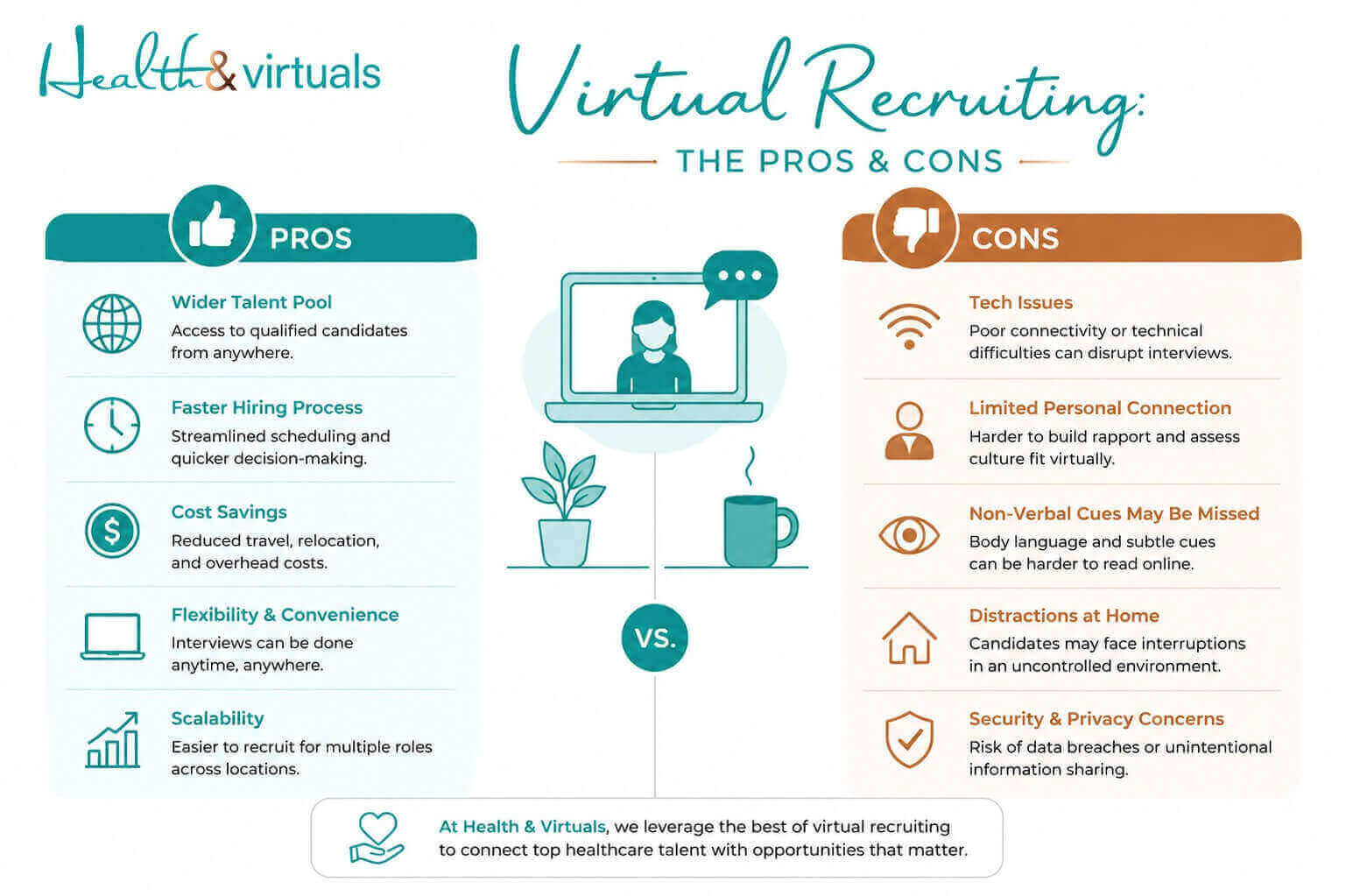
Pros of Virtual Recruiting
Modern organizations are particularly tempted by virtual recruiting due to the number of benefits it offers, such as:
1. Global Talent Acquisition
Recruiters are no longer limited by geography, allowing them to hire purely on the basis of talent regardless of location.
2. Faster Hiring Process
Digital exchange of documents as well as online interviews saves ample time for both the employer and the candidate.
3. Cost Savings
Organizations save on travel allowances, a designated office space, and event-related expenses for virtual candidates.
4. Increased Flexibility
It becomes easier to coordinate a convenient time for both recruiters and candidates to engage, improving participation and efficiency.
5. Scalability
Virtual processes make it easier to handle large volumes of applicants without significantly increasing resources.
Cons of Virtual Recruiting
Despite its advantages, virtual recruiting strategies may fall short in a few areas.
These may include:
1. Limited Interaction
Virtual settings can make it harder to assess personality, communication style, and cultural fit for both employer and candidate.
2. Technology Dependence
The hiring process may experience disruption due to technical issues, including connectivity problems and platform limitations.
3. Candidate Engagement Challenges
Candidates may find it hard to maintain attention and engagement in virtual settings.
4. Risk of Miscommunication
Sometimes, interviews may not go as planned or be misinterpreted due to lack of non-verbal cues in virtual processes.
5. Potential Bias in Digital Tools
Organizations relying on AI-driven screening tools risk judging candidates on the basis of potential bias associated with them.
Best Practices for Virtual Recruiting
Differences between in-house recruiting and online hiring, or we can say pros outweigh the cons… So, virtual recruiting is here to stay. Thus, to make do with it in the most effective way, organizations need to move beyond basic implementation and focus on strategy.
→ Standardize the Process
Hospital, businesses, & organizations should aim to create a structured virtual recruitment workflow to ensure consistency across candidates.
→ Use the Right Mix of Tools
Instead of choosing one digital software and sticking with it for all hiring-related processes, they could combine video interviews, assessments, and communication platforms to create a balanced evaluation.
→ Prioritize Candidate Experience
To make sure candidates are loyally aligned to their potential future workplace, organizations must rely on clear communication, timely updates, and smooth scheduling during the recruitment process.
→ Train Hiring Teams
Recruiters and managers should be trained to evaluate candidates effectively in a virtual setting.
→ Maintain Human Connection
Even in a digital process, personalized interaction is key to building trust and engagement.
Tools Used in Virtual Recruiting
An effective virtual hiring process involves the use of multiple digital tools for different stages. These include:
Zoom: for live interviews.
Microsoft Teams: for communication and interviews.
LinkedIn: for sourcing candidates.
Google Forms: for managing applications.
What Industries Benefit Most from Virtual Recruiting?
Virtual recruiting is particularly effective in industries where work can afford a smooth transition to remote or digital, such as:
These industries benefit from faster hiring cycles and access to global talent pools.
Future of Virtual Recruiting
As the future of work is likely to be hybrid, virtual recruiting is expected to continue evolving alongside in-person interactions.
Future remote hiring strategies may include:
→ Greater use of AI in candidate screening.
→ More immersive virtual interview environments.
→ Enhanced data-driven hiring decisions.
→ Increased focus on remote-first workforce strategies.
Virtual recruiting has the power to streamline hiring. However, it requires strong backing by the right talent and process. With Health & Virtuals, a trusted virtual assistant recruitment agency, you can access pre-vetted professionals and end-to-end hiring support to build a more efficient, scalable workforce.
Virtual recruiting is an online hiring process. Virtual hiring is the process of sourcing, screening, and hiring candidates using digital tools in lieu of in-person interactions.
What are the benefits of virtual recruitment?
Main benefit of online hrirng reduces hiring costs. Also the virtual hiring process is faster than convcentional hiring process and expands access to global talent acquisition.
Is virtual recruiting effective?
Yes, virtual recruiting is effective, given it is supported by the right tools and processes. It enables efficient hiring without compromising candidate quality.
Remote staffing has played its role in transforming the modern workplace. With millions of professionals now working from home. Or in hybrid setups. Or completely remote as virtual staff across different time zones. It’s evident that this flexibility offers freedom and convenience to both companies and talent looking for good opportunities.
But at the same time, this unconventional working pattern also introduces challenges for remote workers.. They are related to productivity, focus, communication, and work-life balance.
Without proper structure, you, as a remote employee, can struggle with a lot. It includes distractions, burnout, missed deadlines, and inefficient workflows.
That is why remote work time management has become one of the most important skills for you if you want to grow your career healthily and progressively!
Why Is Time Management Important for Remote Workers?
As they operate without the traditional office environment, so, time management for remote workers is something that can naturally provide them with schedules, supervision, and structure.
The following are the reasons showing why time management for remote workers is so important
1. Increased Productivity
Studies are evident that employees using time management strategies for remote work are more productive. They experience lower stress levels. Maintaining better job satisfaction…
According to a study, remote workers save an average of 72 minutes daily. YES! By avoiding commuting, focusing better on work than travel … Employees who follow organized schedules complete tasks faster and with better concentration.
Stanford University research claims that a remote employee can be significantly more productive than office workers. Only if distractions are properly managed.
→ Effective remote working time management helps employees:
Prioritize important tasks.
Reduce procrastination.
Maintain consistent workflow.
Improve task completion rates.
Avoid multitasking overload.
2. Better Work-Life Balance
One major challenge in work-from-home time management is that there is usually a blurred boundary between personal and professional life, when pupils are working from theri living spaces.
Remote workers often:
Work beyond office hours.
Skip breaks.
Respond to messages late at night.
Experience difficulty “switching off”.
→ If you follow effective time management tips for remote workers (given below), it will not only help establish healthier routines but also reduce your burnout.
3. Reduced Stress and Burnout
The APA (American Psychological Association) says that workload management and unclear boundaries are major contributors to workplace stress.
Organized remote workers’ experience:
Less anxiety.
Better mental clarity.
Improved energy levels.
Higher job satisfaction.
Greater emotional well-being.
4. Improved Team Collaboration
While working virtually, remote teams rely heavily on communication tools. Also, the shared schedules and accountability systems.
Time management for remote workers ensures:
Timely responses.
Respect to be available only in committed hours.
Better meeting coordination..
Improved project completion.
Stronger collaboration across time zones.
What Are the Common Time Management Challenges in Remote Work?
Although remote work offers flexibility… but it also creates several productivity obstacles.
Common time management challenges you may face as a remote worker are:
1. Home Distractions
One of the biggest remote work productivity challenges is dealing with distractions such as:
Household chores.
Family interruptions.
Social media.
Television.
Mobile phones.
→ Unlike office environments, home settings may lack professional boundaries.
2. Lack of Structured Routine
Without commuting or office schedules, many remote workers struggle with:
Irregular sleep patterns.
Delayed work starts.
Poor task organization.
Inconsistent productivity.
→ A lack of routine often reduces efficiency.
3. Communication Overload
Remote employees often spend large portions of their day on:
Emails.
Instant messaging.
Video meetings.
Collaboration platforms.
→ Research from Microsoft indicates that excessive virtual meetings contribute to digital fatigue and reduced focus.
4. Procrastination
Remote work environments may increase procrastination due to reduced supervision. Employees may:
Delay difficult tasks.
Overuse breaks.
Become distracted online.
Lose track of priorities.
5. Difficulty Separating Work and Personal Life
Many remote employees continue working beyond office hours, causing:
Mental exhaustion.
Reduced family time.
Sleep disturbances.
Increased burnout risk.
Best Time Management Tips for Remote Workers!
You need to go for time management strategies for remote workers. The following are the effective ones and can significantly improve productivity, focus, and work-life balance.
→ Create a Dedicated Workspace
If you have a dedicated workspace, it will improve your concentration. Remember, for a healthy mind & mental health boundaries between work and personal life are very necessary!
Your workspace should ideally:
Be quiet!
Have good lighting…
Include ergonomic furniture.
Minimize distractions.
Support comfort and focus.
Employees working from organized workspaces often demonstrate improved productivity and reduced stress.
→ Set Clear Daily Goals
Start each day with defined objectives.
Use methods such as:
To-do lists.
Priority ranking.
Task batching.
Goal tracking apps.
Clear goals improve focus and reduce wasted time.
→ Use Time Blocking Techniques
Do you know that time blocking is one of the most effective time management strategies for remote work?
This technique involves assigning specific periods for:
Deep work.
Meetings..
Emails.
Breaks.
Administrative tasks.
For example:
9 AM–11 AM: Focused project work
11 AM–12 PM: Emails and communication
1 PM–3 PM: Client tasks
3 PM–3:30 PM: Team meetings
Time blocking reduces multitasking and improves concentration.
→ Follow the Pomodoro Technique
The Pomodoro Technique is a time management method, very effective for work from home remote workers!
It helps maintain productivity by dividing work into intervals.
Example of typical structure:
25 minutes of focused work.
5-minute break.
Longer break after four cycles.
Benefits of the Pomodoro technique include:
Reduced mental fatigue.
Better concentration.
Improved motivation.
Increased task completion.
→ Prioritize Important Tasks First
Use prioritization frameworks such as:
Eisenhower Matrix:Helps categorize your tasks. This categorization is based on urgency and importance… so you can focus on high-priority work first.
ABC prioritization: The ABC method helps you organize your tasks into AB & C… where A tells the most important tasks, B categorizes moderately important tasks, and C for least important… This is very helpful to let you follow categories for better workflow management.
Pareto Principle (80/20 rule):It is a famous rule that suggests that 80% of the required tasks are completed or work results. As it comes from 20% of your most impactful tasks. So follow 80/20 rule. Prioritize those key activities first. At the end of the day, you will be relaxed that the most important tasks are already taken care of, instead of the least impactful ones.
In simple words, remote working time management should be focused on high-impact tasks during peak productivity hours.
→ Limit Multitasking
Research shows that multitasking reduces efficiency and increases errors.
Instead:
Complete one task at a time.
Minimize open tabs.
Turn off unnecessary notifications.
Avoid constant context switching.
Focused work improves quality and speed.
→ Schedule Regular Breaks
Do you break is essential for maintaining energy and concentration. Instead, reward yourself with a bite of chocolate or something you enjoy to entertain with the completion of a task, and take a break after that.
Short breaks help:
Improve creativity.
Reduce eye strain.
Prevent fatigue.
Enhance mental performance.
Experts recommend:
Stretching regularly.
Walking briefly after a minimum of 30 minutes of work.
Staying hydrated.
Avoid continuous screen exposure.
→ Manage Notifications and Digital Distractions
Digital interruptions are major productivity killers.
Helpful strategies include:
Turning off nonessential notifications.
Using “Do Not Disturb” mode.
Checking emails at scheduled times.
Blocking distracting websites during focus sessions.
→ Use Productivity and Time Management Tools
Technology can significantly improve remote work time management.
These tools help remote workers stay organized and accountable.
→ Establish Work-Life Boundaries
One of the most important effective time management tips is learning when to stop working.
Helpful boundary-setting strategies include:
Fixed work hours.
End-of-day routines.
Separate work devices.
Avoiding late-night emails.
Logging out after work.
Healthy boundaries reduce burnout and improve mental health.
→ Plan the Next Day Before Logging Off
Ending your workday with preparation improves morning productivity.
Spend 10–15 minutes:
Reviewing completed work.
Listing priorities for tomorrow.
Organizing files.
Clearing your workspace.
This creates a smoother start the next day.
How Employers Can Support Remote Worker Time Management?
Employers play a major role in helping remote employees stay productive and balanced.
1. Encourage Flexible Scheduling
Employees work best during different hours.
Flexible schedules can improve productivity. Also promotes job satisfaction. Employers can have better employee retention if they allow flexible work scheduling because with this employee can have a better work-life balance.
2. Reduce Unnecessary Meetings
Too many virtual meetings reduce deep work time.
Employers should:
Keep meetings concise.
Use asynchronous communication when possible.
Set meeting-free focus periods.
3. Provide Productivity Tools
If an organization should invest in collaboration software, time tracking tools. Also, the project management systems and better official communication platforms. They, with these tools, can improve workflow transparency and accountability for remote workers.
4. Promote Mental Health and Wellness
Remote workers may experience isolation or burnout.
Employers can help through:
Wellness programs.
Mental health resources.
Encouraging breaks.
Respecting work hours.
5. Set Clear Expectations
Clear expectations reduce confusion and improve efficiency.
Managers should properly communicate:
Deadlines.
Goals.
Performance metrics.
Availability requirements.
Benefits of Effective Time Management for Remote Teams!
Remote working time management is not only for remote worker but equally beneficial for employers hiring remote staffing for their businesses.
→ Benefits for Employees
Employees who master it & follow remote work time management often experience:
Higher productivity.
Reduced stress.
Better focus.
Improved job satisfaction.
Healthier work-life balance.
Greater career growth opportunities.
→ Benefits for Employers
Organizations promoting work-from-home time management for remote workers benefit through:
Increased team efficiency.
Better project completion rates.
Reduced employee burnout.
Higher retention rates.
Improved collaboration.
Greater profitability…
Future of Remote Work and Time Management…
Remote and hybrid work models continue to grow globally. According to workplace studies, flexible work arrangements are now considered a priority by all. Including healthcare providers, big & small sizes of practices, wellness centers, hospitality businesses, law firms, and big companies or start-ups….
As remote work expands, employees who develop strong time management skills will likely experience:
Better productivity.
Greater flexibility.
Improved career advancement.
Cost-effectiveness with more remote hirings.
Enhanced professional independence.
Companies that support healthy remote work practices may also achieve stronger employee engagement and operational success.
Bottom Line!
Remote work offers flexibility, freedom, and convenience… but it can’t be done without discipline and organization. Effective work-from-home time management is essential for maintaining productivity, reducing distractions, and protecting mental well-being.
Get Hired with Health & Virtuals!
What are your skills and specialties? Are you a healthcare professional? Or an executive assistant? Do you specialize in RCM & medical billing? You are a customer support specialist, SDR, or administrative expert ?
Health & Virtuals helps skilled professionals connect with leading US-based companies and healthcare organizations.
We don’t just hire virtual assistants… we train, certify, support, and deploy remote professionals in our certified digital training school, according to US business workplace and healthcare standards, including HIPAA compliance, EMR/EHR systems, communication training, and professional workflow management.
If you have a suitable qualification and interest, and if you are ready to build a remote career with international opportunities, we can help you! Become a job-ready remote worker with us!
Why is time management essential for remote workers?
Time management helps remote workers stay productive. They should be organized and focused. With remote working time management, they can! While reducing stress and maintaining a healthy work-life balance.
What are the biggest remote work productivity challenges?
Common challenges include distractions at home. Procrastination & communication overload are also among the biggest challenges. Others are a lack of structure and difficulty separating work from personal life.
What tools help remote workers manage time?
Popular tools include Trello, Asana, Google Calendar, Notion, and Clockify.
In the current context of law firms, efficiency, cost management and client responsiveness are essential for the success of law firms. With more legal work and customers insisting on shorter turnaround times, the position of support professionals has been more strategic than ever before.
Legal assistants and paralegals are two of the most widely misperceived jobs in this ecosystem.
The employment of paralegals and legal assistants is projected to increase by 4 percent between 2022 and 2032, which indicates that the demand for paralegals and legal assistants remains consistent.
Although it is common to interchange the terms legal assistant and paralegal, there is a difference between paralegal and legal assistant.
What is a Legal Assistant?
A legal assistant tends to perform the administrative and organizational aspects that contribute or add to the daily running of a law firm. Their role is such that attorneys are able to devote substantial time to the substantive work of law.
On-site or virtual legal assistants can frequently be the cornerstone of efficiency in the office. Their roles can be schedule management, document preparation, and interaction with clients.
Key responsibilities include:
Composing the routine letters and preparing legal papers.
Making appointments, dates with the court, and appointments with clients.
Case files and arranging documentation.
Addressing billing, invoicing, and time tracking.
Staying in touch with the clients to update them and send them follow-ups.
Submission of information to the courts both via computers and through other means.
The role of substantive legal analysis is not normally the responsibility of legal assistants. They are rather concerned with administrative accuracy and work organization.
The small firms can allow the legal assistants to wear various hats, which will include administrative support as well as performing simple legal assistant tasks. Nevertheless, the essence of work is not analytical but rather operational.
What Is a Paralegal Assistant?
A paralegal is a legal professional who carries out more specialized legal work, supervised by an attorney. Their work is more analytical and is directly related to the preparation of cases and the legal strategy.


An on-site or a virtual assistant paralegal is also trained to do jobs that demand further insight into legal procedures and records.
Key responsibilities include:
Legal research; Legal databases and case law sources.
Composing pleadings, contracts & legal briefs.
Helping in the preparation of trials such as organizing the evidence.
Formal education or certification, such as an associate’s or bachelor’s degree in paralegal studies are often required of paralegals. They are more directly engaged in the legal results than legal assistants.
Assistant vs Paralegal: What’s the Main Difference?
On a more practical level, the distinction is reduced to the contribution to the functions and value.
→ Nature of Work
Legal assistants concentrate on the administration (maybe as a virtual executive assistant specialized in legal tasks) and operation of the law office so that it runs efficiently.
Paralegal legal assistants, on the other hand, perform substantive legal work to have a direct contribution to case preparation and results.
→ Billing and Revenue Contribution
In many cases, paralegal work can be billed to clients, and thus, it is a revenue-generating activity of a firm.
Duties of legal assistants are not generally billable and are generally regarded as internal operational expenses.
→ Level of Training and Expertise
The paralegals tend to be educated or certified in the study of law, guaranteeing that the paralegals possess technical knowledge.
Legal assistants can also come to the occupation with administrative experience and train on the job, learning the legal processes.
→ Case Development
The paralegal virtual assistants play a crucial role in case building by means of research, drafting, and processing evidence.
The work of legal assistants helps to facilitate the process indirectly, through controlling documentation, scheduling, and communication.
Similarities Between Legal Assistant and Paralegal
→ Under Attorney Supervision of Work
Legal assistants, as well as paralegal assistants, work under the guidance of lawyers who have been licensed. Their services do not override the power or duty of a lawyer but are used in support of the legal services.
→ Strong Organizational Skills
Both positions demand good organizational skills to coordinate documents, deadlines and information related to cases. Time-saving in managing multiple tasks is a critical need in the legal settings that are fast-paced.
→ Participation in Case Management
Legal assistants and paralegals also assist in ensuring and updating the files on cases. Although the extent of their action varies, both are involved in ensuring that cases are organized and moving.
→ Professional Ethics and Confidentiality
The confidentiality of the details of clients is one of the primary tasks in both positions. It is of utmost importance in legal practice to keep confidential information and rely on ethical standards.
→ Use of Legal Technology
Both practitioners are increasingly using legal software, document management software, and e-filing software. Exposure to technology has become a common need in both positions.
Do Law Firms Need Both Legal Assistants and Paralegals?
To most firms, the answer is yes – but it has been decided by size, caseload, and specialization.
Mid-sized firms and large firms usually utilize both positions since they are complementary to one another. The best virtual legal assistants take care of scheduling, communication, and administrative tasks, whereas paralegals are engaged in research, drafting and preparing cases.
This division of labor would make sure that:
Lawyers charge as many hours as possible.
Paralegals specialise in revenue-generating work.
Legal processes are not hampered by administrative activities.
Smaller firms, however, might not have the finances to fund both positions. Usually, hybrid professionals or outsourced services are employed in such cases.
This change is reflected by the emergence of legal process outsourcing (LPO) by hiring legal assistant staffing agencies. A Grand View Research report predicts that the overall LPO market worldwide will grow to reach an estimated 35.9 billion dollars by 2027, owing to the demand for cheaper yet quality legal services provided by legal assistant agencies.
What Is the Right Role for Your Law Firm | Paralegal vs Legal Assistant?
The decision to either hire a virtual legal assistant or a paralegal depends on a clear understanding of gaps in operational activities in your firm.
→ Select a legal assistant in case you need:
Management of workflow and improved organization.
Scheduling, billing and administrative coordination assistance.
Better communication with clients and improved intake procedures.
Sponsorship of daily document management.
Legal assistants as virtual staff come in perfectly when productivity is crippled by inefficiencies in administration.
→ Select a paralegal if you require:
Support in legal research and drafting.
Assistance with litigation and trial preparation
Assistance with the complex cases and discovery procedures.
An efficient means of assigning substantive legal tasks at a cost-effective rate.
Paralegals would be most suitable in a firm with a large volume or cases of high complexity.
A compromising strategy is the best in most instances; a combination of both positions offers the best payoff on investment.
Build a Smarter Legal Team with Health & Virtuals!
The change towards remote work has created new prospects where law firms can streamline their staffing model.
With virtual legal assistant support providers Health & Virtuals, access to trained law firm legal assistants and paralegals is possible without the cost of hiring someone internally.
With the legal industry increasingly becoming technologically driven, you can get your law firm work done at a fraction of the cost with remote legal assistants. They show more cost-saving & productivity compared to in-house staff.
Why Hire Virtual Staff With Health & Virtuals?
Hire the best virtual legal assistant or paralegal services with Health & Virtuals…
What is the greatest difference between a legal assistant and a paralegal?
The major distinction is like their work. Legal assistants are concerned with administration and paralegals are concerned with substantive legal work, including research, drafting and the preparation of cases.
What is the effect of hiring a virtual legal team in terms of improving productivity?
Virtual teams enable companies to outsource administrative and legal services effectively, minimize expenditures in overhead, and be flexible. This will allow the attorneys to concentrate on the high-value, billable work.
Is it necessary to hire a legal assistant or a paralegal by a law firm?
It is a decision that will be based on the needs of your firm. A legal assistant would be the appropriate option in case the problem is administrative inefficiencies. A paralegal is better suited in case your firm needs some assistance with legal investigations and case development. The use of both is beneficial to many firms.
Onboarding of employees is no longer a mere orientation. It is a multi-level investment, which is organized and has a direct effect on productivity, retention, and business performance in the long run. However, although it is an important aspect, most organizations do not optimize or measure the costs of onboarding.
Despite its critical role in building strong, efficient teams, many businesses still fail to measure or optimize onboarding expenses. This lack of clarity can lead to unnecessary spending, slower ramp-up times, and reduced overall ROI on new hires.
How Much Does It Cost to Onboard a New Employee?
Onboarding cost is the total of all onboarding expenses that are incurred to acclimate a new employee into an organization until he or she becomes fully productive.


There are wide industry standards that can be determined by the size of a company and the complexity of its roles. The cost of onboarding is about 4,000 USD on average per employee,according to data provided by SHRM. Nonetheless, this figure usually indicates direct expenses only.
This broad spectrum points to an important aspect: the employee cost is not a constant, but it grows with the complexity, industry & process efficiency.
What are the Stages of Onboarding Employees?
Onboarding is a process and not an event, as it involves many stages and costs are involved in every stage.
→ Preboarding
This phase starts once the offer is accepted, and involves documentation, communication and system setup. Although it might look administrative, time wastage in this case can cause inefficiencies in the future, which add time and cost.
→ Orientation
Orientation will familiarize the employees with company policies, culture and expectations. It is more resource-intensive than it seems since it is usually the work of HR teams and leadership.
→ Role Integration and Training
The stage is the most expensive. Workers have to study tools, work processes, and duties. In the process their productivity is minimal as the experienced team members spend time in mentoring and overseeing.
→ Performance Ramp-Up
Employees need time to achieve optimal productivity even after initial training. Gallup states that a small percentage of employees strongly believe that their organization is doing a great job at onboarding, indicating that many organizations do not maximize this process.
Cost Breakdown of Onboarding a New Employee
Cost Component
What It Includes
Impact on Business
Recruitment Costs
Job ads, recruiter fees, interviews, screening
High upfront hiring expense
Training Costs
Orientation, training sessions, learning materials
Time + resource intensive
Manager & HR Time
Supervising, onboarding support, follow-ups
Reduces productivity of senior staff
Tools & Software Setup
Licenses, systems, accounts, hardware
One-time + recurring costs
Productivity Loss
Reduced output during learning phase
Hidden but significant cost
Administrative Overhead
Documentation, compliance, onboarding paperwork
Ongoing HR workload
Turnover-Related Costs
Rehiring if employee leaves early
Increases long-term hiring expenses
How to Calculate Onboarding Costs?
Businesses should incorporate direct and indirect elements to compute onboarding costs.
Basic Formula:
The Cost of Onboarding = Direct Costs + Indirect Costs.
Onboarding cost and cost-per-hire are used interchangeably, but they are two measures of the hiring process.
Cost-per-hire encompasses the costs incurred during the attraction and recruitment process of candidates, including advertising, recruiter fees, and interview time.
Onboarding cost starts once hired and deals with integration and productivity.
This difference is significant since a decreased cost of recruitment does not necessarily lead to a general reduction in costs. In case onboarding is not efficient, the organization can lose even more money due to low productivity or early turnover.
When both metrics are considered, it will be a clearer picture of the amount of investment that will be needed to attract and retain talent.
Why Is Onboarding So Expensive?
Onboarding is costly as it involves a combination of cost drivers throughout the organization.
1. Productivity Gap
New workers require time to achieve maximum efficiency. The output is reduced during this period and this has a direct effect on the performance of the business.
2. Resource Allocation
Training and supporting new employees consumes a lot of time for the managers and team members. This causes a diversion of main duties and constitutes opportunity costs.
3. Tools and Infrastructure
Making systems, software and equipment available contributes to onboarding costs, particularly in larger organizations.
4. Early Turnover Risk
The high turnover rate among employees is caused by poor onboarding experiences, resulting in a significant percentage of turnover within the first few months. Research has shown that as many as 20 percent of the turnover is during the first 45 days.
Onboarding’s Hidden Costs
In addition to the apparent cost of recruiting, onboarding has a number of hidden costs that have a great effect on budgets.
→ Lost Productivity: Employees can also take months to be fully operational, postponing ROI.
→ Managerial Bandwidth: Old employees lose time for strategic work in order to accommodate the new recruits.
→ Cultural Misalignment: Ineffective onboarding may result in a lack of engagement and performance.
→ Early Turnover: It can cost 16%-20% of the salary of an employee to replace an employee.
→ Manual Processes Inefficiencies: Delays in administration and irregular workflow raise the costs of operation.
This can be attributed to these latent factors, which may consume 60-70 percent of the overall hiring and onboarding cost breakdown.
Best Ways to Bring Down Onboarding Costs Without Cutting Corners
Cost of onboarding reduction is not a matter of under-investment but rather efficiency and waste reduction.
→ Standardization
Standardization is one of the most effective methods. With a well-defined and well-implemented onboarding process, organizations minimize variability and prevent avoidable delays.
The same support is provided to employees and teams do not take as much time to reinvent workflows.
→ Automation
Automation is also a very important factor. Digital tools can help in streamlining such administrative tasks as document collection, system provisioning, and scheduling. This saves on manual work and enables the HR teams to concentrate on more strategic tasks.
→ Preboarding
Preboarding is another important aspect. It is better to engage employees before the first day so that they can begin with clarity and confidence. It reduces the time of adjustment and enhances productivity.
→ Structured Training Programs
Also relevant will be investing in structured training programs. Although it might appear as an extra expense, in many cases, cost of training employees saves on costs in the long-term by enhancing efficiency and decreasing mistakes.
According to research, successful onboarding can enhance employee retention (up to 82) and productivity (over 70).
This is not about saving money, but being smarter with the money.
How Does Virtual Staffing Reduce Onboarding Costs?
Remote working has also provided new avenues to save on hiring costs. The model of virtual staffing is more flexible and cost-efficient, in particular.
Among the short-term benefits of remote hiring are the decrease in infrastructure costs. Businesses no longer have to spend a lot of money on physical office space, equipment, or utilities for each new employee.
Onboarding processes are also more easily scalable because they’re virtual. Digital tools allow organisations to hire several employees at a time without a huge increase in expenses.
It is possible to standardize training materials and deliver them online, avoiding repetitive manual training to increase staffing efficiency.
What Do Businesses Gain by Reducing Onboarding Costs?
The benefits of managing the average cost of onboarding a new employee go much beyond short-term savings. This enhances business efficiency because lean processes help reduce delays and wastage of resources within a business.
Another significant benefit is quicker time-to-productivity. Onboarded employees can start contributing value sooner, which enhances the overall return on investment.
Retention also improves. When an onboarding experience is well organized, it will establish a closer bond between the employees and the organization, which will lower the chances of employees leaving their jobs prematurely.
Finally, the cutting of onboarding expenses is not simply a financial affair. It is a strategic step that enhances the performance of the workforce and helps to contribute to the long-term development.
Conclusion
One of the least considered business costs and performance drivers is onboarding. Although it might seem to be a run-of-the-mill procedure, its effect is directly related to productivity, retention, and profitability.
Companies that invest time to learn and streamline onboarding expenses are set to grow in the long term. Standardization of processes, capitalizing on technology and paying attention to employee experience can help businesses save a lot of money without compromising.
Do you want to cut your onboarding cost? It is time to review your organization’s strategy of onboarding.
With Health & Virtuals, you gain access to fully trained, pre-vetted remote professionals trained in our U.S standard digital training institute who are ready to integrate seamlessly into your workflow from day one.
No long training curves, no excessive HR workload, and no productivity compromises & delays.
Our virtual talent is equipped to step in immediately… helping you reduce onboarding expenses, eliminate inefficiencies, and improve operational output from the very start.
Build stronger teams faster, scale smarter, choose the right VA for your business, and improve ROI with virtual hiring instantly with Health & Virtuals — where trained remote professionals are ready when you are…
Medical billing remains one of the most critical functions within a healthcare practice, and thus often the most strained. A patient may receive the best care if the financial health of a clinic is optimal.
There are many factors that impact the revenue of a medical practice, such as errors in billing, delayed submissions, and inefficient follow-ups. Studies suggest that up to 80% of medical bills contain errors, leading to claim denial rates that can range between 5% to 10% or even higher, depending on the practice and specialty.
Meanwhile, administrative tasks continue to account for a substantial portion of operational costs in healthcare. A landmark study for the United States and Canada found that administrative costs for healthcare providers and insurance companies have exceeded $812 billion per year. It is obviously much higher than in countries with simplified, single-payer systems.
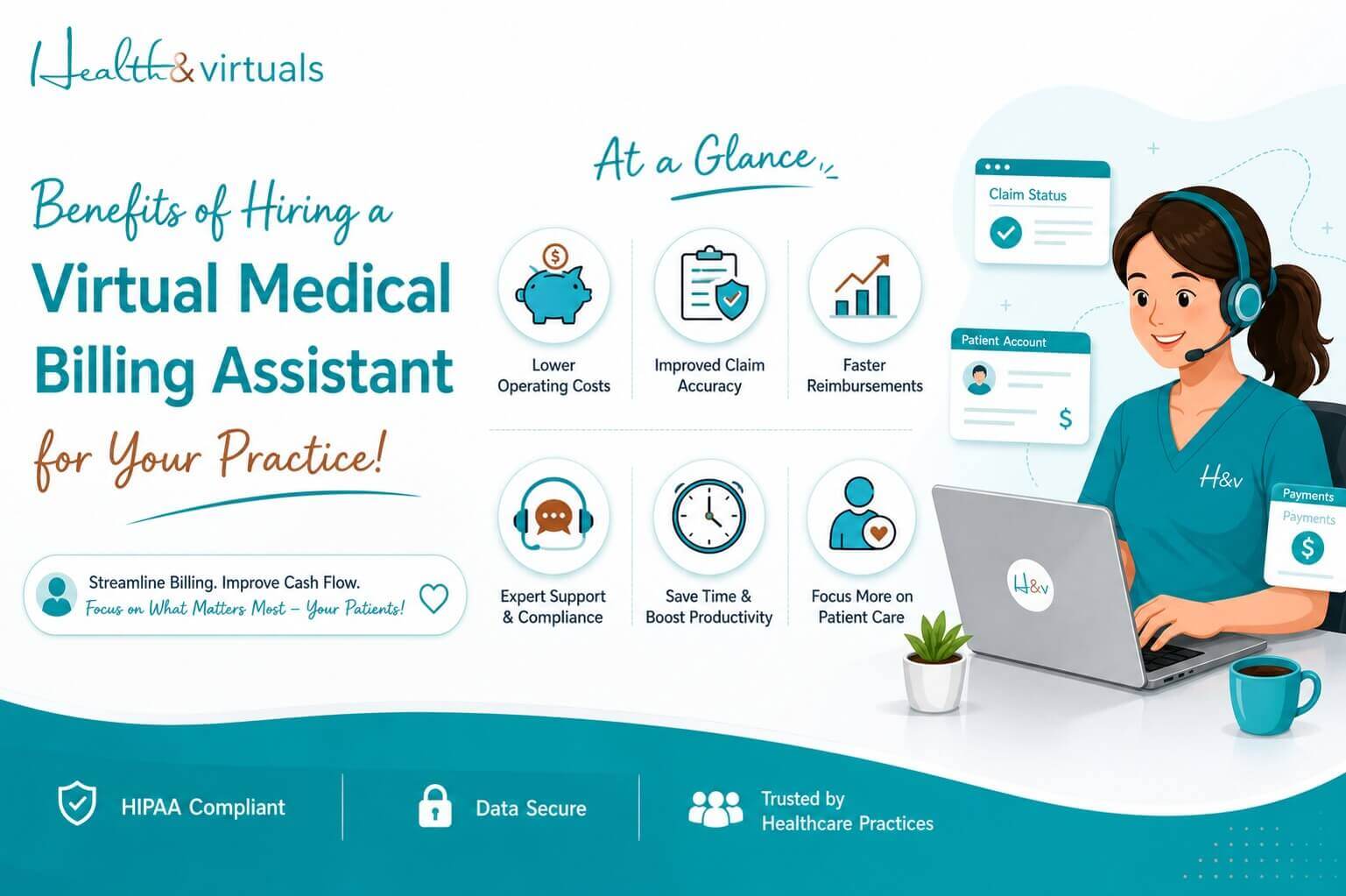
This persistent dilemma has led many practices to turn to a cost-effective solution, which is to hire a virtual medical billing assistant instead of solely relying on in-house teams.
Who is your Virtual Medical Billing Coordinator?
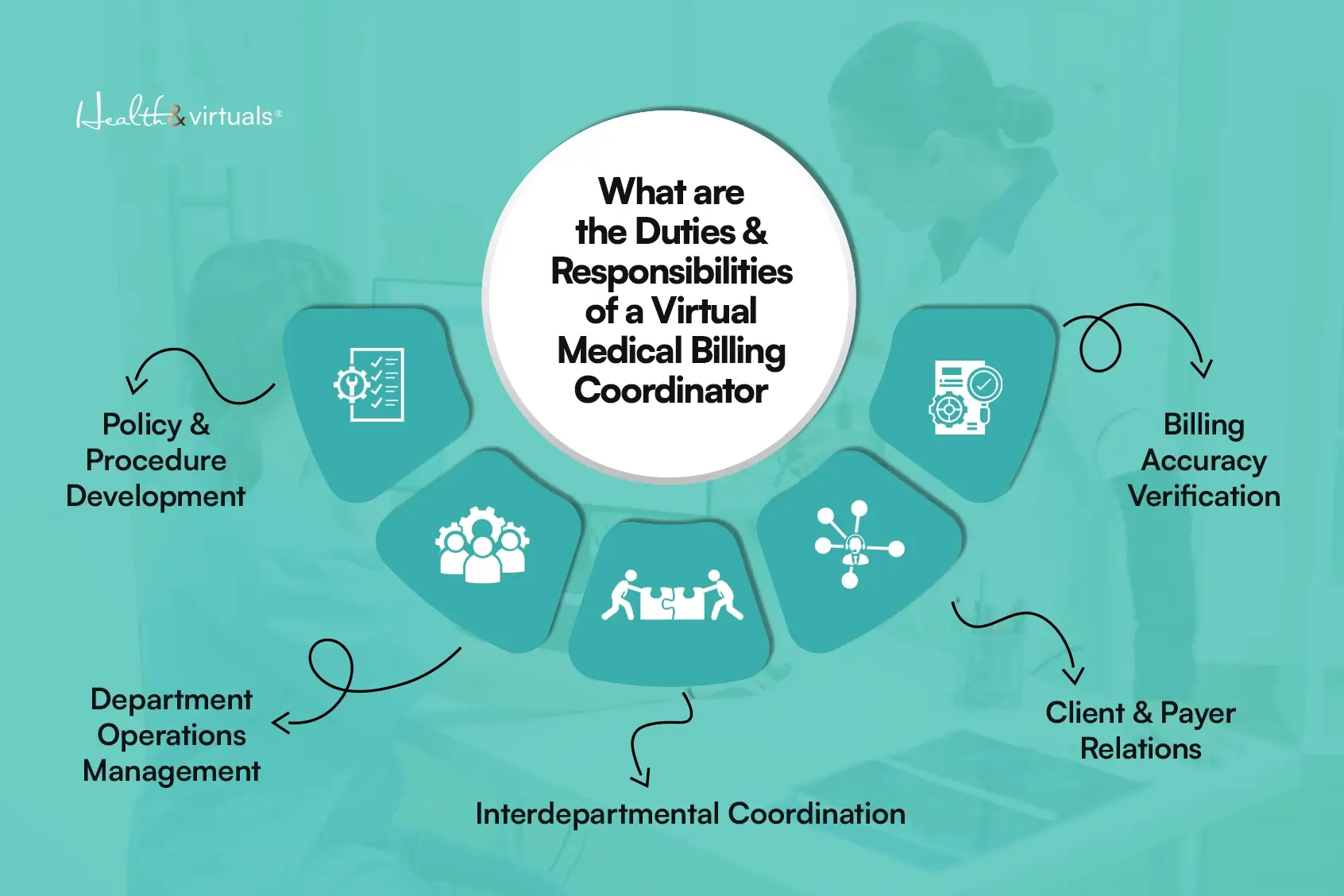
A virtual medical billing coordinator is a remote professional trained to handle billing and revenue cycle management tasks for healthcare providers.
They are meant to improve efficiency, accuracy, and overall revenue performance of a medical practice by assuming the following responsibilities:
Claim submission and follow-ups.
Insurance verification.
Payment posting and reconciliation.
Denial management and appeals.
Maintaining accurate billing records.
Despite operating remotely, a virtual medical billing assistant integrates into the clinic’s existing systems and workflows due to the administrative nature of their jobs.
Why Practices Are Moving Toward Virtual Billing?
The rising trend of shift toward virtual billing in healthcare did not come out of the blue. Instead, it is a product of persistent operational pressure with a direct effect on a practice’s revenue cycle.
Industry analyses already stated that outsourcing your revenue cycle management can reduce operational costs by 30% to 40%, depending on practice size and specialty.
Healthcare practices today face:
Increasing patient volumes.
Complex insurance requirements.
Rising administrative costs.
Staffing shortages.
Relying on an in-house team to manage billing is often a recipe for disaster due to limited resources.
What are the Benefits of Hiring a Virtual Medical Billing Coordinator?
There are endless benefits to hiring a virtual medical billing assistant for a healthcare practice.
One of the key benefits is that outsourcing administrative work as sophisticated as billing allows clinics to focus on patient care while ensuring that revenue cycle management remains efficient and uninterrupted.
Other benefits include:
1. Reduced Operational Costs
If a practice opts for hiring in-house staff to oversee billing, they are looking at multiple additional expenses. These include salaries, benefits, training, office space, and equipment.
A virtual assistant eliminates many of these overhead costs. They only require reimbursement for the service they provide – without the financial burden of maintaining a full-time, on-site employee. This makes it a cost-effective solution, maximizing your ROI, especially for small to mid-sized practices.
2. Improved Billing Accuracy
Billing errors are one of the leading causes of claim denials and revenue loss. Virtual medical billing assistants are typically well-versed in coding standards, payer requirements, and claim submission processes.
Their focused expertise reduces:
Coding errors.
Incorrect claim submissions.
Documentation inconsistencies.
3. Faster Claim Processing and Payments
To maintain a steady cash flow of a medical practice, it is pertinent to timely submit claims and Timely claim submission and follow-ups.
Virtual billing assistants ensure:
Claims are submitted promptly.
Follow-ups are conducted consistently.
Outstanding payments are tracked and addressed.
This reduces delays in reimbursement and improves the overall financial cycle of the practice.
4. Effective Denial Management
In case of denied claims, the financial health of a clinic is significantly affected. Moreover, it also increases the workload on the administrative team.
Due to the work demand of administrative tasks, healthcare practices may end up compromising on patient care. Delegating billing responsibilities to a virtual medical assistant, in-house teams are able to:
Focus on patient interaction.
Improve service quality.
Reduce administrative stress.
This shift improves both patient experience and staff productivity.
6. Scalability and Flexibility
Virtual medical billing coordinators offer scalability in terms of their services due to the remote nature of their jobs, thus offering an exceptional advantage to employers.
A healthcare practice may scale its services based on:
Patient volume.
Billing complexity.
Practice growth.
7. Access to Specialized Expertise
Billing regulations, coding updates, and insurance policies are constantly evolving.
The nature of their roles equips virtual billing professionals to stay updated with industry regulations, coding standards, and payer-specific requirements without requiring additional training.
8. Better Revenue Cycle Management
All of these benefits come together to generate a stronger revenue cycle. With improved accuracy, faster processing, and consistent follow-ups, practices experience:
More predictable cash flow.
Reduced revenue leakage.
Better financial stability.
When to Hire a Right Virtual Medical Billing Assistant?
There are certain signs that may force a healthcare practice to consider hiring a virtual medical billing assistant. These include:
Increase in claim denials.
Delays in payments.
Overwhelmed staff.
Frequent errors in coding or submissions.
Rising administrative costs.
These indicators suggest that the medical billing system of a clinic is under strain and needs support.
Who Should Hire a Virtual Medical Billing Coordinator?
As critical drivers of an organization’s financial health, virtual billing assistants are not limited to a specific type of practice.
Though they offer particular benefits to:
Small to mid-sized practices that, looking to reduce costs.
Growing clinics; managing higher patient volumes.
Specialty practices dealing with complex billing requirements.
Healthcare providers aiming to improve efficiency without expanding in-house teams.
In each case, the goal is the same: streamline operations while improving financial outcomes.
Ready to Improve Your Medical Billing Performance?
If your practice is struggling with claim denials, delayed payments, or rising administrative costs, it may be time to consider a more efficient approach.
Get in touch today to find the right virtual billing support for your practice and start optimizing your revenue cycle.
FAQs
What is the difference between in-house and virtual billing coordinators?
Your in-house billing coordinator works at your workplace. Only in your time zone’s duty hours. A virtual billing coordinator is remotely available and scalable to serve your practice virtually.
Is hiring a virtual medical billing coordinator cost-effective?
Yes. It’s proven. Hiring a virtual medical billing coordinator significantly reduces expenses related to salaries, training, office space, and other benefits. Making it a more cost-effective option for healthcare practices.
How quickly can a virtual billing coordinator start working?
Most virtual billing coordinators can begin within a few days. Though, it depends on the practice’s onboarding requirements, system access, and the complexity of their billing processes.
Remote work has shifted from a temporary trend to a permanent part of how companies hire and operate…. Today, employers are no longer just looking for any remote candidate who can do the job – they are looking for professionals … who have the right skills to work effectively in a remote environment.
Do you know that over 424,000 remote roles were posted all over the world in 2025 alone? It is the biggest year of remote opportunities that we have ever had. Meanwhile, the pace of demand keeps rising, as more than 20 percent of remote job postings are on the rise in 2026.
But, there is a downside to the opportunity: competition is growing. Remote jobs give the opportunity to attract talent all over the world, and employers are no longer restricted to local talent pools. Moreover, approximately 65 percent of remote jobs today focus on seasoned professionals, indicating that there is now an evident shift to skill-based employment.
You need some skills to get hired… from communication and time management to digital collaboration tools, these abilities now determine who gets hired and who gets overlooked.
Why Are Remote Job Skills So Important Today?
A remote workplace does not work the same way as traditional office setups. Companies place a lot of faith in output and communication without physical control. This change has changed the appearance of valuable job skills.
Remote work has more workforce trends. The experts state that nowadays, almost 79 out of 100 workers who can work remotely do it at least in part (it was less than 6 percent before 2020). This radical transformation has put companies back into the process of reconsidering productivity, cooperation, and performance measurements.
Business-wise, remote workers will cut overhead and widen access to talent around the world. Yet it also brings with it risks, such as miscommunication, time-zone delays & accountability. That is why employers give priority to applicants who are skilled, and who are able to show independence, digital savvy & reliability.
Concisely, now good skills for a job remotely are not a nice-to-have anymore. They are business skills that have a direct influence on business results.
What Are The Essential Remote Work Skills You Must Have?
Remote recruitment is moving towards skill-based hiring & the most successful performers exhibit a combination of technical and behavioral job skills list.
→ Skills in Communication (Async + Sync)
Remote work is based on effective communication. You cannot afford fast and brief desk talks, as in the office. On the contrary, you will have to express yourself using written notices, video conferences, and collaborative technologies.
Employers are interested in candidates who can easily communicate concisely without having to clarify all the time and across time zones.
→ Self-Management: Staying Productive Without Supervision
Remote jobs require a lot of discipline. In the absence of supervision, your time and task prioritization and deadline achievement capability become critical. It is especially significant because the work of many companies has become distributed teams in different regions.
→ Technical Literacy for Remote Work Efficiency
Tools are major in remote work: project management software, communication applications, and cloud-based solutions are all important. Knowledge of such tools as Slack, Notion, Trello, or CRM systems is popular and is required.
→ Adaptability and Problem-Solving
Remote environments are changing rapidly. It can be new tools, changing priorities, or cross-functional cooperation, which requires flexibility. Employers prefer those who can be able to solve problems on their own without being directed.
→ Cooperation Over Time Zone
Remote working in many cases implies global work. The ability to work asynchronously and across time zones is an important remote job skill that can be overlooked by many candidates.
→ Results-Oriented Mindset
In remote environments, output is used as a measure of performance and not time spent working. Busy people are not sought after by companies because they are looking to hire people who are oriented to the achievement of measurable outcomes.
How Can You Improve Your Remote Work Skills?
It takes deliberate effort to develop remote-ready job skills.
This list of job skills may not necessarily be learned formally as they are developed through experiences and exposure, unlike in traditional roles.
1. Stimulation
Start by simulating a remote work environment. Real life experience can be gained through freelancing websites or internships or remote jobs that are part time. The familiarity with remote workflow can be achieved even by doing personal projects with the aid of digital tools.
2. Learning
Another viable alternative is online learning. Communication, productivity & digital tools courses can help greatly enhance your preparedness. But simply learning will not suffice–it has to be applied.
3. Feedback
Feedback is also essential. Be it that you are working on a team project, or as a freelancer, actively solicit feedback on your communication, responsiveness and quality of output.
The insights can be used to narrow down to specific skills in an online job that employers consider throughout hiring.
4. Consistency
Finally, your consistency. It matters! Telecommuting favors those who can be productive without being forced to do so. Routine creation and systems creation: the creation of routines and systems such as daily planning, tracking of tasks, and regular check-ins, can greatly enhance performance over time.
What Employers Look for in Remote Candidates?
Hiring managers treat remote candidates in a different manner as compared to conventional applicants. They also analyze behavioral signals that reveal remote readiness in addition to the technical qualifications.
Experience level: One of them is the level of experience. As has been mentioned above, most of the remote jobs target professionals in the middle-career segment. This portrays a favor towards those who do not need much supervision.
Reliability and trustworthiness: Reliability and trustworthiness are also a priority for employers. Because remote staff work on their own, businesses must be assured that business activities will be accomplished without having to watch over their shoulders.
Communication: Clarity of communication is another important aspect. Applicants who exhibit organized thoughts and articulate expression, particularly in written expression, are instantly singled out.
Global skills: Also, the companies appreciate global collaboration skills. Remote staff is usually set up at a distance, and the possibility to operate internationally and in various time zones is one of the substantial advantages.
Tech-savvy: Lastly, the focus on tech-enabled productivity is increasing. Employers do not only want applicants to be users of tools, but also to be efficient and effective users in order to enhance efficiency and teamwork.
What are the Best Ways to Display Remote Skills on Your Resume?
Being equipped with the appropriate top skills is one thing, but you must be able to demonstrate them.
→ Start by highlighting remote-specific experience. If you have worked remotely previously. Be able to include information like tools, communication methodology, and quantifiable results.
→ Rather than enumerating generic skills, emphasize impact. As an example, instead of stating that you had good communication skills, explain how you handled cross-time-zone cooperation or spearheaded distance projects and made them work.
→ Apply measures wherever feasible. Employers are next to respond to data-driven successes, be it the enhanced productivity, decreased turnaround time, or successful project delivery.
→ It is also necessary to re-tune to applicant tracking systems (ATS). Most organizations have automated processes that they use to sieve through the candidates, hence tuning your resume according to job-related keywords is quite important.
→ Lastly, with most of these remote jobs- particularly in technology, marketing or design- it may be more effective to show your portfolio, rather than what you have done.
Bottom Line
The remote work is no longer a niche possibility, but a competitive market around the world. The opportunity is evident with hundreds of thousands of jobs open and more positions on the rise. But so is the challenge.
In this space, qualifications are not enough. It involves a conscious effort to cultivate and showcase the competencies most desired by the remote employers, namely: communication, accountability, flexibility & performance-oriented results.
The next thing that you need to do is start developing your remote job skills for a resume, acquire some practical experience, and place yourself in a strategic position in the job market.
Looking For Remote Jobs?
Health & Virtuals supports remote professionals like you to prepare and get high-quality remote jobs by developing skills, providing career counseling, and accessing global jobs.
We also offer a digital training school designed to polish your talent with top skills and make you job-ready for today’s competitive remote market.
Get hired with us and speed up your remote career with the right guidance, training, and opportunities from a trusted organization in the US…
Remote work was once seen as the ultimate upgrade. No commute. Flexible hours. More control.
But it is way more complex than that in the practical world.
Recent workplace burnout statistics show a sharp rise in both: work burnout and employee burnout. Specially among remote professionals.
According to global workforce studies:
Over 70% of employees report experiencing burnout at some point.
Remote workers are more likely to work longer hours than office-based employees.
Nearly 1 in 2 remote employees say they struggle to disconnect… after work.
When flexibility offered by remote work comes without boundaries… it often turns into constant availability. And that’s where workplace burnout begins to take hold.
What Is Remote Work Burnout?
When you are a remote worker. And you start feeling chronic physical and emotional exhaustion. You are in this state, caused by prolonged work stress in your remote setting. It is your “remote work burnout.”
If you are assuming that you are just being tired. You are wrong!
It is deeper. More persistent. It typically includes:
Mental fatigue. That doesn’t improve with rest.
Reduced productivity. Despite longer working hours.
Emotional detachment from work..
It is different from traditional work burnout; remote burnout often hides behind productivity. You may still be completing tasks. But at a higher personal cost.
Common Signs of Burnout
Burnout builds gradually. It rarely announces itself clearly. Common signs of work burnout may include all or a few of these:
Burnout is not just an individual struggle of a worker. The problem is it is a measurable risk to the business around.
When work burnout and employee burnout go unaddressed, the consequences ripple. It can cost your productivity, culture, and profitability.
→ Reduced Productivity and Output Quality
Burnout directly weakens cognitive performance. Employees who are mentally exhausted struggle with focus, creativity, and decision-making.
Research indicates that burned-out employees are the ones who take sick leave. The percentage of such workers is up to 63%. They are significantly less productive when they are working.
In remote settings, this often appears as:
Longer time to complete tasks.
Reduced innovation and problem-solving ability.
“Presenteeism”. Being online but not fully functioning…
It is a silent productivity loss. Becomes more costly than absenteeism.
→ Higher Turnover and Talent Loss
One of the most expensive outcomes of workplace burnout is employee attrition.
Employees experiencing chronic stress are far more likely to:
Seek new job opportunities.
Resign without long transition periods.
Disengage before leaving.
High turnover disrupts team dynamics, delays projects, and increases recruitment costs. Thus making burnout a direct financial liability.
→ Lower Engagement and Organizational Commitment
Burnout leaves a worker with NO emotional connection to work. It is worse than an employees who once felt motivated begin to detach.
This leads to:
Minimal participation in meetings.
Lack of initiative.
Reduced collaboration.
While in remote jobs, the engagement of workers is already required to make an intentional effort. Their burnout accelerates disconnection. Your tired employees stop aligning with company goals. Thus, performance becomes purely transactional.
→ Increased Errors and Operational Risk
It is obvious that fatigue and an overloaded mind can significantly make more mistakes.
In high-responsibility roles, such as healthcare, finance, or technical operations, this can result in:
Costly errors.
Compliance issues.
Client dissatisfaction.
→ Strain on Team Dynamics and Leadership
Burnout does not stay isolated. It spreads.
When one team member is overwhelmed, others have to deal with an additional workload. Team morale declines. And ultimately, managers spend more time resolving issues. Instead of driving growth.
From a business perspective, burnout is not just an HR issue… it is an operational and financial challenge.
It reduces efficiency, increases costs, and weakens organizational culture.
Modern companies are beginning to recognize that workplace burnout prevention is not optional. It is a strategic investment.
Why Remote Workers Experience Burnout More Often?
Remote work introduces unique stressors that accelerate burnout.
1. Blurred Work-Life Boundaries
When your home becomes your office, “logging off” becomes harder.
2. Always-On Culture
Notifications. Messages. Emails. There is a constant digital presence.
3. Isolation
Lack of social interaction reduces emotional support and collaboration.
4. Overcompensation
Remote employees often work harder to “prove” productivity.
5. Lack of Structure
No defined schedules? Your work expands into personal time. Making you feel overwhelmed and disturbing your work-life balance.
These factors collectively increase the risk of work burnout in remote settings.
Ways to Avoid Burnout While Working Remotely!
Preventing burnout requires intentional habits. Not just motivation, it needs structure.
As a remote candidate, you should:
1. Set Clear Work Boundaries
Define start and end times. Stick to them. Avoid checking emails many times, outside work hours.
2. Create a Dedicated Workspace
Create a small home office space. Even a small desk can create psychological separation between work and home.
3. Follow the “Deep Work + Break” Model
Work in focused blocks (60 to 90 minutes). Then take short breaks. It will train your mind to be distant from work hours.
4. Prioritize Tasks, Not Hours
Focus on outcomes instead of time spent online.
5. Schedule Social Interaction
Regular check-ins with colleagues reduce isolation. It will increase your sense of engagement and let you enjoy your off-duty hours.
6. Take Time Off. Seriously!
Many remote workers skip vacations. They assume that if working remotely, they should be available when called. It is wrong and accelerates your employee burnout. Take your off-time, as an off-time!
7. Practice Digital Detox
After your duty hours, turn off non-essential notifications. Limit after-hours communication.
8. Invest in Mental Health
Your mental health is important! Mindfulness, exercise, or even short daily walks can significantly reduce stress levels.
These strategies are essential components of workplace burnout prevention; a remote worker should be aware of them!
How a Staffing Agency Can Help Reduce Burnout
Planning to work remotely? Take the first step correctly. Always start by choosing the right and most suitable environment for you.
You can connect with job recruiters or a remote staffing company. A good staffing agency helps you get a job. Not only do they know the talent pool, but also the company recruiting the candidate.
They can play a critical role in reducing burnout. How?
By matching candidates with roles that align with their workload capacity.
By offering flexible remote opportunities. But with healthier expectations.
By providing access to companies with strong work-life balance cultures.
By reducing job-search stress and also the uncertainty that comes with it.
When you connect with a staffing agency, you are more likely to get a better opportunity. It is a good start! This reduces your urge to accept any tiring or time-demanding job offer coming your way. Preventing you from suffering from work burnout in the future.
For both businesses and professionals, staffing partners help create sustainable work arrangements, not just job placements.
Best Remote Jobs with Lower Burnout Risk
Not all remote jobs carry the same stress levels.
Roles with lower burnout risk typically have:
Clear deliverables
Flexible timelines
Minimal real-time pressure
Low-Burnout Remote Jobs include:
Virtual Assistant (Structured role): Low stress if workload is defined
Medical Transcriptionist: Repetitive but stable work.
Sales/ Research Analyst: Analytical, low urgency tasks.
Connect with the Best Remote Staffing Agency
Burnout is a widespread challenge in the modern workforce. Remote work has amplified both. The opportunity for flexibility and the risk of burnout. The difference lies in how it is managed.
With the right strategies, structure, and support systems. Including thoughtful job placement… You can build a remote work lifestyle that is not just productive, but sustainable.
Get Hired by connecting with the best remote staffing agency, Health & Virtuals!
FAQs
Is burnout more common in remote jobs?
Yes. Under certain conditions, remote work itself is not the problem. Lack of boundaries is.
When managed well, remote jobs can actually reduce burnout. But without structure, they often increase it.
How can i avoid burnout while working remotely?
Focus on three core principles:
Boundaries: Protect your personal time
Structure: Maintain a consistent routine
Well-being: Prioritize mental and physical health
Consistency matters more than intensity
Can a staffing agency help me find better remote jobs?
Absolutely. Staffing agencies help connect you with roles that match your skills, schedule, and stress tolerance. This reduces the mismatch that often leads to burnout.